Two forces
Every bridge has the same job: to carry its own weight and the weight of traffic across a gap and deliver those loads safely to the ground. Engineers think about this in terms of two forces. Compression squeezes a material, pushing its particles together, as a pillar does when it holds up a roof. Tension pulls a material apart, as in a rope holding a weight. Stone and concrete are excellent in compression but weak in tension, while steel cables are superb in tension. The main bridge types are essentially different strategies for arranging these forces, matching each part of the structure to the material that handles its share best.
Beams and trusses
The simplest bridge is a beam: a plank across a stream. When a load sits on it, the beam bends, so its top surface is squeezed and its bottom surface stretched. That is why concrete beams contain steel bars near the bottom, and why steel girders are shaped like an I, with most material at the top and bottom where the forces are largest. Beams are cheap and quick to build but become heavy and inefficient over long distances, so most simple beam spans are relatively short, often up to a few hundred metres when supported by piers. Trusses, frameworks of triangles, spread the forces through many slender members, allowing longer spans with less material.
Arches
An arch carries load almost entirely in compression. Weight pressing down on it is redirected around the curve and into the ground at each end, where massive foundations, called abutments, resist the outward push. That is why Roman builders could cross rivers with unreinforced stone arches, some of which still stand two thousand years later. Modern arches use steel or concrete and can span several hundred metres. The deck may sit on top of the arch, hang beneath it or pass through it. Abu Dhabi's Sheikh Zayed Bridge, designed by Zaha Hadid and opened in 2010, uses sweeping arches, and Dubai's Infinity Bridge, opened in 2022, is built around one tall arch.
Suspension and cable-stayed
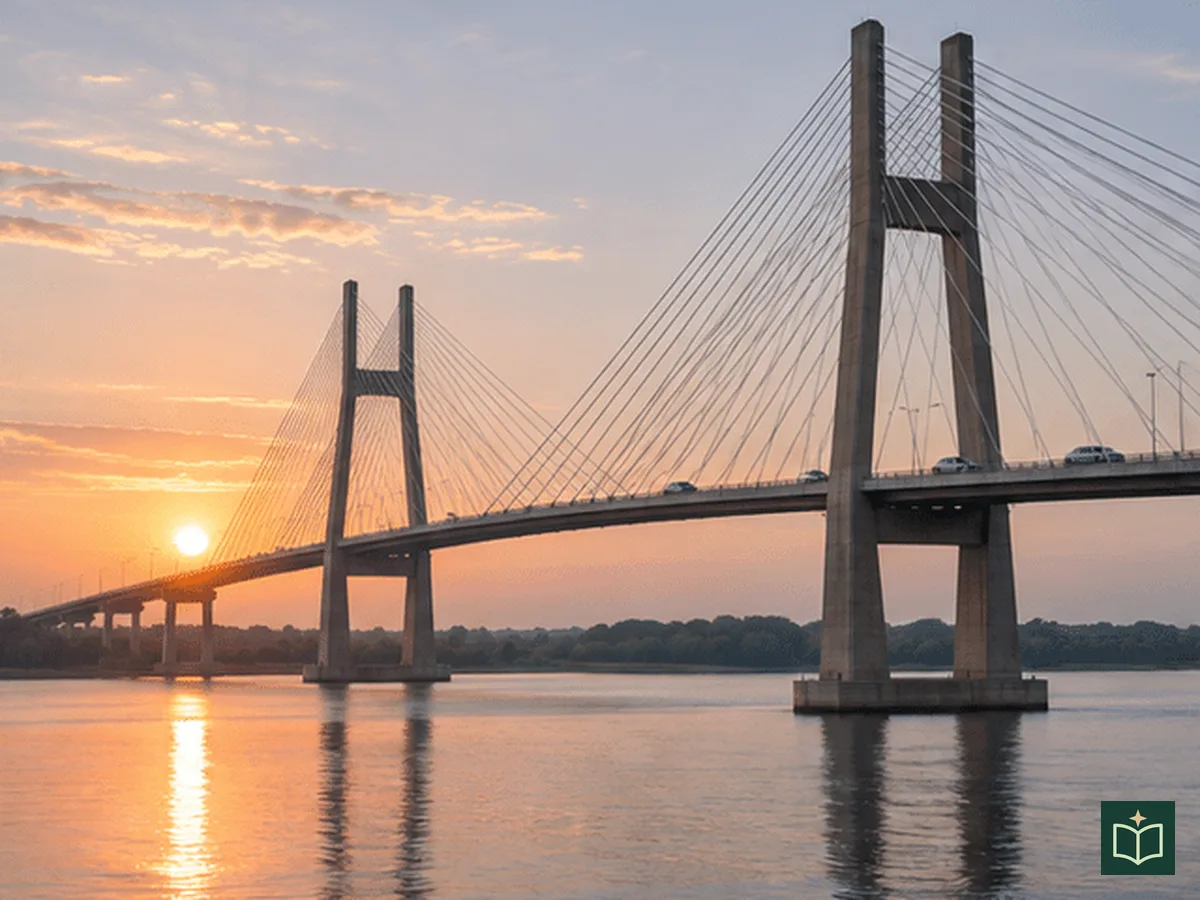
For the longest spans, engineers hang the deck from cables. In a suspension bridge, two main cables drape over tall towers and are anchored into huge blocks at each end; vertical hangers carry the deck. The cables are in tension, the towers in compression. In a cable-stayed bridge, straight cables run directly from the towers to the deck in fan or harp patterns, with no separate anchorages. Cable-stayed designs are often cheaper and stiffer for spans of a few hundred metres to around a kilometre. Suspension bridges dominate beyond that, with the longest main spans now exceeding two kilometres, such as the 1915 Çanakkale Bridge in Türkiye.
Why flatter means stronger cables
A rough engineering rule shows the trade-offs in a suspension bridge. The horizontal pull in the main cable is roughly the weight per metre of deck, multiplied by the span squared, divided by eight times the sag, the dip of the cable at mid-span. Take a span of 1,000 metres carrying 200 kilonewtons per metre, about 20 tonnes per metre, with a sag of 100 metres. The horizontal pull is 200 times 1,000,000, divided by 800, or 250,000 kilonewtons, roughly the weight of 25,000 tonnes. Halve the sag and the pull doubles. Taller towers allow more sag and smaller cables, but they cost more, so designers balance the two.
Choosing a design
The choice of bridge depends on far more than span. Engineers weigh soil and rock conditions, since arches need firm ground to push against and suspension bridges need anchorages. Ships may need tall, wide clearance, ruling out low beams with many piers. Earthquakes, cost, construction time and the look a city wants all play a part. Wind is a special danger for long, light decks: the Tacoma Narrows Bridge in the United States twisted itself apart in 1940 in a moderate wind. Its failure led to wind-tunnel testing and aerodynamic deck shapes that are now standard practice. A bridge's form is therefore a negotiation between physics, geology, money and appearance.
Sources & further reading
Figures are rounded and widely published; check the linked organisations for the latest editions. These organisations do not endorse this website.