Why gold suits the body
Most metals placed in the warm, salty and slightly acidic environment of the mouth or body slowly corrode. Gold is an exception. It sits near the bottom of the reactivity series, so it does not tarnish in saliva or dissolve in tissue fluids, and allergic reactions to it are uncommon, though not unknown. It is also soft and malleable, which lets skilled hands form it into exact shapes and seal it tightly against a tooth. Those properties were valued long before anyone understood the chemistry. Ancient Etruscan dental bridges, made with fine gold bands, show that people recognised gold’s durability and comfort in the mouth thousands of years ago.
Crowns, inlays and alloys
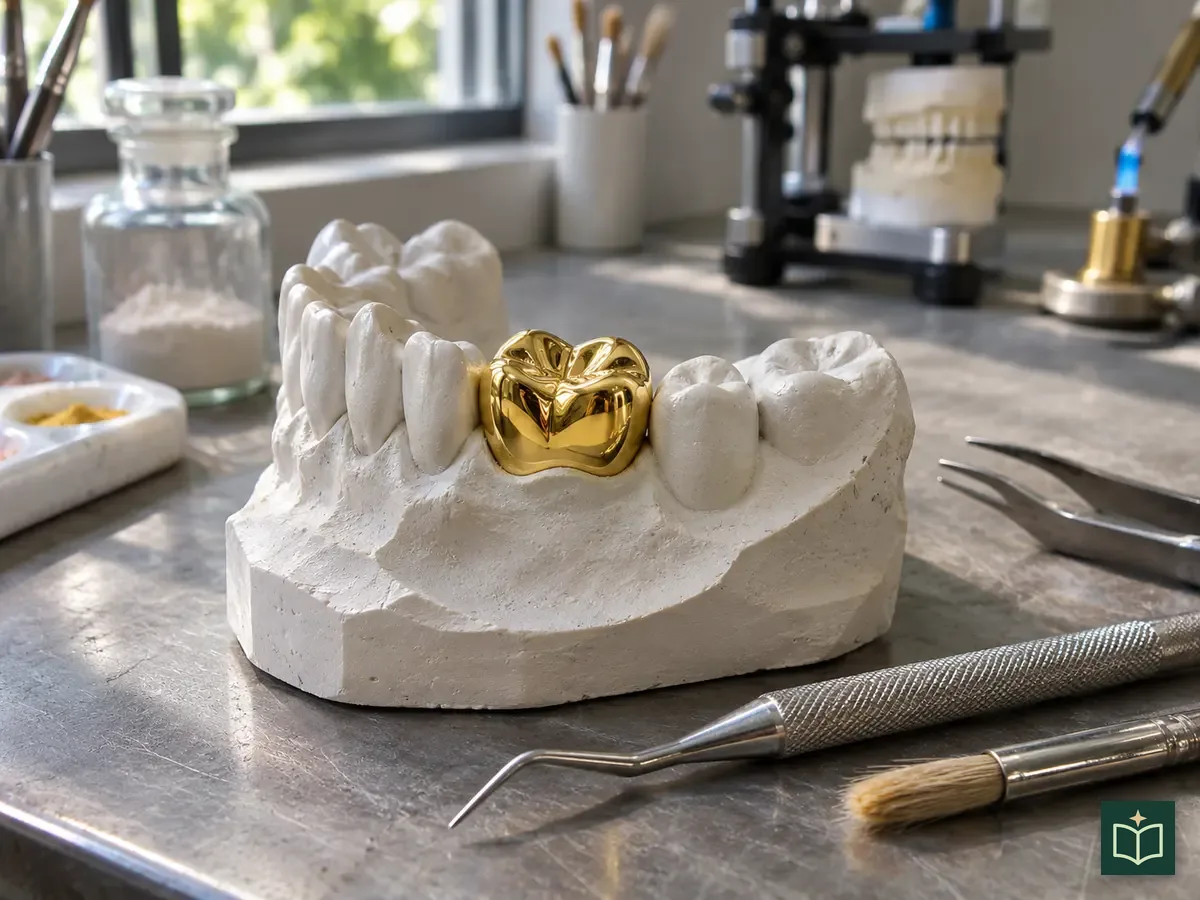
Modern dental gold is rarely pure. Pure gold is too soft to withstand years of chewing, so it is alloyed with metals such as platinum, palladium, silver and copper to add strength and hardness. In the classification used by the American Dental Association, a high-noble alloy contains at least 60% noble metals, of which at least 40% must be gold. Gold crowns and inlays wear gently against opposing teeth, fit precisely and can last for decades. Their main drawbacks are cost and colour, since many patients prefer tooth-coloured materials. Ceramics and resins have therefore replaced gold in much routine work, though some dentists still choose it for back teeth under heavy load.
Gold as a medicine
In the 1920s and 1930s, doctors began treating rheumatoid arthritis with injectable gold compounds, a practice later called chrysotherapy. These drugs could reduce inflammation in some patients, although exactly how they worked was not well understood. An oral gold drug, auranofin, was approved in the 1980s. Side effects, including skin rashes and kidney problems, required careful monitoring, and gold treatments were gradually displaced by newer medicines that work more reliably. Researchers still study gold compounds in laboratories for other possible uses. It is worth stressing that metallic gold eaten as decorative leaf on food simply passes through the body; it is not a remedy, and medical decisions belong with qualified professionals.
The red line on a test
One of gold’s most common medical roles today is almost invisible. Many rapid lateral-flow tests, including widely used pregnancy tests and some antigen tests, rely on gold nanoparticles. These particles, far smaller than the wavelength of light, appear deep red rather than yellow because of the way they interact with light. Antibodies are attached to their surfaces. When a sample flows along the strip, the particles bind to the target molecule and become trapped at the test line, concentrating enough of them to produce a visible coloured band. The amount of gold in each strip is tiny, but the method is cheap, stable at room temperature and needs no laboratory equipment.
Implants and devices
Gold also appears inside medical devices. Its reliable electrical conductivity and resistance to corrosion make it useful for contacts and wires in some implanted electronics and diagnostic equipment. Surgeons sometimes place a small gold weight in the upper eyelid of patients who cannot close their eyes fully after facial nerve paralysis, using gold’s density and inertness to help the lid close by gravity. Gold coatings have been tested on stents and other implants, and gold markers can help guide imaging during some treatments. In each case the material is chosen for specific physical properties rather than any healing power, and alternatives such as platinum or titanium often compete for the same roles.
Limits and misconceptions
Gold’s stability is real but not absolute in every context. Some people develop contact allergies to gold, and dental alloys contain other metals that may cause reactions. Products marketed as gold-infused skincare or drinks usually contain negligible amounts, and claims of special health benefits are generally not supported by strong evidence. In medicine, as elsewhere, gold competes on cost: when cheaper materials perform as well, they usually win. What remains is a set of niches where gold’s particular combination of inertness, workability, conductivity and colour is hard to match. This explainer is general information only; anyone considering dental or medical treatment should seek advice from a qualified practitioner who knows their history.
Sources & further reading
Figures are rounded and widely published; check the linked organisations for the latest editions. These organisations do not endorse this website.