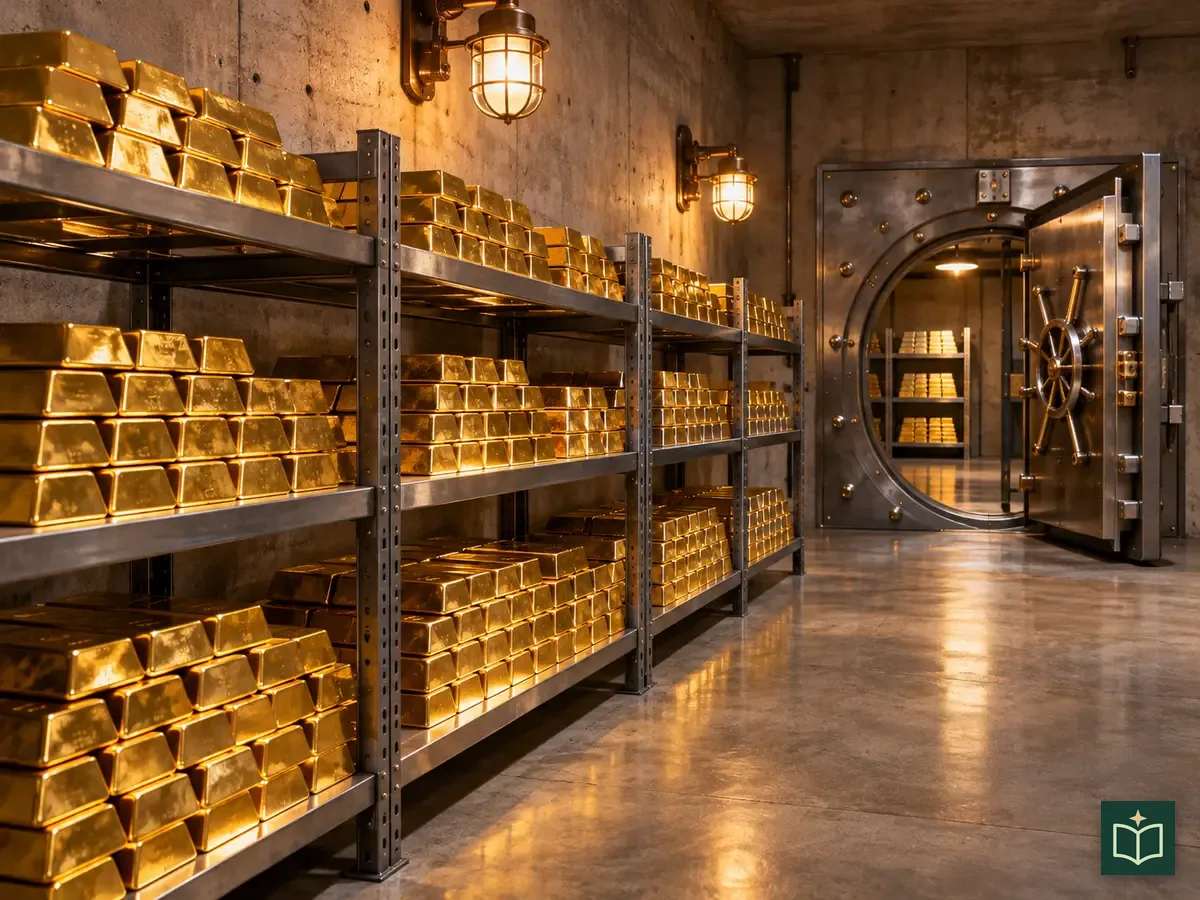
A surprisingly small cube
Estimates from the World Gold Council put all the gold ever mined at a little over 200,000 tonnes by the mid-2020s. That sounds like a lot, but gold is extremely dense: a cubic metre weighs about 19.3 tonnes. Divide the total by that density and the volume is roughly 11,000 cubic metres, which corresponds to a cube a little over 22 metres along each side, or about four and a half Olympic swimming pools. Compare that with the tens of millions of tonnes of copper produced every single year, and gold’s scarcity becomes vivid. All of human history’s gold would fit comfortably within a modest city block, stacked only a few storeys high.
Most of it is recent
Although gold has been worked for more than 6,000 years, the bulk of the total is modern. Roughly two-thirds of all gold ever mined has been extracted since 1950, thanks to industrial methods such as deep shafts, large open pits and cyanide leaching that can recover gold from ore containing only a few grams per tonne. Annual mine production in recent years has been around 3,500 tonnes, adding somewhere between 1.5% and 2% to the existing stock each year. That ratio is unusual. For most commodities, such as oil or wheat, annual production is consumed and must be replaced, so the amount in existence at any time is small compared with annual output.
Where the gold sits
The World Gold Council divides the above-ground stock into broad categories. Jewellery accounts for the largest share, close to half of the total, with India, China and the Middle East holding especially large amounts in household jewellery. Private investment in bars and coins, along with gold held by exchange-traded funds, makes up roughly a fifth or more. Central banks hold around a sixth, much of it in vaults in New York, London and national capitals. The remainder sits in industrial uses, such as electronics and dentistry, or is classed as unaccounted for. These shares shift gradually as gold moves between categories, for example when jewellery is melted and recast as bars.
Why it does not disappear
Gold’s chemical stability explains why the stock keeps growing. Gold does not rust, tarnish or dissolve in ordinary conditions, so a coin minted two thousand years ago can still be melted and reused today. Some gold is effectively lost: thin plating on electronics that is never recovered, objects buried or sunk at sea, and tiny amounts worn away over time. Yet the losses are small relative to the total. Recycling returns a meaningful amount to the market each year, as old jewellery and industrial scrap are refined again. In the Gulf, where trading jewellery for new designs is common, this circular flow of old gold into new pieces is a familiar part of the market.
Uncertainty in the numbers
The figure is an estimate, not a precise count. Historical production before modern record-keeping must be reconstructed from archives, archaeological evidence and geological studies, and some countries report mining output incompletely. Informal and artisanal mining, which occurs in many regions, is especially hard to measure. Analysts therefore treat the total as having a margin of error of several per cent. Occasionally, claims circulate that the true figure is far higher or far lower, but those usually rest on weak evidence. The broad picture, however, is robust: the above-ground stock is large relative to annual mining, small relative to most other metals, and growing steadily as mines add new metal each year.
Why the stock matters
The size of the stock helps explain how gold behaves in markets. Because new mine supply is small relative to the gold already in existence, decisions by existing holders, including households, investors and central banks, about whether to buy, hold or sell can matter more than changes in mine output. A disruption at a single large mine has less effect than it would for a metal with small inventories. That is one reason gold is often analysed differently from industrial commodities such as copper or oil. This story is educational and does not offer investment advice; it simply describes why the arithmetic of gold supply is so unusual among the world’s metals.
Sources & further reading
Figures are rounded and widely published; check the linked organisations for the latest editions. These organisations do not endorse this website.