Water in the rock
Groundwater fills the tiny spaces between grains of sand and the cracks in rock beneath our feet. Layers that store and transmit water well enough to supply wells are called aquifers. In humid regions, rain recharges them every year. In deserts, much groundwater is far older. Dating techniques using isotopes such as carbon-14 and chlorine-36 show that water beneath parts of the Sahara and Arabia fell as rain thousands to hundreds of thousands of years ago, during periods when North Africa and Arabia were wetter, greener and dotted with lakes. Hydrologists call this fossil, or palaeo, groundwater, and treat it very differently from renewable supplies.
Giants beneath the desert
Some of these aquifers are enormous. The Nubian Sandstone Aquifer System underlies roughly two million square kilometres of Egypt, Libya, Sudan and Chad and holds a vast volume of water. Beneath Arabia, sandstone and limestone formations such as the Saq, shared by Saudi Arabia and Jordan, where part of it is known as the Disi aquifer, store water that has been tapped for cities and farms. These systems receive some recharge at their edges and from occasional floods, but in the desert interior the inflow is tiny compared with what is stored, so pumping effectively draws down a fixed reserve.
Turning the desert green
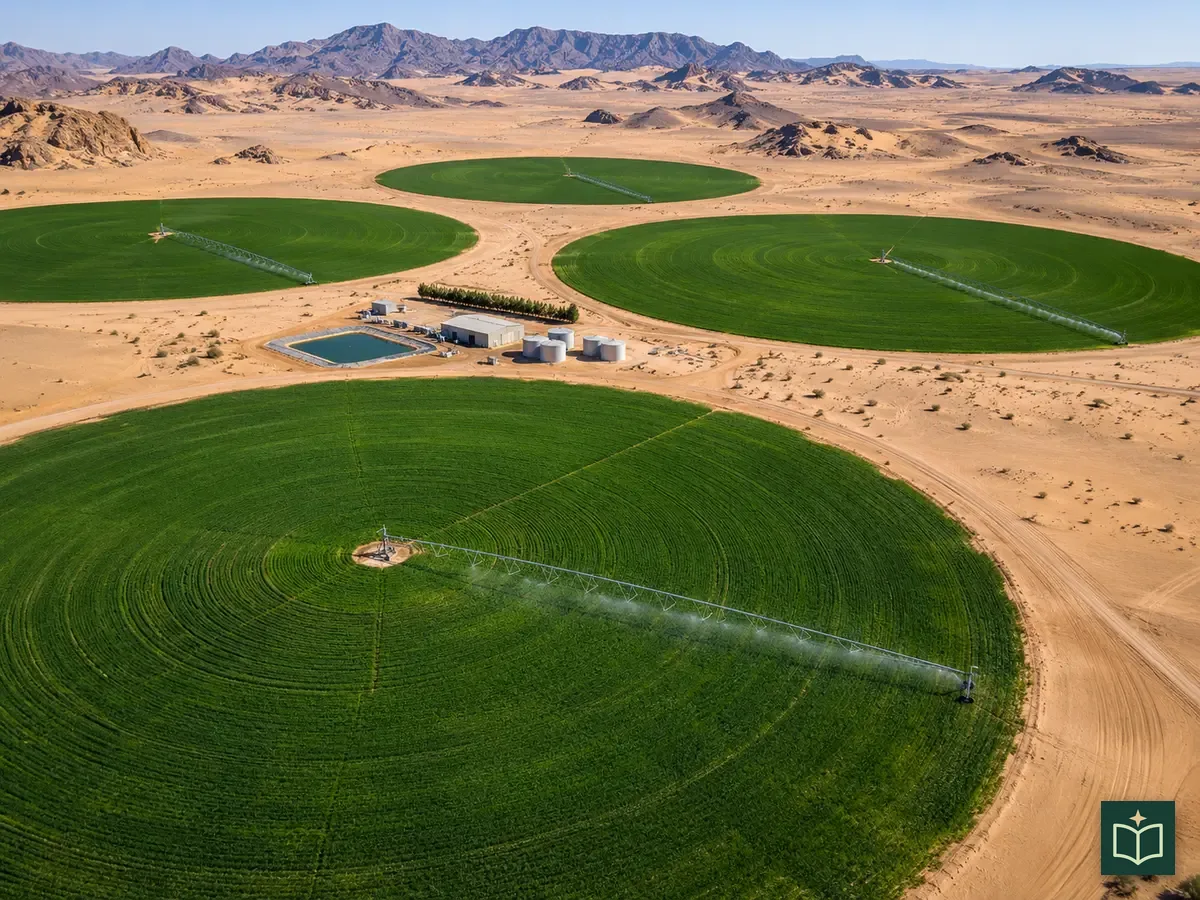
From the 1970s onwards, deep drilling and cheap energy allowed several countries to use fossil groundwater on a large scale. Satellite images of Saudi Arabia show the circular green fields of centre-pivot irrigation, each watered by a well and a rotating sprinkler arm. In the 1980s and 1990s the kingdom became a significant wheat producer, before phasing out subsidised wheat cultivation to conserve water. Libya’s Great Man-Made River, begun in the 1980s, pipes water from wells deep in the Sahara to coastal cities. In the UAE, groundwater has supplied much of the water used in agriculture, while desalination provides most drinking water.
Watching from space
Measuring groundwater across whole regions is difficult because it is hidden. Since 2002, the GRACE satellite missions, a partnership between NASA and Germany, have measured tiny changes in Earth’s gravity caused by shifts in the mass of water. Their successor, GRACE Follow-On, launched in 2018, continues the record. These data have revealed significant groundwater declines beneath several of the world’s major aquifers, including in the Middle East, northern India and California’s Central Valley. Combined with measurements from wells, the satellites help governments understand where water is being withdrawn faster than it returns, even across national borders. Without them, many aquifer declines would have gone unnoticed for years.
Common misunderstandings
Fossil groundwater is sometimes imagined as underground lakes. In reality, it is spread through the pores of rock, and the amount that can be practically extracted is much smaller than the total stored. As water levels drop, wells must go deeper and pumping costs rise, while water quality may deteriorate; some deep water is naturally salty or contains elements such as radium that require treatment. Using fossil water is not inherently wrong, but it resembles mining a mineral more than drawing from a river: once withdrawn, it will not be replaced within human timescales, so planners increasingly treat it as a strategic reserve.
Managing a shared reserve
Many large aquifers cross borders, which raises questions about how to share them. Egypt, Libya, Sudan and Chad have cooperated on studying the Nubian system through a joint authority, and Saudi Arabia and Jordan agreed in 2015 on arrangements for managing the Saq–Disi aquifer. Across the Gulf, strategies now emphasise efficient irrigation, treated wastewater reuse, crops that need less water and, in some places, injecting surplus desalinated water underground for emergency storage. Abu Dhabi’s strategic storage scheme in the Liwa area, which stores desalinated water in an aquifer for later recovery, is one example of treating groundwater as a reserve rather than a daily supply.
Sources & further reading
Figures are rounded and widely published; check the linked organisations for the latest editions. These organisations do not endorse this website.