A different battery design
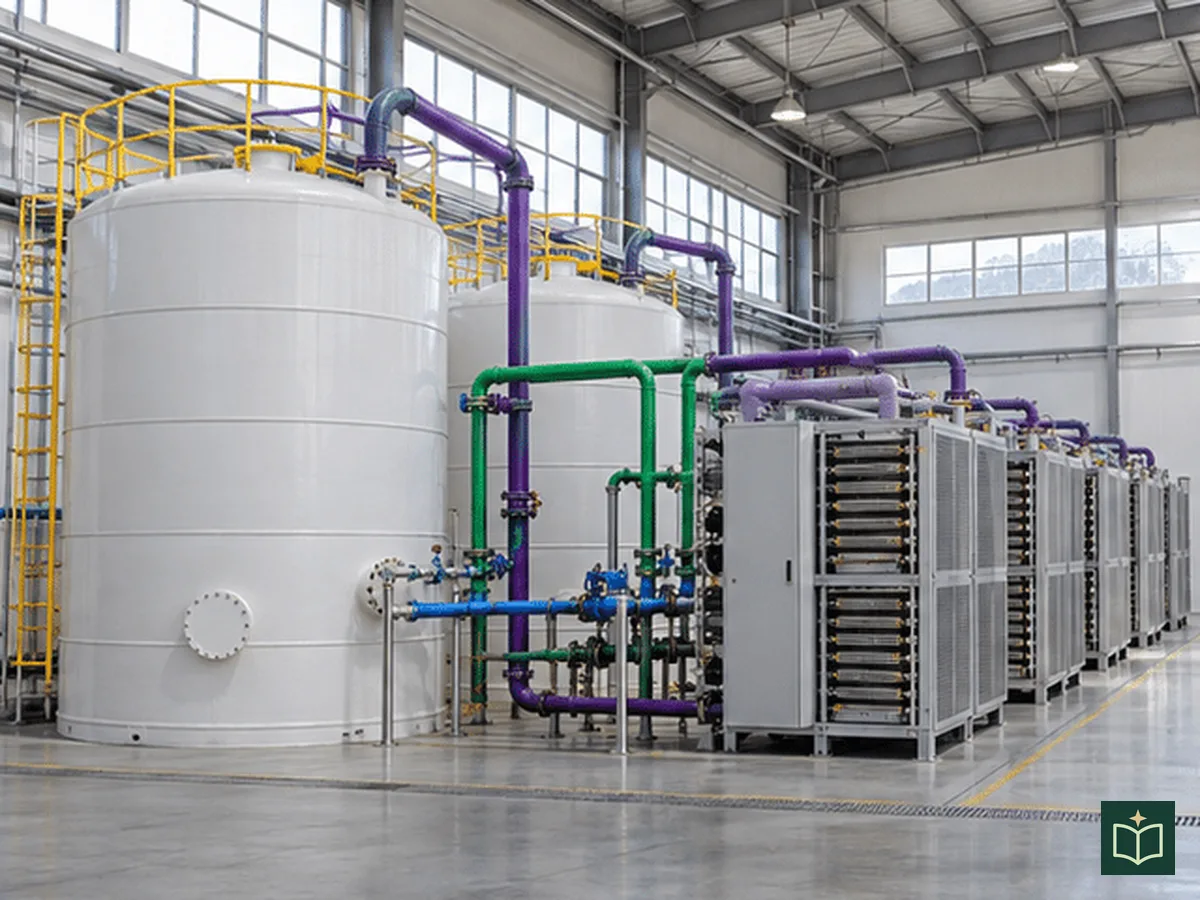
In an ordinary battery, the chemicals that store energy are sealed inside each cell alongside the electrodes. A flow battery separates the two jobs. Its energy is held in two liquid electrolytes kept in external tanks, one for the positive side and one for the negative. When the battery is charging or discharging, pumps push both liquids through a stack of cells. Inside each cell, a thin membrane keeps the liquids apart but lets certain ions pass. Chemical reactions on either side of the membrane release or absorb electrons, which flow through the external circuit. Reverse the current, and the reactions run backwards, recharging the liquids for later.
Power and energy apart
This architecture has one major consequence. The power of a flow battery, how fast it can deliver energy, depends on the size and number of cell stacks. Its energy, how much it can store in total, depends on the volume of electrolyte in the tanks. The two can be scaled independently. A system rated at 10 megawatts with 40 megawatt-hours of electrolyte can become an 80 megawatt-hour system, discharging for eight hours instead of four, by adding tanks rather than stacks. That makes flow batteries most attractive where long durations are needed, such as shifting solar output deep into the night, because the incremental cost of extra hours falls.
Chemistries in use
The most established type is the vanadium redox flow battery, developed in the 1980s by Maria Skyllas-Kazacos and colleagues at the University of New South Wales, building on NASA research into iron-chromium systems in the 1970s. Vanadium can exist in several charged states, so both tanks can contain vanadium dissolved in acid. If some leaks across the membrane, the electrolytes are not contaminated, only partly discharged, and they can be rebalanced. Other designs use zinc and bromine, iron, or organic molecules intended to cut material costs. Among the largest installations is a vanadium system in Dalian, China, connected to the grid in 2022 with a first phase of 100 megawatts and 400 megawatt-hours.
The weight of water
The big drawback is bulk. Because the active chemicals are dissolved in water, flow batteries store far less energy per litre than lithium-ion cells. Vanadium electrolyte holds roughly 25 watt-hours per litre, compared with hundreds for lithium-ion. A 40 megawatt-hour system therefore needs on the order of 1,600 cubic metres of electrolyte, enough to fill well over half an Olympic swimming pool. That rules out phones and cars but matters less for a fixed site on an industrial plot. Pumps, controls and temperature management also consume energy, so round-trip efficiency is typically somewhere around 65 to 80 per cent, lower than the 85 to 95 per cent typical of lithium-ion.
Where they compete
Flow batteries have strengths that lithium-ion struggles to match. Their electrolytes can be cycled many thousands of times with little degradation, so a system can last twenty years or more, and the vanadium can be recovered and reused at the end. Water-based electrolytes do not burn, reducing fire risk, which matters for sites near homes or in hot climates. Their main weaknesses are higher upfront cost per kilowatt-hour at short durations, lower efficiency and the space they occupy. As lithium-ion prices have fallen sharply, it has dominated batteries of two to four hours, while flow batteries have mainly targeted longer durations and applications needing very heavy daily cycling.
What to watch
The future of flow batteries depends on cost, supply and the need for long-duration storage. Vanadium prices have been volatile, because most supply is a by-product of steelmaking and comes from a handful of countries, so some companies lease the electrolyte rather than sell it. Researchers are testing cheaper chemistries, better membranes and higher-concentration electrolytes. Demand for storage lasting eight hours or more is expected to grow as solar and wind take larger shares of power systems, including in sunny regions such as the Gulf, where evening cooling demand follows the solar peak. Whether flow batteries win that market, or lose it to cheaper lithium-ion, iron-air or thermal storage, remains open.
Sources & further reading
Figures are rounded and widely published; check the linked organisations for the latest editions. These organisations do not endorse this website.