Electricity before generators
In the early nineteenth century electricity came from batteries. Alessandro Volta's pile, built in 1800, gave a steady current, and chemists used ever larger batteries for experiments, but they were expensive and ran down. In 1820 the Danish physicist Hans Christian Ørsted found that an electric current deflects a compass needle, showing that electricity can create magnetism. Scientists across Europe wondered whether the reverse was possible: could magnetism create electricity? Several tried and failed, often because they looked for a current from a magnet held still beside a wire. The answer came from Michael Faraday, a former bookbinder's apprentice who had become a leading experimenter at the Royal Institution in London.
The discovery of induction
In August 1831 Faraday wound two separate coils of wire around opposite sides of an iron ring. When he connected one coil to a battery, a needle wired to the other coil flicked, then fell back to zero. It flicked again, the other way, when he disconnected the battery. The current appeared only when the magnetic field was changing, not while it was steady. Weeks later he showed the same effect by pushing a bar magnet in and out of a coil. This was electromagnetic induction: a changing magnetic field drives a current through a nearby conductor. It explained earlier failures and opened the way to making electricity from motion.
The first generator
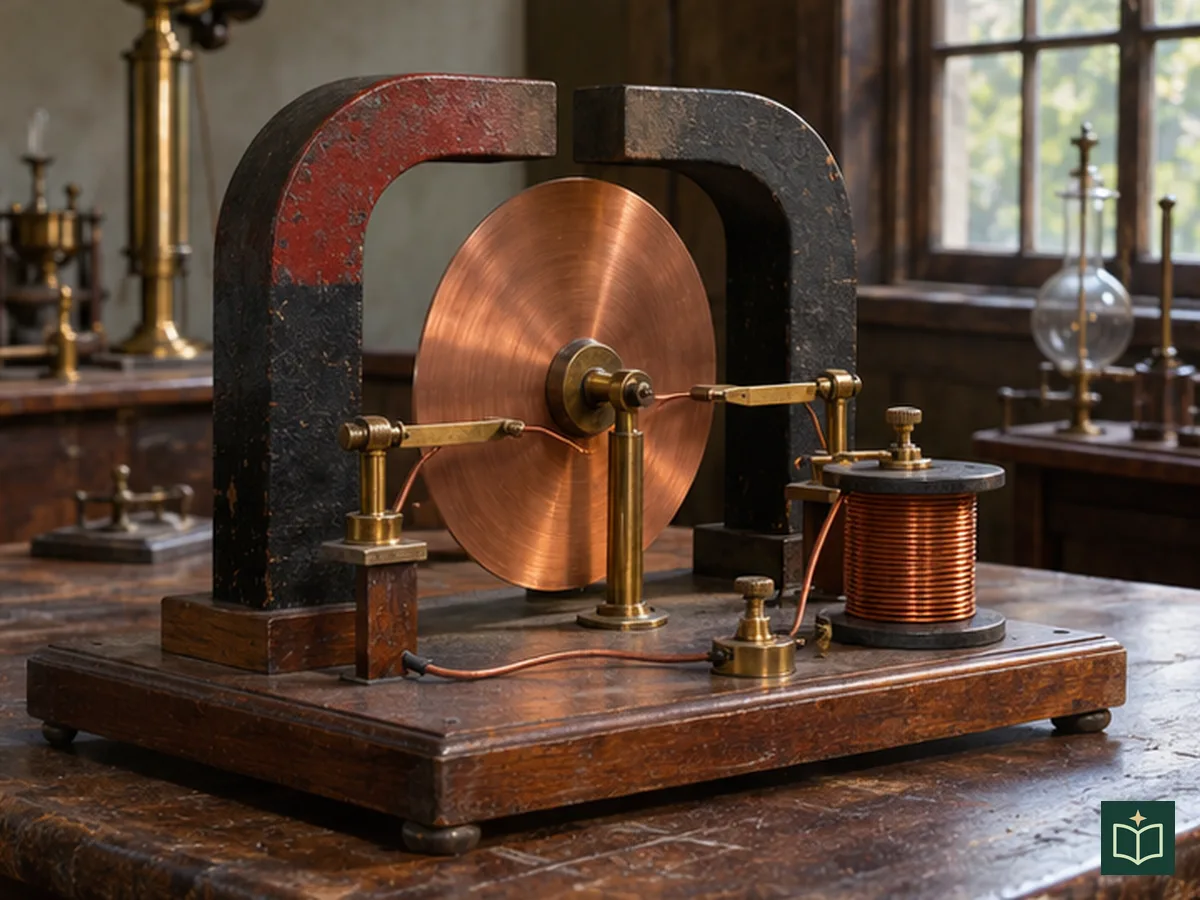
Faraday then built a copper disc that spun between the poles of a strong magnet, with sliding contacts at its rim and axle. Turning the disc by hand produced a small, continuous current, making it the first electric generator. It was inefficient, but it proved the principle. In 1832 the French instrument maker Hippolyte Pixii built a hand-cranked machine that spun a magnet near coils, producing alternating current, later fitted with a switch to make the output flow one way. Through the following decades, inventors improved coil designs and replaced permanent magnets with electromagnets powered by the machine's own output. Zénobe Gramme's ring dynamo, introduced in 1871, became one of the first commercially successful designs.
A worked example
Faraday's law states that the voltage induced in a coil equals the number of turns multiplied by how fast the magnetic flux through it changes. Flux is measured in webers. Suppose a coil of 100 turns sees its flux change by 0.01 webers in a tenth of a second. The induced voltage is 100 × 0.01 ÷ 0.1, or 10 volts. Change the flux ten times faster, by spinning the coil faster, and the voltage rises tenfold. Power station generators exploit this with powerful electromagnets, many tightly wound conductors and rotors turning up to 50 or 60 times a second, locked to the grid frequency, to produce thousands of volts.
Myths and credit
A popular story has a politician asking Faraday what use electricity could be, and Faraday replying that one day the government would tax it. It is almost certainly apocryphal, with no reliable record of the exchange. Credit for induction is also sometimes shared: the American scientist Joseph Henry observed similar effects around the same time, but Faraday published first and explored it most thoroughly. Faraday himself had little formal mathematics and described his results with the idea of lines of force filling space. James Clerk Maxwell later turned those ideas into equations in the 1860s, unifying electricity, magnetism and light into a single theory.
Why it still matters
Almost every large power station applies Faraday's principle. Steam from gas, coal or nuclear heat, falling water in a dam and wind on a turbine's blades all do the same job: spin a magnet inside coils of wire. Transformers, which step voltages up for transmission and down for homes, depend on induction too, as do electric motors running in reverse, induction hobs and wireless chargers. The main exceptions are solar panels, batteries and fuel cells, which make current without moving parts. As solar grows, a larger share of electricity now bypasses spinning machines, but the grids it feeds were designed around Faraday's discovery for nearly a century and a half.
Sources & further reading
Figures are rounded and widely published; check the linked organisations for the latest editions. These organisations do not endorse this website.