The core idea
Natural selection rests on a few simple observations. Individuals within a species differ from one another. Some of those differences are inherited. More offspring are born than can survive and reproduce. And those whose traits suit their surroundings tend to leave more descendants. Put together, these facts mean that helpful inherited traits become more common over generations, while unhelpful ones become rarer. Nothing in the process requires a plan or a goal. The environment does not create the variation; it filters what already exists. Given enough time, small shifts accumulate into substantial changes, including the separation of one population into two distinct species that can no longer interbreed.
Where variation comes from
Darwin did not know how inheritance worked. The answer arrived in the 20th century with genetics. Variation comes mainly from mutations, which are changes in DNA, and from the reshuffling of genes that happens during sexual reproduction. Most mutations have little effect, some are harmful and a small fraction turn out to be useful in a particular environment. Natural selection is one of several mechanisms of evolution. Genetic drift, the random change in gene frequencies that is especially strong in small populations, also matters, as does the movement of genes between populations. Modern evolutionary biology combines Darwin’s insight with genetics, a combination often called the modern synthesis.
Watching it happen
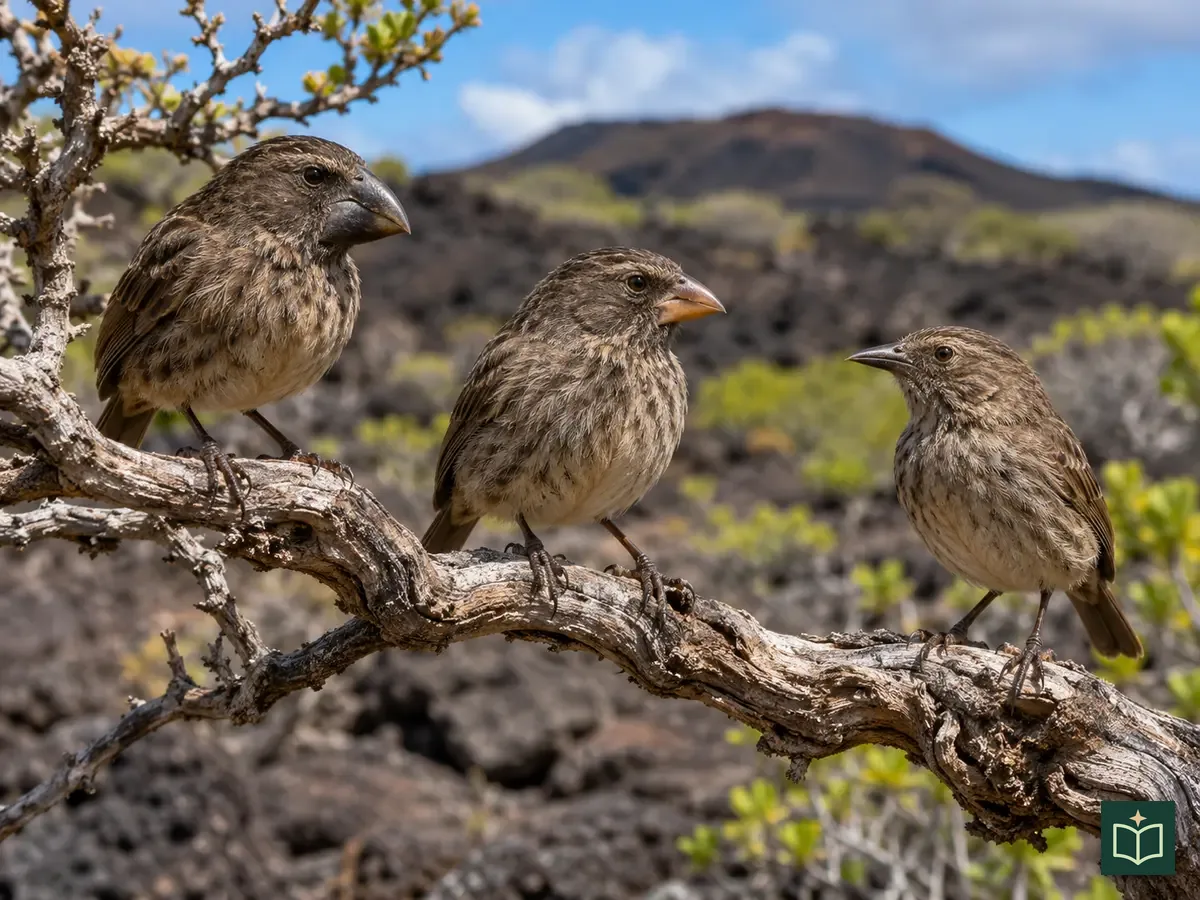
Evolution is often imagined as too slow to observe, but there are clear modern examples. On the Galápagos Islands, researchers measuring finches over decades recorded beak sizes shifting after droughts changed which seeds were available. Bacteria evolving resistance to antibiotics, insects becoming resistant to pesticides and viruses acquiring new variants are all natural selection in action, sometimes within months. Laboratory experiments with fast-breeding organisms such as bacteria, run over tens of thousands of generations, have documented new abilities emerging. These cases show the mechanism at work in real time, while the deeper history of life is recorded in fossils, anatomy and DNA.
Lines of evidence
The case for evolution draws on independent sources that point the same way. The fossil record shows life changing over hundreds of millions of years, with transitional forms such as early whales that still had legs. Comparative anatomy reveals shared structures: the same arrangement of bones appears in a human arm, a bat’s wing and a whale’s flipper. Embryos of related animals pass through similar stages. Most powerfully, DNA comparisons let scientists reconstruct family trees, and these largely match those built from fossils and anatomy. Humans and chimpanzees, for example, share the large majority of their DNA, consistent with a common ancestor several million years ago.
Common misconceptions
‘Survival of the fittest’, a phrase coined by Herbert Spencer, is often misread. Fitness in biology means reproductive success in a given environment, not strength or intelligence. A slow, small animal can be extremely fit if it leaves many offspring. Evolution is also not a ladder with humans at the top; every living species is the product of the same long history and is adapted to its own circumstances. Individuals do not evolve during their lifetimes, populations do. And ‘theory’ in science does not mean a guess: it means a well-tested explanation that ties together many observations, in the same sense as the theory of gravity.
Why it matters today
Evolutionary thinking has practical uses far beyond biology classrooms. It explains why antibiotics and antivirals must be used carefully, because every treatment applies selection pressure on microbes. It guides how vaccines are updated for changing viruses such as influenza. Farmers and plant breeders use evolutionary principles to manage pests and develop crops suited to heat and salty soils, a pressing concern in arid regions including the Arabian Peninsula. Conservation biologists use it to judge how isolated populations may cope with environmental change. The theory remains one of the most thoroughly supported ideas in science, and it continues to be refined as new genetic tools reveal fresh detail.
Sources & further reading
Figures are rounded and widely published; check the linked organisations for the latest editions. These organisations do not endorse this website.