Light without heat
Bioluminescence is the production of light by living organisms. It is different from fluorescence, in which a material absorbs light and re-emits it, and from the glow of hot objects such as a candle flame. Instead, it is chemiluminescence: energy from a chemical reaction is released directly as light. Because very little of that energy is lost as heat, it is sometimes called cold light. The ability has evolved independently dozens of times across the tree of life, in bacteria, fungi, insects, worms, jellyfish, squid and fish. That repeated evolution suggests light is an extremely useful tool, particularly where sunlight cannot reach.
The chemistry of a glow
Most bioluminescence involves two components. Luciferin is the molecule that emits light, and luciferase is the enzyme that makes the reaction happen. When luciferin reacts with oxygen under the enzyme’s control, it forms a product in an excited state; as that product relaxes, it gives off a photon. Different groups of organisms use different luciferins, which is one sign that the ability evolved many times. Some animals make the chemicals themselves, others obtain them through their diet, and some, such as certain fish and squid, house colonies of glowing bacteria in special light organs, controlling the light with shutters, filters or lenses.
Why the sea glows blue
On land, the best-known glowing animals are fireflies, whose yellow-green flashes are mating signals with patterns specific to each species. In the ocean, bioluminescence is far more common. Below about 200 metres, sunlight fades rapidly, and by 1,000 metres it is effectively gone. In that darkness, most light comes from living things. Marine bioluminescence is usually blue or blue-green, because those wavelengths travel furthest through seawater, and many deep-sea animals can see only those colours. A few predators, such as some dragonfish, produce red light that most other animals cannot detect, giving them a private searchlight for finding prey. It may also help them signal to one another.
Hunting, hiding and warning
Animals use light for many purposes. The anglerfish dangles a glowing lure in front of its mouth to attract prey. Many mid-water fish and squid use counter-illumination: lights on their undersides match the faint glow from above, erasing their silhouette from predators looking up. Some shrimp and squid release clouds of glowing fluid to distract attackers, much as an octopus uses ink. Certain animals flash when grabbed, possibly to attract larger predators that might attack whatever is attacking them, an idea known as the burglar-alarm hypothesis. Others use light to recognise their own species or to find mates in a vast, dark environment.
Glowing shores
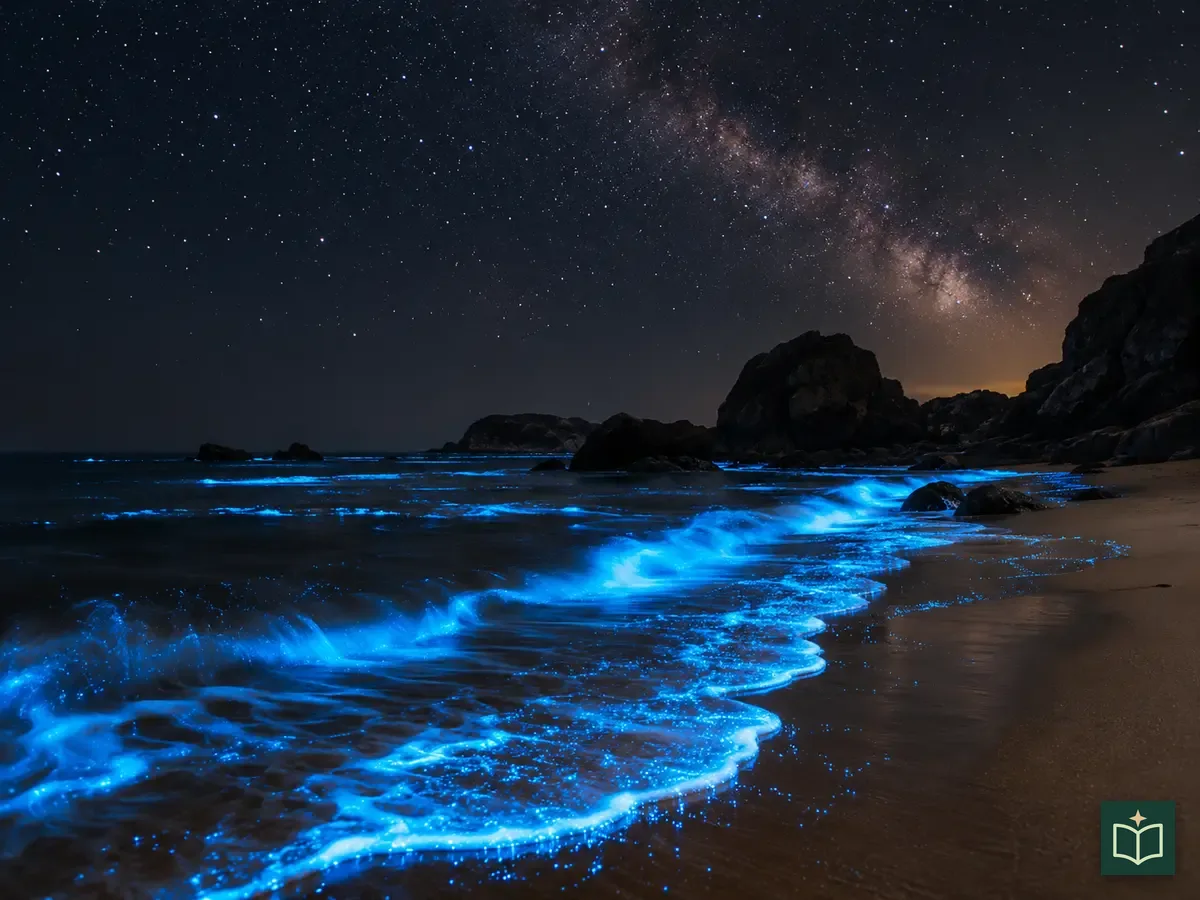
The most widely seen marine bioluminescence comes from tiny plankton called dinoflagellates. When disturbed by waves, boats or swimmers, they emit brief blue flashes, turning breaking surf or a paddle’s wake into streaks of light. Displays occur along many coastlines, from the Maldives to Puerto Rico. Blooms of a dinoflagellate called Noctiluca scintillans have become frequent in the Arabian Sea and the Sea of Oman in recent decades and can light up beaches at night. Such blooms are beautiful but not always benign: large ones can reduce oxygen in the water and disrupt fisheries and desalination intakes, so scientists monitor them closely.
From the sea to the laboratory
Bioluminescence has transformed biology. A green fluorescent protein from a glowing jellyfish, identified alongside its light-producing system, became one of the most widely used tools in research, allowing scientists to tag and watch specific proteins inside living cells; its development earned the 2008 Nobel Prize in Chemistry. Firefly luciferase is used to detect bacterial contamination and to measure gene activity. Researchers are still discovering new glowing species, and much of the deep ocean remains unexplored. Common misconceptions include the idea that glowing water is caused by pollution or radioactivity; in nearly all cases, it is simply living organisms reacting to movement in the water.
Sources & further reading
Figures are rounded and widely published; check the linked organisations for the latest editions. These organisations do not endorse this website.