Two routes to vapour
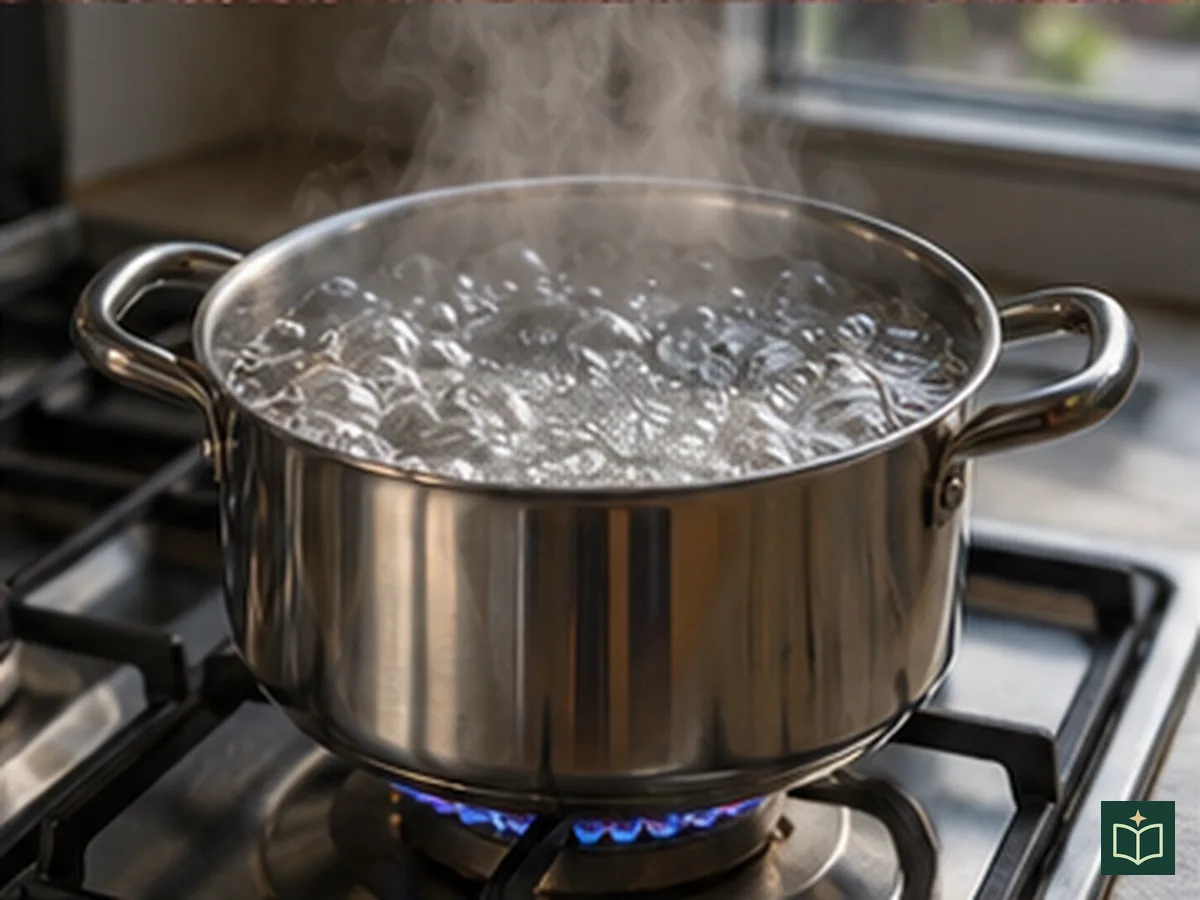
Evaporation and boiling both turn a liquid into a gas, but they happen in different ways. Evaporation takes place only at the surface of a liquid, and it happens at almost any temperature: a puddle dries on a mild day, washing dries on a line and sweat dries on skin. Boiling takes place throughout the liquid, with bubbles of vapour forming deep inside and rising to burst at the surface, and it happens only at a particular temperature, the boiling point. For pure water at sea level that is 100°C. Evaporation is slow and quiet; boiling is rapid and visible. Both require energy, which is why each has a cooling effect.
Why puddles dry
The molecules in a liquid are constantly moving, but not all at the same speed. At any moment a few near the surface are moving fast enough to break free of their neighbours and escape into the air. That is evaporation. Because the fastest, most energetic molecules leave, the average energy of those left behind falls, so the liquid cools. Evaporation speeds up with higher temperature, a larger surface area, moving air and dry air. In humid air it slows, because the air already holds a lot of water vapour and molecules return to the liquid almost as fast as they leave. That is why sweat feels so ineffective on a sticky Gulf summer evening.
What makes boiling different
Every liquid has a vapour pressure, the push of its escaping molecules, which rises as it is heated. Boiling begins when that vapour pressure equals the pressure of the atmosphere pressing down on the liquid. At that point bubbles of vapour can form inside the liquid without being crushed, and they grow and rise. Once boiling starts, extra heat does not raise the temperature further; it goes into turning liquid into vapour. That energy is known as the latent heat of vaporisation. A pan of boiling water stays at about 100°C at sea level however high the flame, which is why turning the hob to maximum makes pasta bubble harder but not cook much faster.
The energy involved
Turning water into vapour takes a surprising amount of energy. Heating one litre of water from 25°C to 100°C needs about 314 kilojoules. Turning that same litre entirely into steam at 100°C needs about another 2,260 kilojoules, roughly seven times as much again. The same physics works in reverse in the body. When sweat evaporates, every gram carries away a large amount of heat, which is why it is such an effective cooling system in dry heat. It also explains steam burns. When steam condenses on skin it releases that stored latent heat, so steam at 100°C can scald more severely than water at the same temperature.
Boiling on mountains
Because the boiling point depends on air pressure, it falls with altitude. Very roughly, water's boiling point drops by about 1°C for every 300 metres of height. On the summit of Jebel Jais, the UAE's highest peak at around 1,900 metres, water boils at roughly 93 to 94°C. On the summit of Everest, where air pressure is about a third of sea level, it boils at around 70°C, too cool to cook food properly. That is why climbers and people living at high altitude often use pressure cookers. These seal in steam, raising the pressure so water boils at around 120°C, which cooks food faster. Mountain recipes are often adjusted for longer cooking times.
Where each matters
Both processes are everywhere. Evaporation from oceans drives the water cycle and supplies the rain that falls far inland. Evaporation ponds are used to harvest salt, and evaporative coolers work well in dry climates. Boiling powers most of the world's electricity: in coal, gas and nuclear plants, heat boils water into high-pressure steam that spins turbines. Desalination plants, a major source of drinking water in the Gulf, have long used thermal methods that boil seawater at reduced pressure and condense the vapour, although membrane techniques are now more common. In the kitchen, a lid on a pan traps vapour, speeding up boiling and saving energy.
Sources & further reading
- USGS Water Science School · Evaporation and the water cycle ↗
- Britannica · Boiling point ↗
- Britannica · Vaporization ↗
Figures are rounded and widely published; check the linked organisations for the latest editions. These organisations do not endorse this website.