What triage means
The word triage comes from the French verb trier, to sort. It was developed on battlefields, notably by surgeons in Napoleon’s armies, who treated wounded soldiers according to the severity of their injuries rather than their rank or arrival. Modern emergency departments use the same principle every day. Soon after arrival, usually within about fifteen minutes in well-run departments, a trained nurse assesses each patient and assigns a priority level. That level, not the time on the clock when you arrived, decides who sees a doctor first. It is why someone who arrives after you, perhaps by ambulance with chest pain, may be seen long before you are.
How the scales work
Most countries use a structured five-level scale. In the United Kingdom and many other countries, the Manchester Triage System uses flowcharts for common complaints, such as headache or abdominal pain, and asks a series of questions about discriminators, including the level of pain, bleeding, consciousness and temperature. The result is a colour category, from red for immediate to blue for non-urgent, each with a target time to be seen. In the United States, the Emergency Severity Index also considers how many resources, such as scans or blood tests, a patient is likely to need. Australia and Canada use their own national scales, built on the same idea.
What the nurse checks
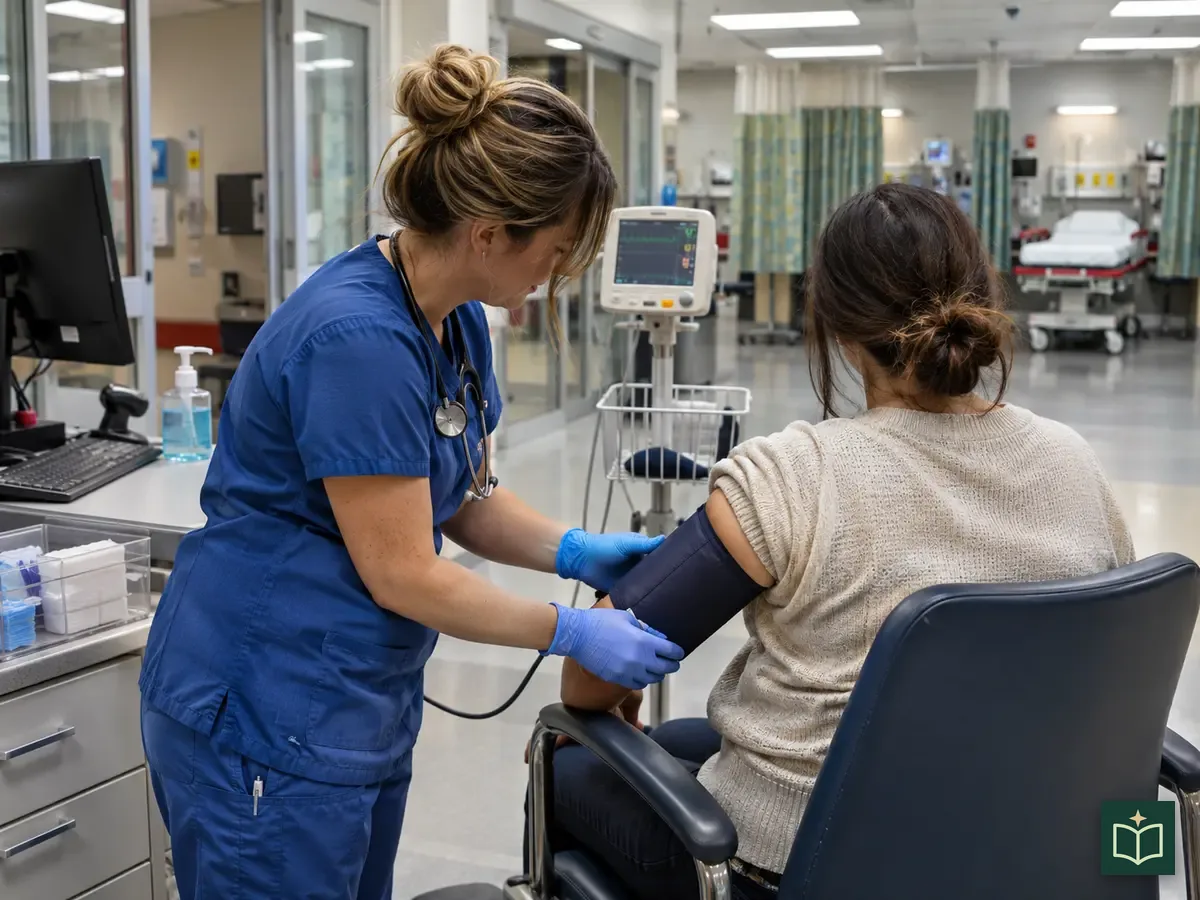
Triage is quick, but it is not a casual chat. The nurse asks about your main problem and when it started, checks vital signs such as pulse, blood pressure, breathing rate, oxygen level and temperature, and looks for red flags. Severe pain, difficulty breathing, signs of stroke, heavy bleeding and confusion all push a patient up the scale. Children, pregnant women and older people may have special pathways. Some departments start tests at triage, such as an electrocardiogram for chest pain or blood samples, so that results are ready when the doctor arrives. The aim is to spot the patient who looks well but is not.
Waiting is part of the system
A triage category is not a final judgement. Conditions change, so patients in the waiting area should be reassessed, and anyone who feels worse should tell staff straight away. Waits for lower-priority patients rise when departments are crowded, which in many health systems is driven less by arrivals than by a shortage of hospital beds for admitted patients, who then remain in emergency cubicles. Some hospitals in the UAE and elsewhere offer a separate fast-track stream or urgent care clinic for minor injuries and illnesses, which can be quicker. Telephone advice lines and family doctors may be more appropriate for problems that are not emergencies.
Misconceptions
Arriving by ambulance does not guarantee being seen first; ambulance patients are triaged too, and a stable patient may wait. Nor does a low category mean staff think your symptoms are unimportant or imagined. It means that, based on what they can see, other patients face a greater immediate risk. Triage scales are designed to be cautious, accepting that some patients will be over-prioritised so that very few genuinely sick people are missed. Research continues on how accurately different scales predict outcomes. This article offers general information only; anyone with worrying symptoms should seek professional medical advice or call their local emergency number.
Beyond the hospital door
Triage principles extend far beyond emergency departments. Ambulance control rooms use structured questions to prioritise calls, sending the fastest response to cardiac arrests and the most serious emergencies. At major incidents, such as large accidents or natural disasters, responders use mass-casualty triage systems that sort many victims within seconds using simple checks like whether a person can walk or is breathing. Online symptom checkers and telephone lines borrow the same logic. The underlying idea is a hard but fair one: when demand exceeds immediate capacity, care should go first to those who will benefit most from rapid treatment, and everyone else should be safely monitored.
Sources & further reading
Figures are rounded and widely published; check the linked organisations for the latest editions. These organisations do not endorse this website.