Motors are everywhere
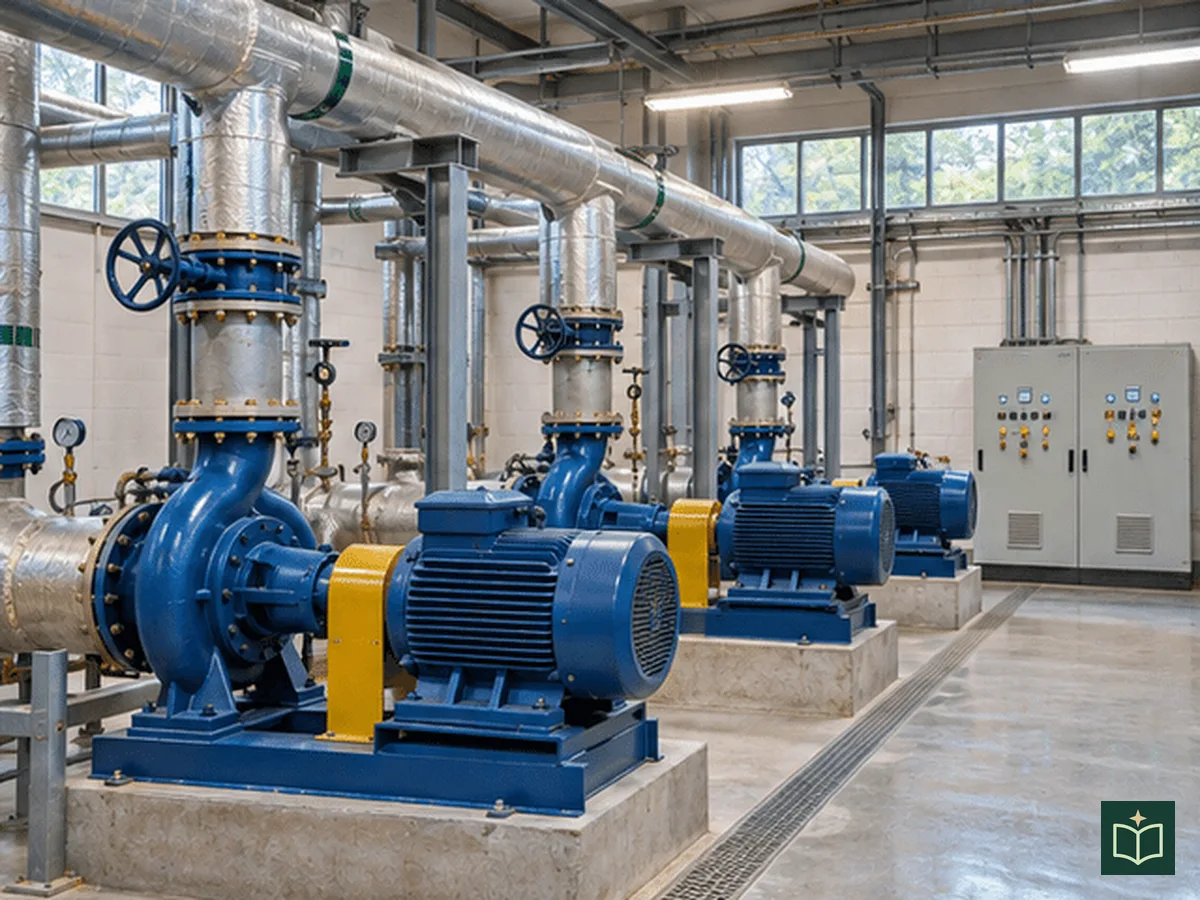
Few people think about electric motors, yet they are hidden in nearly every building and factory. They drive the compressors in air conditioners and refrigerators, the fans that move air through offices, the pumps that lift water up towers and push it through pipes, and the conveyors, mills, mixers and machine tools of industry. In a 2011 analysis, the International Energy Agency estimated that motor-driven systems account for roughly 43 to 46 per cent of global electricity use, far more than lighting. In industry the share is higher still, around two-thirds of electricity consumption. Any serious attempt to use electricity more efficiently has to start with the motors.
How a motor works
An electric motor converts electrical energy into rotation using magnetism. Most industrial motors are induction motors, a design dating from the 1880s. Alternating current in fixed coils, the stator, creates a rotating magnetic field, which induces currents in the rotor and drags it round. They are rugged, cheap and can run for decades. Their losses are heat: resistance in the copper windings, magnetic losses in the steel core, friction in the bearings and air drag from the cooling fan. A large modern motor can convert well over 95 per cent of its input into mechanical power, while small or old motors may manage considerably less.
Efficiency classes
To make motors comparable, the International Electrotechnical Commission defines efficiency classes in its standard IEC 60034-30-1, running from IE1, standard efficiency, through IE2 and IE3 to IE4, super premium. A further IE5 class is defined in a related specification. Each step cuts losses noticeably for a given size of motor. Many governments now set minimum levels. The European Union, for example, has required most new motors between 0.75 and 1,000 kilowatts to meet IE3 since 2021, and some mid-sized motors to meet IE4 since 2023. Because a motor running for years can consume many times its purchase price in electricity each year, buying the higher class usually pays back quickly.
The cube law
The biggest savings often come not from the motor itself but from how it is controlled. Traditionally, many fans and pumps ran at full speed while dampers or valves throttled the flow, wasting energy rather like driving with the brake on. For fans and centrifugal pumps, the power needed rises roughly with the cube of speed. A variable-speed drive, an electronic device that adjusts the frequency of the supply, lets the motor slow down instead. Running at 80 per cent speed then needs only about half the power, because 0.8 cubed is about 0.51. Flow falls by a fifth, but energy use almost halves, a striking gain for systems that rarely need maximum output.
A fan, worked through
Consider an illustrative 15-kilowatt ventilation fan in a building or factory running 8,000 hours a year at full speed. It consumes about 120,000 kWh. If a variable-speed drive lets it run at 80 per cent speed for the same hours, its consumption falls to roughly 61,400 kWh, a saving of about 58,600 kWh. At an illustrative commercial tariff of 40 fils per kilowatt-hour, that is around AED 23,400 a year, often enough to repay the drive within a year or two. In the Gulf, where chillers, cooling towers, chilled-water pumps and air-handling fans run for most of the year, such savings multiply across thousands of motors in every large building.
Beyond the motor
Experts stress that the motor is only one part of a system. A premium motor driving an oversized pump through a pipe network full of partly closed valves can still waste much of its energy. Replacing worn belts, choosing the right pump for the real duty, cleaning filters, sealing compressed-air leaks and straightening ducts all reduce the work demanded. Compressed air is notoriously wasteful, because only a small fraction of the electricity used to make it does useful work at the tool. Motors also last long, so inefficient units stay in service for decades. Policies that encourage audits and system redesign, not just new motors, have proved essential.
Sources & further reading
- IEA · Energy-Efficiency Policy Opportunities for Electric Motor-Driven Systems ↗
- International Electrotechnical Commission ↗
Figures are rounded and widely published; check the linked organisations for the latest editions. These organisations do not endorse this website.