Removal, not reduction
Most climate measures aim to stop new carbon dioxide reaching the atmosphere. Direct air capture, or DAC, does something different: it removes carbon dioxide that is already there. If the gas is then stored permanently underground, the process creates ‘negative emissions’. Climate scientists, including in IPCC assessments, generally find that limiting warming to well below 2 degrees Celsius will require some carbon dioxide removal to balance emissions that are very hard to eliminate, such as from aviation and agriculture. DAC is one option alongside nature-based methods such as planting forests, and other technologies, such as burning biomass for energy with carbon capture.
Why it is hard
Carbon dioxide makes up only about 0.04 per cent of the air, roughly 420 molecules in every million. A coal plant’s exhaust, by comparison, contains around 10 to 15 per cent. Collecting a tonne of carbon dioxide from ordinary air means processing an enormous volume of it, on the order of a couple of million cubic metres. That requires large fans, big contactor surfaces and significant energy to release the carbon dioxide afterwards. Physics sets a minimum energy for separating such a dilute gas, and real systems use several times that minimum. The energy must also be low-carbon, otherwise the process may emit nearly as much as it captures.
Two main approaches
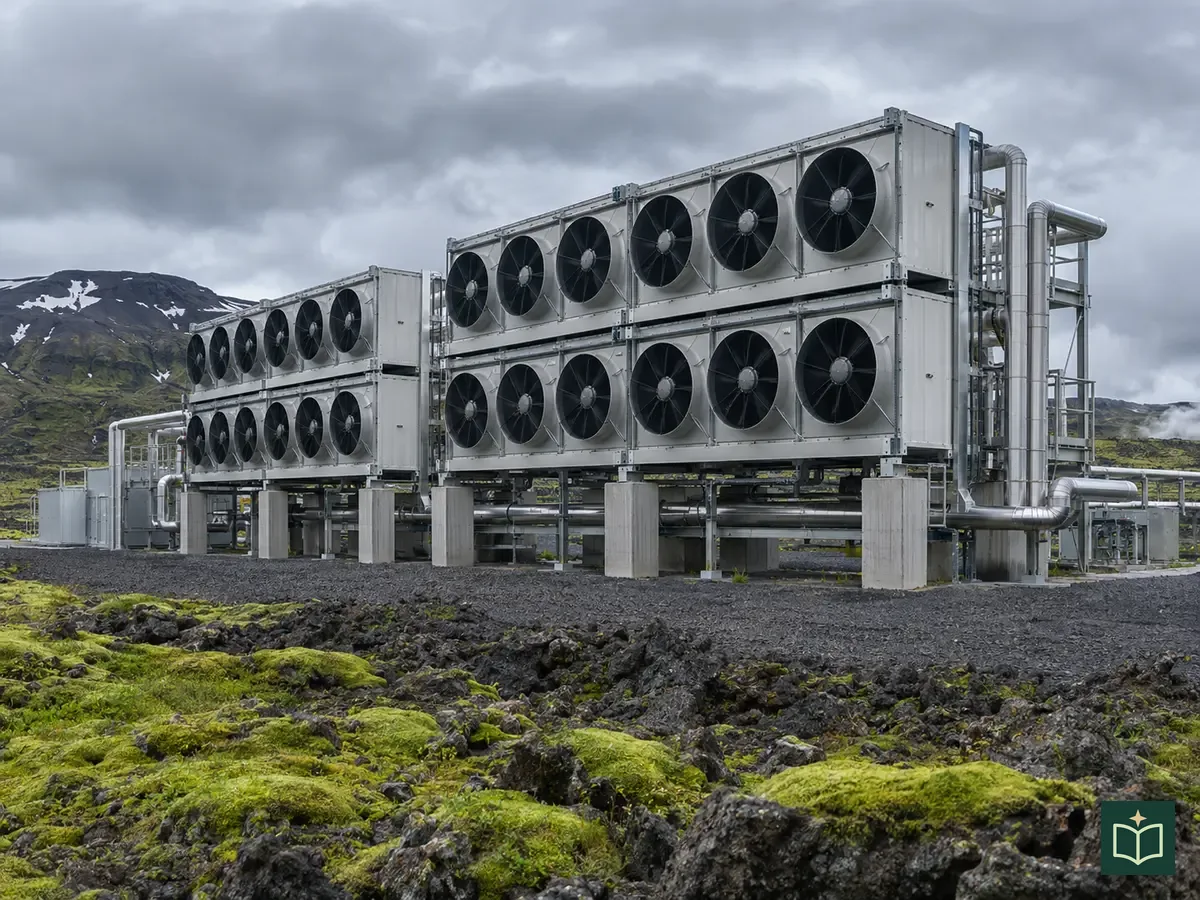
Liquid systems pass air over a strong alkaline solution, such as potassium hydroxide, which reacts with carbon dioxide; a series of chemical steps, including heating to around 900 degrees Celsius, then releases it as a pure stream. Solid sorbent systems use filters coated with amine-based materials that bind carbon dioxide at ambient temperatures and release it when heated to roughly 80 to 120 degrees Celsius, which can be supplied by waste heat or heat pumps. The Swiss company Climeworks uses solid sorbents; the Canadian firm Carbon Engineering pioneered a liquid system that has been developed for large plants in the United States.
Scale so far
Operating DAC plants worldwide capture only a few tens of thousands of tonnes of carbon dioxide a year in total, a vanishingly small fraction of global emissions. Climeworks’ Orca plant in Iceland, which opened in 2021, was designed to capture about 4,000 tonnes a year, and its larger Mammoth plant was designed for up to 36,000 tonnes. Both send carbon dioxide to Carbfix for mineral storage in basalt. Larger plants targeting hundreds of thousands to a million tonnes a year have been announced in the United States and elsewhere, and Gulf companies have explored projects, since the region combines cheap solar power with suitable geology for storage.
Costs and doubts
Current costs are commonly estimated in the hundreds of US dollars per tonne of carbon dioxide removed, well above what most carbon markets pay. Developers hope costs will fall with larger plants and mass-produced equipment, as happened with solar panels, but this is uncertain because DAC involves moving large amounts of air and heat rather than manufacturing simple modules. Critics warn that promises of future removal could be used to justify delaying cuts today, a concern sometimes called ‘mitigation deterrence’. Supporters reply that some removal will be needed regardless and that early deployment is necessary to learn and reduce costs.
How to read claims
When companies or governments announce DAC projects, a few questions clarify their significance. Is the carbon dioxide stored permanently, or used in products, such as fuels or fizzy drinks, that release it again soon? How much energy does the plant use, and where does it come from? Has the claimed capacity actually been achieved, and is the removal independently verified? Comparisons with total emissions are also useful: the world emits tens of billions of tonnes of carbon dioxide each year, so a 1-million-tonne plant would be important technically but small globally. DAC is best seen as a complement to cutting emissions, not a substitute for it.
Sources & further reading
Figures are rounded and widely published; check the linked organisations for the latest editions. These organisations do not endorse this website.