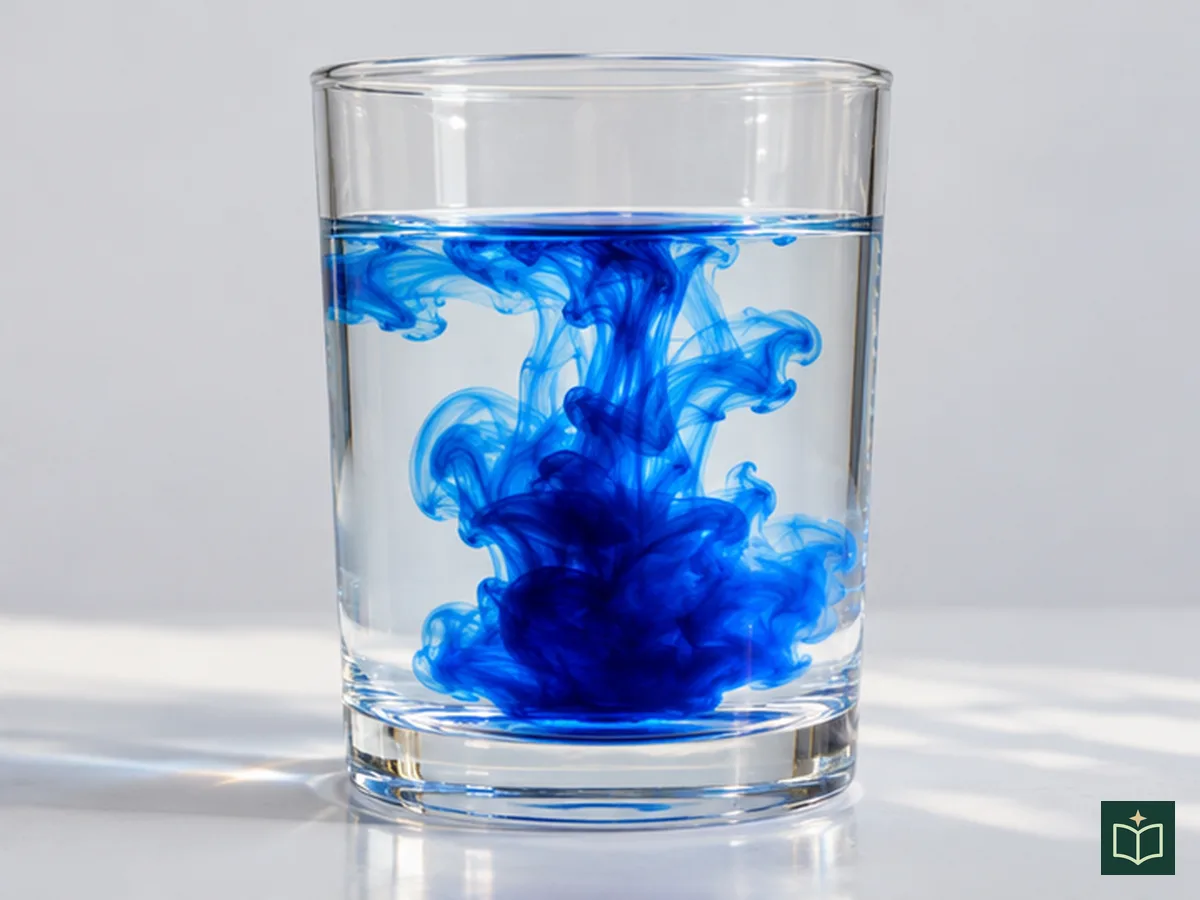
Diffusion: spreading out
Molecules in liquids and gases are constantly moving and colliding at random. If a substance is concentrated in one place, those random movements will, on average, carry more molecules away from the crowded area than back into it, until they are evenly spread. This net movement from high to low concentration is diffusion. It needs no energy from a cell; it simply happens because of molecular motion. Perfume spreading across a room, sugar dispersing through tea without stirring, and oxygen passing from the lungs into the blood are all examples. Warmer temperatures speed diffusion because molecules move faster, while larger molecules diffuse more slowly than small ones.
Osmosis: water on the move
Osmosis is a special case of diffusion involving water and a membrane. A selectively permeable membrane, such as a cell membrane, allows water molecules to pass but blocks larger dissolved particles such as salts and sugars. When the solutions on either side differ in concentration, water moves across the membrane from the more dilute side to the more concentrated side, as if trying to even out the difference. Water is not being pulled by the dissolved particles; rather, more water molecules are free to cross from the dilute side. Specialised channel proteins called aquaporins, whose discovery earned a Nobel Prize in 2003, speed water through many cell membranes.
What happens to cells
Osmosis explains why cells must be kept in the right surroundings. Human blood cells sit in fluid containing about 0.9% salt. If they are placed in pure water, water rushes in and they swell and can burst. In very salty water, water leaves the cells and they shrivel. That is why intravenous drips use saline matched to blood, not plain water. Plant cells, by contrast, have tough walls. Water entering them by osmosis pushes outward, creating turgor pressure that keeps stems and leaves firm. When a plant loses too much water, the pressure falls and it wilts. Salting cucumbers to make pickles draws water out the same way.
Why seawater dehydrates
Seawater contains about 3.5% salt on average, and the Gulf is saltier still, at around 4% in many places because of intense evaporation. That is roughly four times the concentration of body fluids. Drinking it adds salt faster than the kidneys can remove it, because they cannot produce urine as salty as seawater. To flush out the excess, the body loses more water than was drunk, deepening dehydration. Marine fish face the opposite problem: their bodies are less salty than the sea, so they constantly lose water by osmosis. They compensate by drinking seawater and excreting salt through specialised cells in their gills.
Reversing osmosis
Gulf countries rely heavily on desalination for drinking water, and many modern plants use reverse osmosis. Seawater is pumped at high pressure against a membrane that lets water molecules through but holds back salt. The pressure must exceed the natural osmotic pressure of seawater, which tends to push fresh water back towards the salty side, so plants typically operate at several dozen times atmospheric pressure. The fresh water that emerges is then treated and has minerals added before distribution, while the concentrated brine is returned to the sea. Reverse osmosis uses less energy than older thermal methods, which boil seawater and condense the steam.
Mixing up the terms
A common error is to describe osmosis as salt moving into water; in fact, it is water that moves. Another is to assume that diffusion requires a membrane; it happens anywhere particles are free to move. Both processes are passive and need no energy, unlike active transport, in which cells use energy to pump substances against their concentration gradient, as the kidneys and nerve cells do constantly. Diffusion is also only efficient over short distances, because the time it takes rises with the square of the distance. That limitation is why large organisms need hearts, blood vessels and lungs rather than relying on diffusion alone.
Sources & further reading
Figures are rounded and widely published; check the linked organisations for the latest editions. These organisations do not endorse this website.