Not related at all
Sweet potatoes and yams are often treated as the same vegetable, but botanically they are distant. The sweet potato, Ipomoea batatas, belongs to the morning glory family and is a flowering plant whose edible part is a swollen storage root. True yams belong to the genus Dioscorea, in a separate family of climbing plants that are monocots, more closely related to lilies and grasses than to sweet potatoes. Their edible part is a tuber, a swollen underground stem. Neither is a close relative of the ordinary potato either, which belongs to the nightshade family alongside tomatoes and peppers. The shared names are historical accidents, not evidence of kinship.
Origins and where they grow
The sweet potato originated in Central or South America and was cultivated there for thousands of years before spreading across the Pacific and, after the 16th century, to Asia, Africa and Europe. China is now by far the largest producer. True yams were domesticated independently in West Africa and in Southeast Asia. West Africa grows the great majority of the world's yams, with Nigeria the largest producer, and the crop carries deep cultural importance there, celebrated in harvest festivals. In the Caribbean and parts of Asia, yams are also staple foods. Gulf supermarkets mostly stock imported sweet potatoes; true yams are found mainly in specialist African and Asian grocers.
Telling them apart
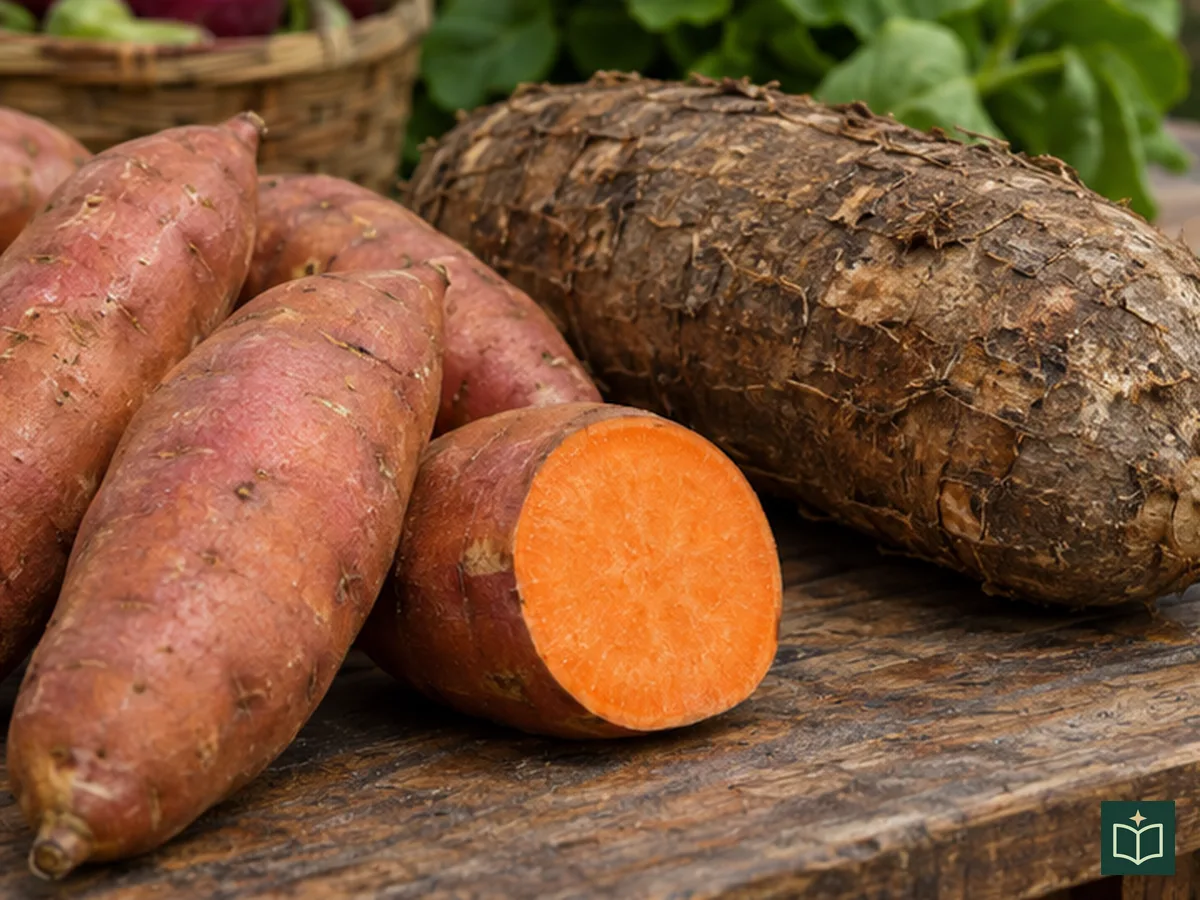
In the kitchen, the differences are easy to spot. Sweet potatoes are usually small to medium, with thin, smooth skin in shades of copper, red, cream or purple, and flesh that ranges from white to deep orange or violet. When cooked, they are moist and noticeably sweet. True yams are often much larger, sometimes weighing many kilograms, with rough, dark, bark-like skin and white, yellow or purple flesh. They are starchy and drier, closer in texture to a potato, and only mildly sweet. Some wild and cultivated yams contain bitter or irritating compounds when raw and must be peeled and thoroughly cooked before they are eaten.
How the confusion began
The mix-up is mainly American. Enslaved West Africans in the United States are thought to have applied a word for yam, such as nyami, to the soft, orange sweet potatoes they found there, which resembled the yams they knew. In the 1930s, growers in Louisiana promoted their soft, orange-fleshed varieties as 'yams' to distinguish them from firmer, paler sweet potatoes grown elsewhere, and the name stuck. US regulations now require produce labelled as a yam to carry the words 'sweet potato' as well. Canned 'yams' in American supermarkets are almost always sweet potatoes. True yams remain rare outside specialist shops.
Nutrition compared
Both are valuable sources of carbohydrate, fibre and potassium, but their strengths differ. Orange sweet potatoes are rich in beta-carotene, which the body converts to vitamin A; a single medium sweet potato can provide more than a day's recommended intake. For this reason, orange-fleshed varieties have been promoted in parts of Africa to combat vitamin A deficiency. True yams contain little beta-carotene, but they are rich in starch and supply vitamin C and other minerals. Wild yam species also contain diosgenin, a compound that chemists in the mid-20th century used as a starting material for making steroid hormones, including early contraceptive pills.
What to take away
In practice, the confusion rarely matters for a home cook following a recipe written in the United States, since the 'yams' it calls for will be sweet potatoes. It does matter for anyone buying true yams from an African or Caribbean grocer and expecting a sweet, soft result, or for someone substituting one for the other in a stew. The names also remind us how trade and migration reshape the language of food. The sweet potato travelled from the Americas around the world, and the yam's name travelled from Africa to America, attaching itself to a different plant along the way.
Sources & further reading
Figures are rounded and widely published; check the linked organisations for the latest editions. These organisations do not endorse this website.