Cousins, not the same
Spiders are often called insects, but biologists place them in a different class. Both belong to the arthropods, the vast group of animals with jointed legs and a hard external skeleton that must be shed and replaced as they grow. Within that group, insects form the class Insecta, which includes beetles, flies, ants, bees, butterflies and locusts. Spiders belong to the class Arachnida, together with scorpions, ticks, mites and harvestmen. The two lineages split hundreds of millions of years ago, long before either colonised land in a big way, and they evolved very different body plans, senses and ways of life.
Body plans compared
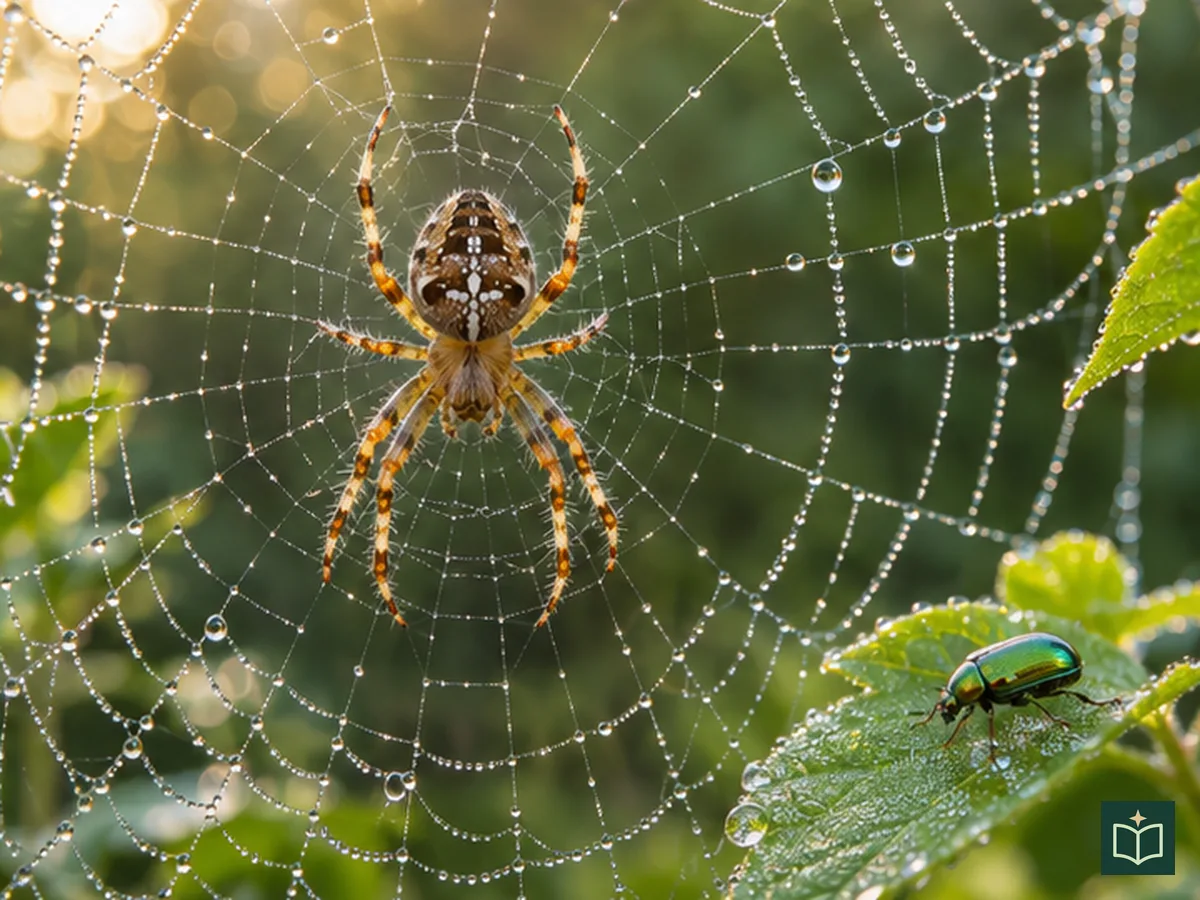
The quickest test is to count. An adult insect has six legs and a body divided into three parts: a head carrying the eyes, mouthparts and a pair of antennae; a thorax bearing the legs and, in most species, one or two pairs of wings; and an abdomen. A spider has eight legs and only two main body parts: a fused head and chest called the cephalothorax, and an abdomen, joined by a narrow waist. Spiders have no antennae and no wings. Instead they have a pair of fangs, called chelicerae, and a pair of short, leg-like feelers called pedipalps, which can be mistaken for an extra pair of legs.
Senses and silk
Most insects see with large compound eyes, each made of many small units, often supplemented by simple eyes. Spiders usually have eight simple eyes, though the number varies; jumping spiders have sharp forward-facing eyes that give excellent vision, while many web-building spiders rely mainly on touch, sensing vibrations through their silk. Silk is a spider speciality. Every spider produces it from spinnerets at the tip of the abdomen, using it for webs, egg sacs, safety lines and even for ballooning on the wind. Some insects make silk too, most famously the silkworm, a moth caterpillar, but they produce it from glands near the mouth.
Growing up differently
The two groups also develop in different ways. Many insects undergo complete metamorphosis, passing through egg, larva, pupa and adult stages that can look nothing alike, as when a caterpillar becomes a butterfly. Others, such as grasshoppers, hatch as smaller versions of the adult and grow through a series of moults. Spiders hatch as tiny spiderlings that resemble adults and simply moult several times as they grow. Nearly all spiders are predators, and nearly all have venom glands, though very few species are dangerous to people. Scientists have estimated that the world's spiders together eat several hundred million tonnes of insects and other prey each year.
Look-alikes and myths
Several creatures confuse the picture. Ticks and mites are arachnids, not insects, which is why they have eight legs as adults. Scorpions are arachnids too. In the deserts of Arabia, camel spiders, or solifugids, are often feared, but they are neither true spiders nor insects; they form their own arachnid order, lack venom glands and are harmless to people despite their speed and fearsome appearance. Myths that they chase people or attack camels are untrue: they are simply running for the nearest shade. Centipedes and millipedes, with dozens of legs, belong to yet another arthropod group, the myriapods, and woodlice are crustaceans.
Why the difference matters
Correct identification has practical value. Pest control treatments that work on insects may not affect spiders, and vice versa. Medical responses differ too: an insect sting, such as a bee's, may cause allergic reactions, while a spider bite is usually minor but occasionally needs attention, depending on the species. Both groups are vital to ecosystems. Insects pollinate crops, recycle waste and feed birds and reptiles, while spiders are among the most important natural controllers of insect numbers, including pests in gardens and farms. Telling them apart is a first step towards understanding the small animals that outnumber humans by an almost unimaginable margin.
Sources & further reading
Figures are rounded and widely published; check the linked organisations for the latest editions. These organisations do not endorse this website.