Why dates were squeezed
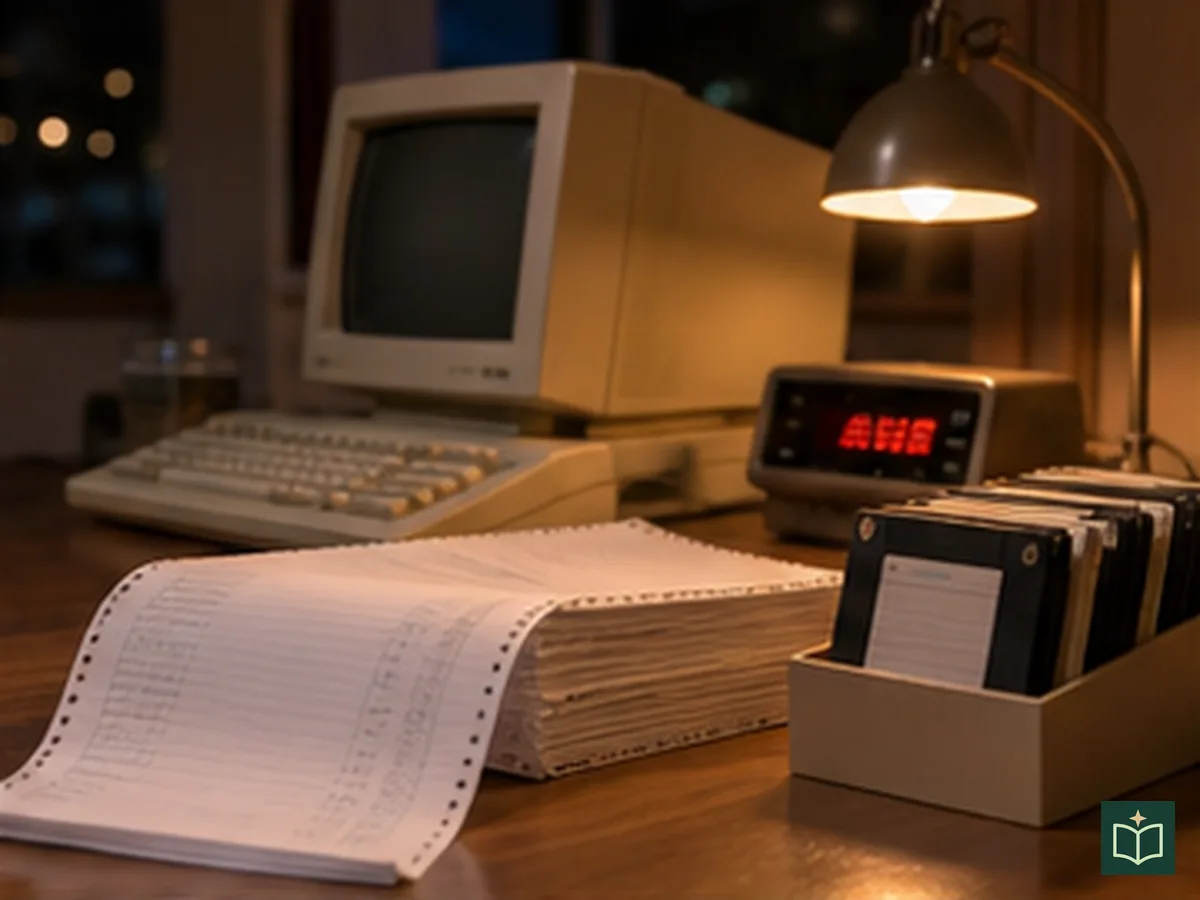
In the 1960s and 1970s, computer memory and storage were extraordinarily expensive. Every character mattered, whether on punched cards, magnetic tape or in memory. Programmers therefore stored years using just two digits, writing 1975 as 75, and assumed the 19 in front. It was a sensible economy at the time, and few expected their software to remain in service for decades. Yet banking, insurance, payroll and government systems were built on that code and then extended rather than replaced. By the 1990s, millions of programs around the world held dates in a form that could not distinguish 2000 from 1900. Any calculation crossing that boundary risked going wrong.
The Year 2000 problem
The danger was not that computers would explode at midnight but that they would calculate nonsense. A loan running from 1998 to 2003 might appear to last minus 95 years. Sorting by date could place new records before old ones. Systems checking whether something had expired might reject everything. The year 2000 added a further twist: it was a leap year, as centuries divisible by 400 are, but some software wrongly assumed otherwise. Embedded controllers in lifts, power stations and medical equipment also needed checking. Governments and companies worldwide launched remediation programmes, reviewing code line by line and testing systems with their clocks wound forward to simulate the new century.
Did all that work matter?
When 1 January 2000 arrived, problems were few and minor: some incorrect dates on receipts and websites, a handful of monitoring glitches. That calm led some people to conclude the threat had been exaggerated. Most engineers who worked on it disagree. The quiet outcome reflected years of effort and spending estimated in the hundreds of billions of US dollars worldwide, along with countless failures found and fixed before they occurred. Organisations that did little often had less-exposed systems, not proof that the risk was imaginary. Y2K also brought lasting benefits: many organisations inventoried their software for the first time and replaced fragile old systems they had forgotten they depended on.
The clock that runs out in 2038
A second deadline lies ahead. Many computers, especially those descended from the Unix operating system, record time as the number of seconds since midnight on 1 January 1970, Coordinated Universal Time. On older systems that count is stored as a signed 32-bit integer, whose largest value is 2,147,483,647. That number of seconds is reached at 03:14:07 UTC on 19 January 2038. One second later, the counter overflows and wraps around to its most negative value, which corresponds to 20:45:52 on 13 December 1901. Software relying on such a clock could suddenly believe it is more than a century in the past, breaking certificates, schedules and logs.
How it is being fixed
The solution is simple in principle: use 64 bits instead of 32. A signed 64-bit count of seconds will not overflow for about 292 billion years, comfortably longer than the age of the universe. Mainstream operating systems, including modern versions of Linux, macOS and Windows, already use 64-bit time on current hardware, and most phones and laptops are unaffected. The harder cases are embedded devices that run for decades without updates: industrial controllers, vehicles, building systems, network equipment and old file formats and databases that store 32-bit times. Calculations that look into the future, such as 30-year mortgages or long-term certificates, can already encounter dates after 2038 today.
Lessons from rollover bugs
Y2K and 2038 are the best-known members of a wider family. The satellite navigation system GPS counts weeks in a 10-bit field that rolls over every 1,024 weeks, about 19.6 years; the 1999 and 2019 rollovers caused some older receivers to show wrong dates. Other systems have stumbled over leap seconds and daylight-saving changes. The common thread is that every counter stored in a fixed space eventually fills up. Good engineering anticipates the limit, documents it and leaves a generous margin. For organisations, the practical lesson from Y2K still applies to 2038: list the systems you rely on, check how they store time and test them early.
Sources & further reading
Figures are rounded and widely published; check the linked organisations for the latest editions. These organisations do not endorse this website.