Balance in a moving system
Normally, an object orbiting the Sun closer than Earth goes round faster, and one farther out goes round more slowly, as Kepler's laws describe. Yet there are five special places where a small spacecraft can orbit the Sun in exactly one year, keeping pace with Earth as if parked. They are called Lagrange points, after the Italian-born French mathematician Joseph-Louis Lagrange, who described them in 1772; Leonhard Euler had found three of them a few years earlier. Every pair of large bodies has its own set, such as Earth and the Moon or the Sun and Jupiter. For spacecraft, the most useful are those of the Sun–Earth system, labelled L1 to L5.
How the pulls add up
At L1, about 1.5 million kilometres from Earth towards the Sun, Earth's gravity pulls slightly outwards against the Sun's, weakening the net inward pull so that a spacecraft there orbits more slowly than it otherwise would, just enough to match Earth's year. At L2, the same distance on the far side of Earth, the two pulls add together, giving the extra force needed to keep pace despite the greater distance. L3 lies on the far side of the Sun, beyond Earth's orbit. L4 and L5 sit 60 degrees ahead of and behind Earth along its orbit, forming equilateral triangles with the Sun and Earth. A simple approximation confirms the 1.5 million kilometre figure.
Stable and unstable points
Not all five are equally restful. L1, L2 and L3 are like a ball balanced on a saddle: stable in some directions but not others, so a spacecraft left alone gradually drifts away over weeks or months. Missions therefore do not sit at the exact point. They fly large looping paths around it, called halo or Lissajous orbits, and fire small thrusters every few weeks to stay on track. L4 and L5 are genuinely stable for the Sun–Earth and Sun–Jupiter pairs, because a drifting object is steered back by the combined effect of gravity and its own motion. Natural debris collects there, including thousands of 'Trojan' asteroids sharing Jupiter's orbit.
L1: an uninterrupted view of the Sun
L1 offers something no Earth orbit can: a constant, unobstructed view of the Sun, never blocked by the planet. The Solar and Heliospheric Observatory, a joint European and American mission launched in 1995, has watched the Sun from near L1 for decades, tracking eruptions that can disturb satellites, radio and power grids. Other spacecraft at L1 sample the solar wind about an hour before it reaches Earth, giving forecasters useful warning of geomagnetic storms. Looking the other way, a camera at L1 can photograph the fully sunlit face of Earth. India's Aditya-L1 solar observatory also operates there, showing how this location has become a busy hub for solar science.
L2: a cold, quiet observatory
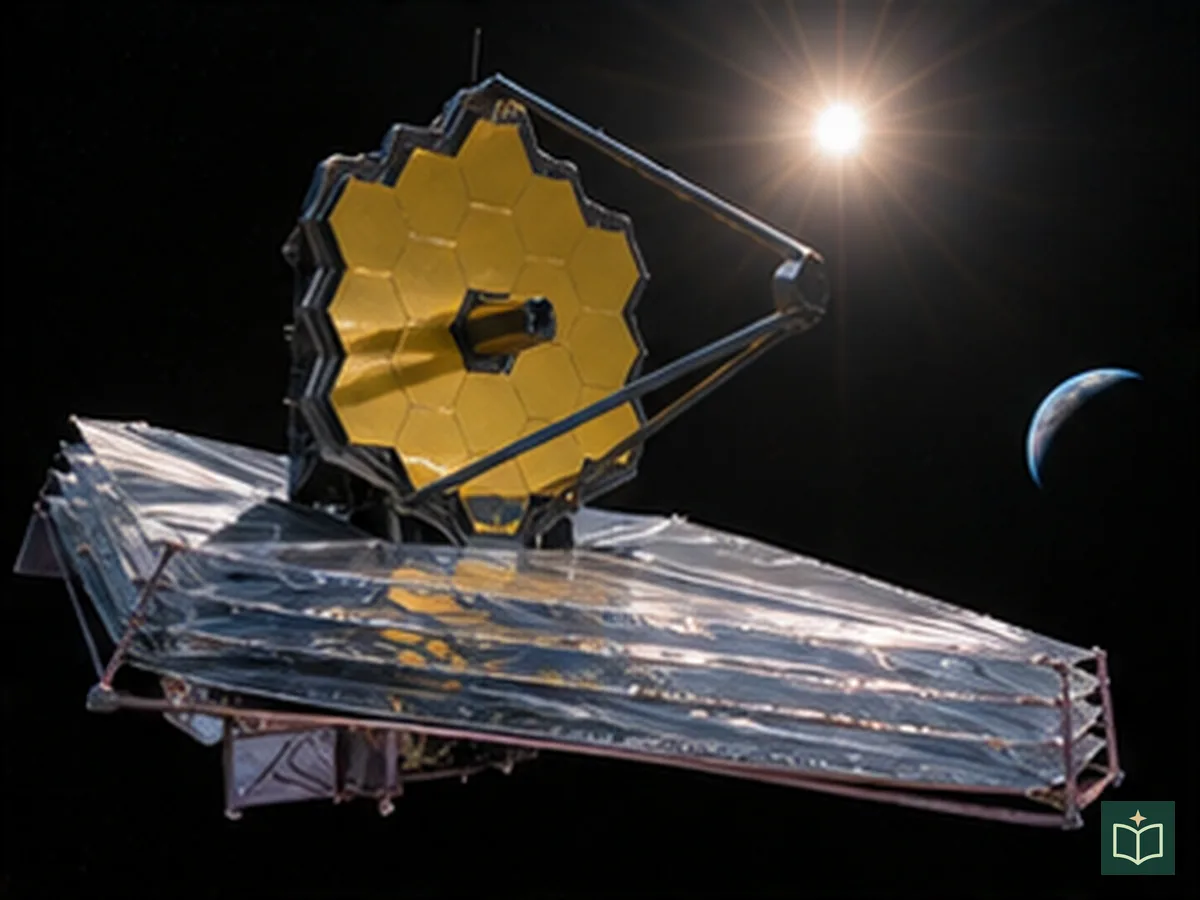
L2 suits telescopes that study the faint, distant universe. From there the Sun, Earth and Moon all lie in roughly the same direction, so a single shield can block their heat and light while the instruments face outwards into cold darkness. The James Webb Space Telescope, launched on 25 December 2021, reached its orbit around L2 the following month. Its five-layer sunshield keeps its infrared instruments far below freezing, which is essential for detecting faint heat from early galaxies. Earlier missions, including Planck and Herschel, worked there too, and Europe's Gaia and Euclid observatories followed. Its loop around L2 also keeps Webb clear of Earth's shadow, so its solar panels stay lit.
Limits and the future
Lagrange points are convenient but not easy. Reaching L2 takes about a month, and at 1.5 million kilometres a broken spacecraft is beyond the reach of repair crews, unlike the Hubble Space Telescope in low orbit. Communications need large dish antennas on the ground. The halo orbits must be planned carefully, and missions eventually end when station-keeping propellant runs out. Earth–Moon Lagrange points are also attracting interest. China's first Queqiao relay satellite used a halo orbit around the Earth–Moon L2 point, beyond the Moon, to pass signals from a lander on its far side. As traffic grows, these gravitational parking spots are likely to become as valued as prime positions in Earth orbit.
Sources & further reading
Figures are rounded and widely published; check the linked organisations for the latest editions. These organisations do not endorse this website.