Robots in factories
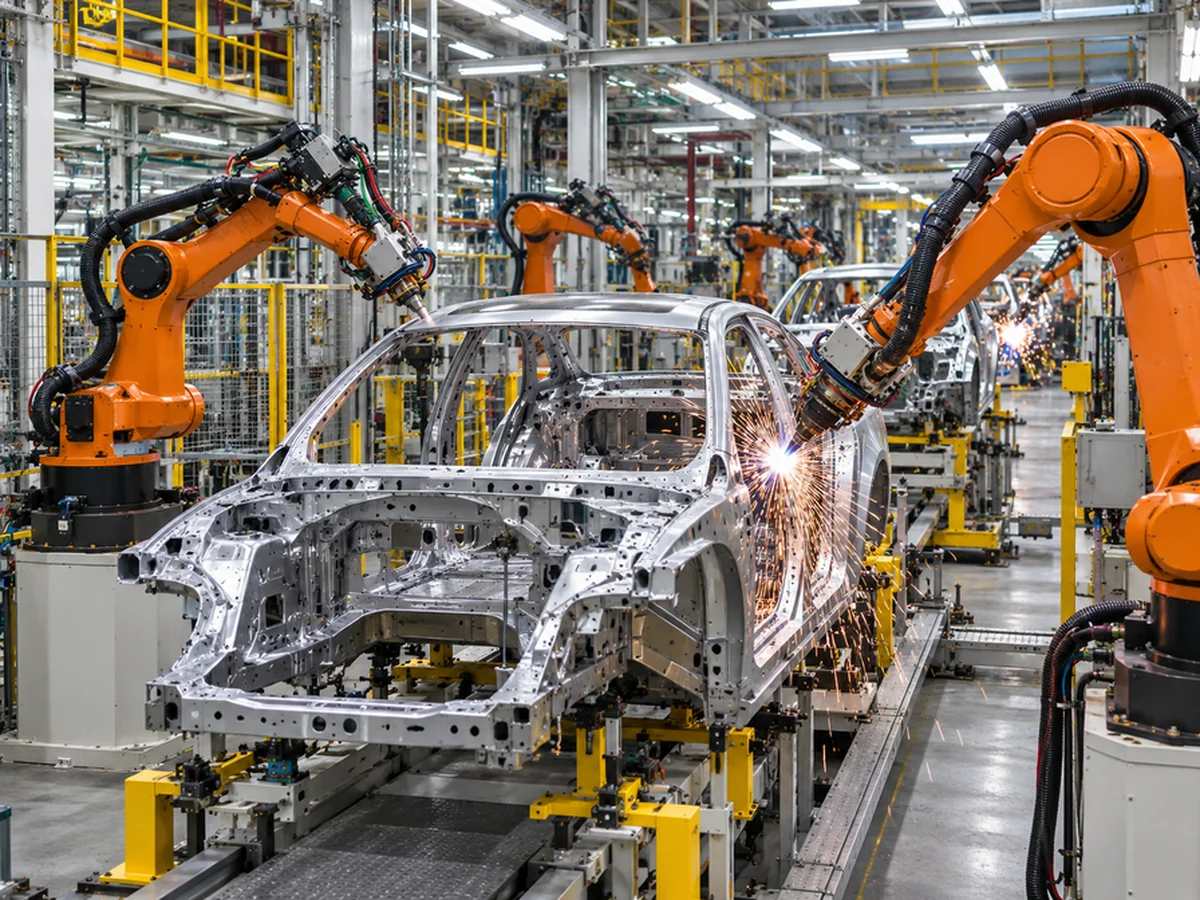
Industrial robots are programmable machines, usually robotic arms, that perform tasks such as welding, painting, assembling, packing and moving materials. They work tirelessly with high precision and are especially common in car and electronics factories. The International Federation of Robotics, based in Germany, collects data on robot installations worldwide and publishes its World Robotics report each year.
A record decade
According to the World Robotics 2025 report, factories worldwide installed about 542,000 industrial robots in 2024, the second-highest total ever and more than double the number ten years earlier. It was the fourth year in a row above half a million. The total number of industrial robots operating worldwide reached about 4.66 million, an increase of 9% from the previous year. Asia accounted for 74% of new installations, Europe for 16% and the Americas for 9%. The car and electronics industries remain the biggest buyers of robots, followed by metal, machinery, plastics and chemicals.
China's dominance
China installed 295,000 industrial robots in 2024, a record and 54% of the global total, up 7% from the previous year. Its operational stock passed two million robots, the largest of any country. China's government has promoted automation through industrial policies, and Chinese robot makers have rapidly increased their share of the domestic market, which was once dominated by Japanese and European suppliers.
Japan and the United States
Japan remained the second-largest market, with 44,500 robots installed in 2024, and it is also home to leading robot manufacturers such as Fanuc and Yaskawa. The United States installed 34,200 robots, down 9%, and has about 394,000 robots working in its factories. The IFR noted that China installs almost nine times as many robots each year as the United States.
Korea and Germany
South Korea installed 30,600 robots in 2024 and has long had the world's highest robot density, with more than 1,000 robots per 10,000 manufacturing workers, reflecting its large electronics and car industries. Germany is Europe's largest market and the fifth-largest worldwide. India installed a record 9,100 robots, ranking sixth, driven mainly by the car industry.
Robots get smarter
Traditional industrial robots follow fixed programs and work in cages separated from people. AI is changing this. Computer vision lets robots see and handle objects of different shapes, such as picking items from mixed bins in warehouses. Collaborative robots, or cobots, can work safely alongside humans. AI also helps program robots more easily, sometimes by demonstration or natural language instructions.
Humanoid robots
Companies in China, the United States and elsewhere are developing humanoid robots designed to work in spaces built for people, using AI models to understand instructions and learn tasks. Car makers and logistics companies are testing them in factories and warehouses. Most humanoids are still at an early stage, but large investments and rapid progress in AI have sparked intense interest and competition.
Robots in the UAE
The UAE is investing in robotics and automation as part of its industrial strategy, Operation 300bn, which aims to grow manufacturing, and its AI strategy. Robots are used in industries such as aluminium, logistics and construction, and in 2022 Dubai launched a Robotics and Automation Programme to expand the use of robots across the economy. Universities such as Khalifa University and MBZUAI conduct robotics research.
Jobs and productivity
Robots raise productivity and can take over dangerous, dirty or repetitive jobs. Studies have found that they can reduce employment in some local areas and occupations, while creating jobs in robot manufacturing, programming and maintenance, and helping companies stay competitive. Countries with ageing populations, such as Japan, South Korea, Germany and China, see robots as a way to address labour shortages.
Why it matters
Industrial robots are a key measure of how advanced a country's manufacturing is, and their numbers are rising fast. China's enormous lead in installations strengthens its position as the world's factory, while AI promises to make robots more capable and widespread. The combination of AI and robotics may transform not only factories but also warehouses, farms, hospitals and homes. Countries that combine strong manufacturing with strong AI research, such as China, Japan, South Korea, Germany and the United States, are best placed to lead this next wave of automation.
Sources & further reading
- International Federation of Robotics · Global robot demand in factories doubles over 10 years (2025) ↗
- IFR · China tops world record of 2 million factory robots (2025) ↗
- IFR · US lags China in factory robot deployment (2025) ↗
Data covers industrial robots, not service or consumer robots. Photograph: original AI-generated illustration (Adobe Firefly). Reference organisations do not endorse this website.