A palace-city on a hill
The Alhambra stands on a ridge above Granada in southern Spain, facing the Sierra Nevada. Its name comes from the Arabic for 'the red one', after the colour of its walls. Muhammad I, founder of the Nasrid dynasty, began building a fortified complex there in the 1230s. For more than 250 years his successors ruled the Emirate of Granada, the last Muslim state on the Iberian Peninsula, from inside these walls. The site includes a military fortress, the Alcazaba, a small town for officials and craftsmen, and the royal palaces. Most of the famous rooms date from the fourteenth century, under the rulers Yusuf I and his son Muhammad V.
Tiles that follow rules
The lower walls of many rooms are lined with tile mosaics, cut piece by piece from glazed ceramic and fitted into interlocking stars, polygons and ribbons. Each design starts from a geometric construction, such as an eight-pointed star made from overlapping squares. The pattern is then repeated across the wall by shifting, rotating and mirroring the basic unit. Mathematicians recognise that there are exactly seventeen distinct ways to repeat a pattern across a flat surface, called wallpaper groups. Studies have found many of them in the Alhambra, though how many is debated. The craftsmen did not use modern group theory, but their practical knowledge of symmetry led them to the same results.
Plaster carved like lace
Above the tiles, walls are covered with stucco, a plaster that was moulded and carved while soft, then painted. Bands of vegetal scrolls, geometric panels and Arabic calligraphy cover almost every surface. Some inscriptions are verses by court poets, including Ibn Zamrak, that speak in the voice of the building itself. The phrase 'There is no victor but God', the dynasty's motto, is repeated thousands of times. Stucco was cheaper and faster to work than stone, so whole rooms could be decorated within a few years. Much of the original colour, once vivid blues, reds and gold, has faded, leaving the pale surfaces that visitors see today.
Honeycomb ceilings
The most astonishing ceilings use muqarnas, a technique of stacking small curved cells in tiers so that a dome appears to dissolve into a honeycomb or stalactites. In the Hall of the Two Sisters, the vault is built from thousands of individual plaster pieces, often counted at more than 5,000. Each piece belongs to a small set of standard shapes, assembled according to a plan drawn on a grid. Light from windows around the base moves across the cells during the day, so the ceiling seems to change. The Hall of the Abencerrajes, opposite, has a star-shaped muqarnas dome. Similar vaults appear across the Islamic world, from Iran to Morocco.
Water as a building material
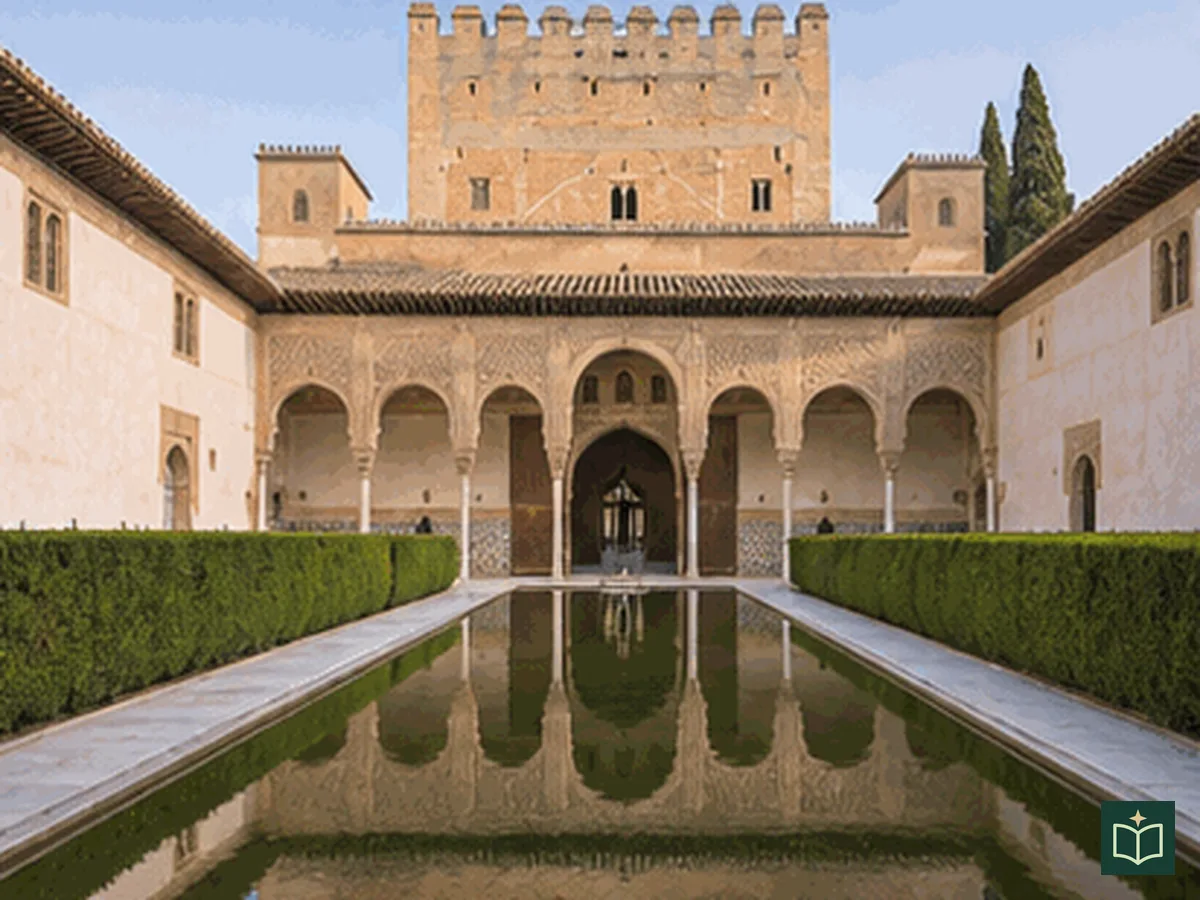
The Alhambra would not exist without water. Engineers built the Royal Canal, which diverted the river Darro several kilometres upstream and carried water by gravity onto the hill. From there it fed cisterns, baths, gardens and fountains. In the Court of the Myrtles, a long, still pool reflects the tower of the Comares palace, doubling the facade. In the Court of the Lions, twelve stone lions support a basin, and four channels run from the centre towards the halls, a layout often linked to descriptions of paradise gardens. The summer palace of the Generalife, on a neighbouring slope, uses the same water system to irrigate terraced gardens and orchards.
After 1492
In January 1492 the last Nasrid ruler, Muhammad XII, known in Europe as Boabdil, surrendered Granada to Ferdinand and Isabella of Castile and Aragon. The new rulers kept the palaces, partly as a symbol of conquest. In the sixteenth century Emperor Charles V built a large Renaissance palace inside the complex, square outside with a circular courtyard. Later the site was neglected, and parts were damaged by French troops in 1812. Interest revived in the nineteenth century, helped by travellers and writers such as Washington Irving. Systematic restoration began in the twentieth century. The Alhambra, the Generalife and the old Albayzín district were listed by UNESCO as World Heritage.
Sources & further reading
Figures are rounded and widely published; check the linked organisations for the latest editions. These organisations do not endorse this website.