Wooden hulls under attack
For centuries wooden ships fought a losing battle beneath the waterline. In warm seas the shipworm, which is not a worm at all but a small burrowing clam, drilled long tunnels through hull planks until timbers crumbled. At the same time, weed and barnacles grew thickly on the hull, adding drag that could cut a ship's speed noticeably and force regular, costly cleaning in dock. Shipwrights tried many defences: coatings of tar, sulphur and tallow, an outer layer of sacrificial planking stuffed with hair, and sheets of lead. None worked well for long, and lead added weight and attacked the iron fittings it touched.
The copper experiment
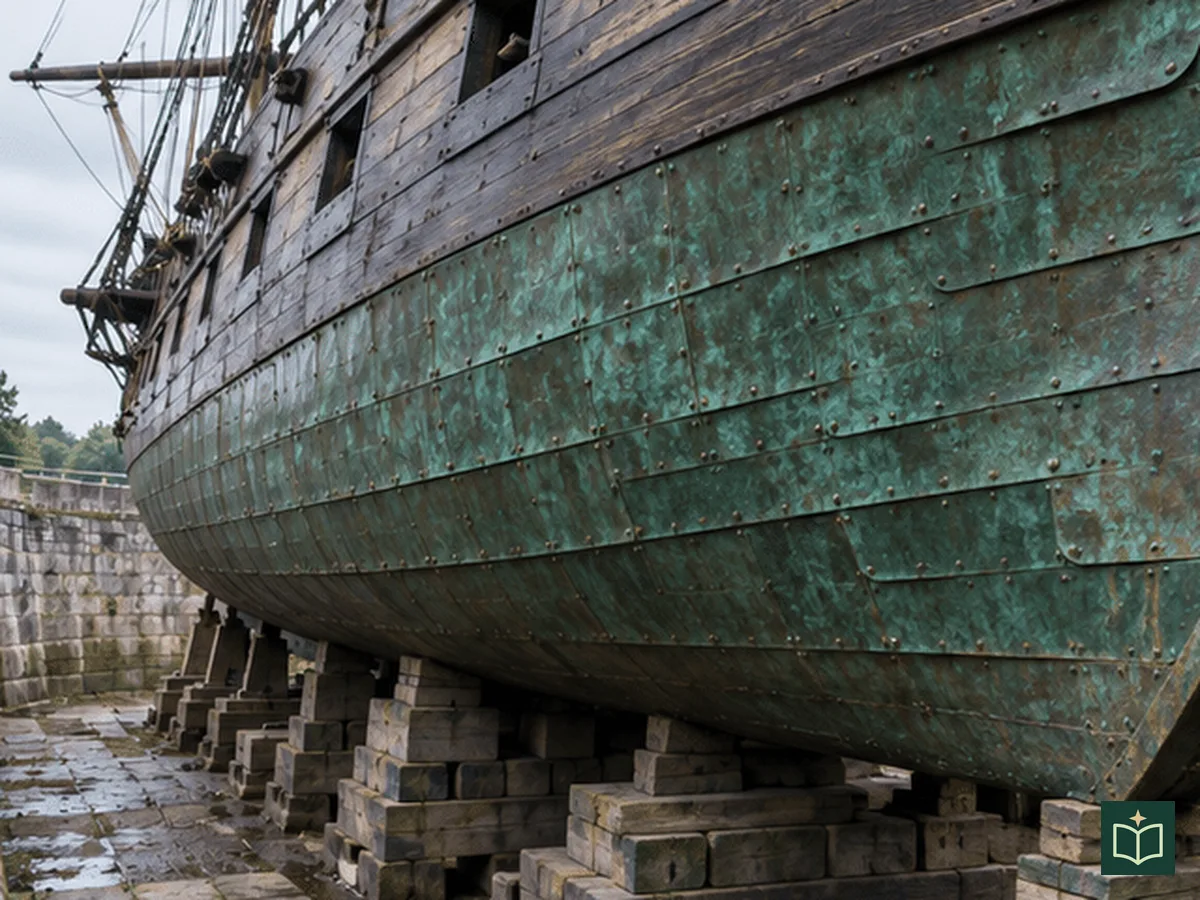
In 1761 the Royal Navy sheathed the frigate HMS Alarm in thin copper plates and sent it to the West Indies, where shipworm was a constant threat. When the ship returned about two years later, the timber beneath was sound and the hull largely free of growth. Copper works because it slowly dissolves in seawater, releasing copper ions that are toxic to larvae of barnacles, weed and shipworms trying to settle. The surface also sheds a thin corrosion film as it wears, carrying any attached growth away with it. The idea looked like a clear success, but the trial had revealed a serious hidden problem.
An accidental battery
On Alarm, iron bolts and rudder fittings close to the copper had corroded badly. When two different metals touch in seawater, they form a simple battery: the more reactive metal, here iron, corrodes faster while the nobler copper is protected. Nobody could yet explain the chemistry, but the danger was obvious, since bolts hold a ship together. Early coppered ships sometimes leaked or lost fittings. The solution, developed in the 1780s, was to replace iron bolts below the waterline with bolts of hardened copper or copper alloy, and to separate the sheets from iron with layers of tarred paper or felt. With that, coppering became safe.
Speed in wartime
During the American War of Independence, Britain faced the combined navies of France and Spain, and the Admiralty ordered coppering across the fleet. By the early 1780s most ships of the line had copper bottoms. Coppered ships stayed clean and fast for longer, needed docking less often and could spend more time at sea, an important advantage for a navy stretched across several oceans. The demand created a boom in British copper mining, notably at Parys Mountain on Anglesey in Wales, then one of the largest copper mines in the world, and in the smelting works of Swansea that processed its ore.
From science to a phrase
In the 1820s the chemist Humphry Davy, now understanding the electrochemistry, proposed fixing small blocks of zinc or iron to copper sheathing to protect it. The method worked too well: the copper stopped dissolving, and weed and barnacles returned. Shipowners preferred fouling protection to longevity. In 1832 a cheaper brass of about 60% copper and 40% zinc, known as Muntz metal, was patented and widely used on merchant ships, including the clipper Cutty Sark. Meanwhile English gained the word copper-bottomed, first describing a sound ship and later anything, from an investment to a guarantee, considered thoroughly safe, sound and reliable.
Copper still fights fouling
Wooden warships have gone, but the problem of fouling has not. A rough, overgrown hull can raise a modern ship's fuel use markedly, so most vessels are coated with antifouling paints. After the very toxic tributyltin compounds were banned under an international convention that took effect in 2008, many paints went back to copper compounds, especially cuprous oxide, as their main active ingredient. Davy's protective zinc blocks also survive as sacrificial anodes on hulls, piers and offshore platforms. The 18th-century coppering trials, in other words, laid the foundations of two modern technologies: antifouling coatings and cathodic protection against corrosion in seawater.
Sources & further reading
Figures are rounded and widely published; check the linked organisations for the latest editions. These organisations do not endorse this website.