How cold is officially measured
Like heat records, cold records are kept by the World Meteorological Organization, which checks the instrument, the site and the weather before accepting a reading. Official values are air temperatures measured in a shaded screen above the ground. Very low readings need special instruments, because mercury freezes at about −39°C; older records used alcohol thermometers, while modern stations use electronic sensors. This table lists the lowest accepted temperature for each continent or region, ranked from coldest. Several countries have national records not shown here, such as −62.2°C at Prospect Creek in Alaska in 1971, the lowest in the United States.
Vostok and the Antarctic plateau
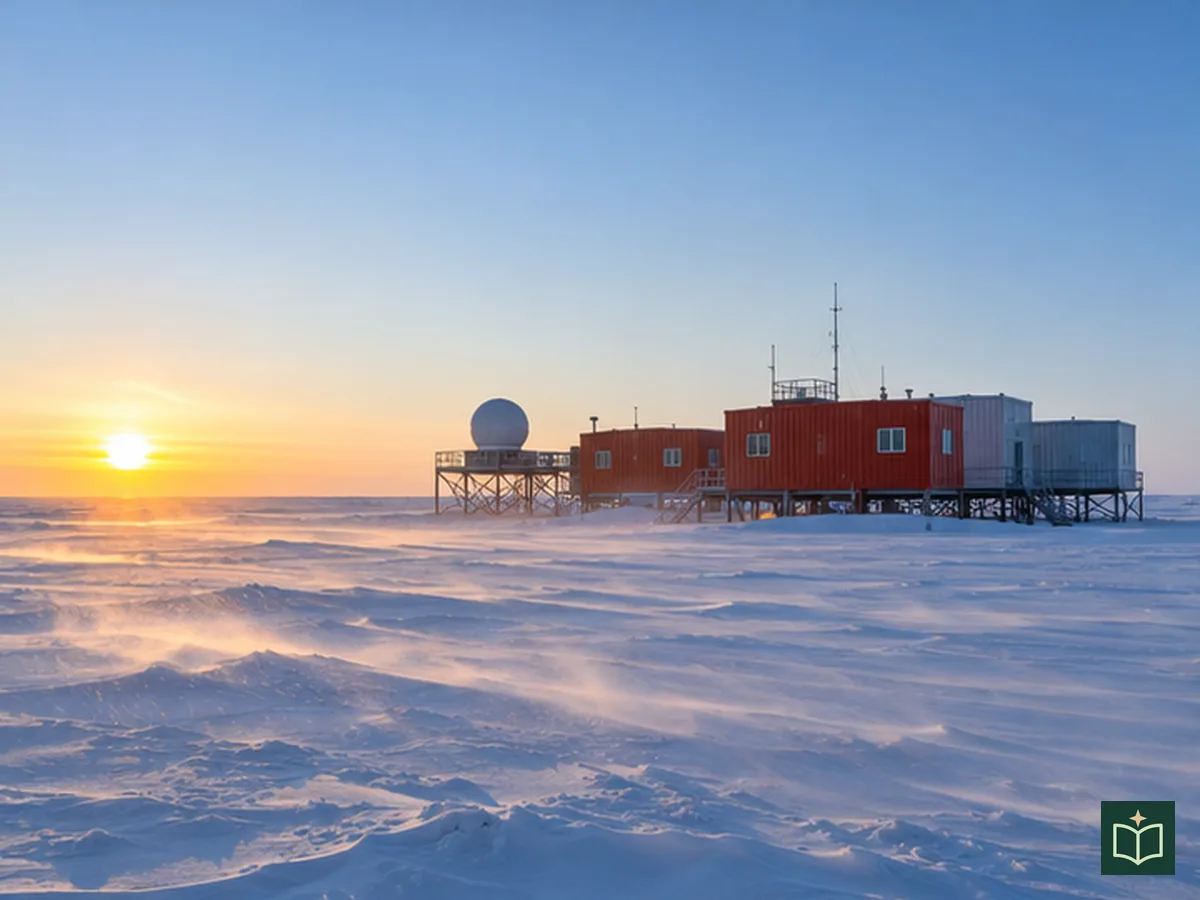
The coldest air temperature ever measured, −89.2°C, was recorded on 21 July 1983 at Vostok Station, a research base built by the Soviet Union on the East Antarctic ice sheet. The station stands about 3,500 metres above sea level, far from the moderating influence of the ocean, and in winter it sees months without sunlight. Under clear, calm skies, the snow surface radiates heat to space and the air just above it chills further. Satellites have detected snow surface temperatures near −98°C in hollows on the high plateau, but those are measurements of the surface itself, not official air temperatures.
Greenland’s high ice
The northern hemisphere’s lowest accepted temperature comes from the top of the Greenland ice sheet. On 22 December 1991 an automatic weather station called Klinck, at an altitude of about 3,100 metres, recorded −69.6°C. The reading was forgotten for decades and only recognised by the WMO in 2020, after researchers recovered and checked the data. The station was part of a network installed to study the ice sheet’s climate. Automatic stations have opened up the coldest parts of the world to measurement, since few people can spend winters on an ice sheet. Greenland’s record beat the long-standing Siberian figures and showed how much colder the high ice can be than inhabited places.
Siberia’s Pole of Cold
The coldest places where people live year-round are in north-eastern Siberia. Verkhoyansk recorded −67.8°C in February 1892, and Oymyakon matched it in 1933. Both towns sit in valleys surrounded by mountains. In winter, dense cold air drains into the valleys and stays there under a lid of warmer air, a temperature inversion that can last for weeks. Summers are surprisingly warm: Verkhoyansk has also reached 38.0°C, giving it a recorded range of about 106°C between its hottest and coldest days, one of the largest of any place on Earth. Residents keep car engines running or garaged for months, because oil and fuel thicken in the cold.
North America and Europe
North America’s record of −63.0°C was set at Snag, a small airfield in Canada’s Yukon Territory, on 3 February 1947. Observers reported that the air was so cold their breath hissed and fell as ice crystals, and that sounds carried for kilometres. Europe’s lowest reading, −58.1°C, was recorded at Ust-Shchugor in Russia’s Komi Republic in December 1978, west of the Ural Mountains that mark the continental boundary. Elsewhere in Europe, extreme cold is moderated by the Atlantic Ocean and its warm currents, which is why western Europe’s winters are mild compared with those at the same latitude in Siberia or Canada.
The southern continents and the Gulf
Outside Antarctica, the southern continents are much milder, because they are surrounded by ocean and have little land at high latitudes. South America’s record is −32.8°C at Sarmiento in Argentine Patagonia, and New Zealand’s is −25.6°C at Ranfurly. Africa’s lowest accepted temperature, −23.9°C, was measured at Ifrane in Morocco’s Middle Atlas mountains, now a ski destination; its cold comes from altitude, as the town lies at about 1,650 metres. Australia’s record is −23.0°C at Charlotte Pass in the Snowy Mountains. In the UAE, frost is rare, but temperatures can fall below freezing on the summit of Jebel Jais in winter, a reminder that altitude can bring cold even to the desert.
Sources & further reading
Figures are rounded and widely published; check the linked organisations for the latest editions. These organisations do not endorse this website.