How a dome stands
A dome is an arch turned around its centre. Its weight presses down through the curved shell and also pushes outwards at the base, a force called thrust. Masonry is strong when squeezed but weak when pulled apart, so early builders thickened the lower walls, added buttresses or bound the base with chains of iron or timber to stop it spreading. Each increase in size therefore needed a better material or a cleverer design. This ranking lists domes that held the record for the widest span, by diameter. The great domes of earlier centuries are smaller than any modern entry, but they held the record for far longer.
The Pantheon’s concrete
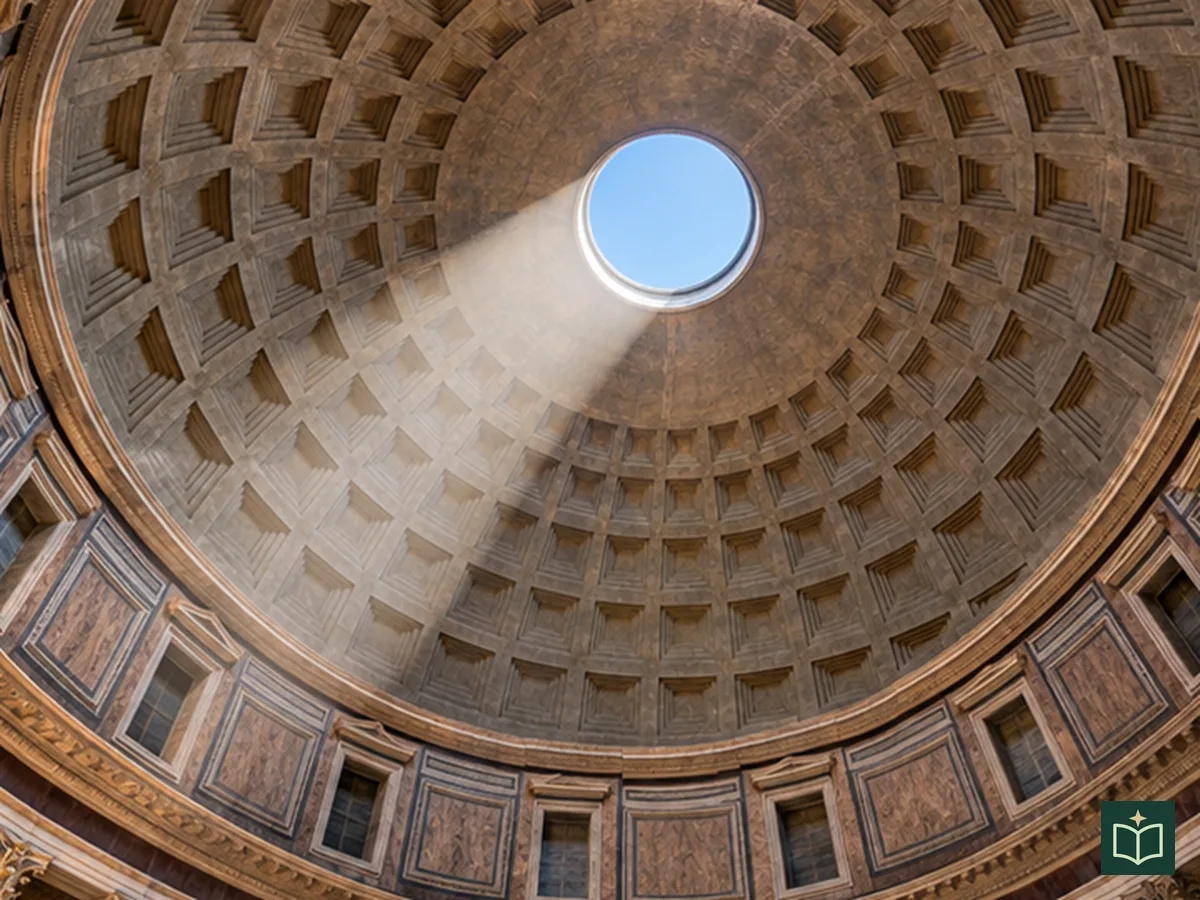
Rome’s Pantheon, completed around AD 128 under the emperor Hadrian, has a dome about 43.4 metres across, and it remains the largest unreinforced concrete dome in the world. Its builders made the concrete lighter towards the top by mixing in volcanic pumice, and they reduced the shell’s thickness as it rises. At the summit an open oculus, about eight metres wide, removes weight where it would be hardest to support and lets in the only daylight. The dome has stood for almost nineteen centuries, partly because Roman concrete, made with volcanic ash, has proved remarkably durable. It held the record for more than 1,300 years.
Hagia Sophia and Florence
Hagia Sophia in Istanbul, completed in 537, has a dome about 31 metres across that seems to float above a ring of windows. Its innovation was the pendentive, a curved triangle that lets a round dome sit on a square base. The first dome collapsed after an earthquake in 558 and was rebuilt higher. In Florence, Filippo Brunelleschi completed the cathedral dome in 1436, spanning about 45.5 metres across an octagon. He built it without a wooden supporting frame, using two shells, herringbone brickwork and hidden chains to resist spreading. It finally passed the Pantheon and remains the largest masonry dome ever built.
Iron, concrete and steel
The industrial age changed everything. For the 1873 World’s Fair in Vienna, engineers built the Rotunde, an iron dome about 102 metres across, more than twice the Pantheon’s span; it burned down in 1937. In the twentieth century, reinforced concrete and steel allowed thin shells and lightweight frames over arenas and exhibition halls. The Astrodome in Houston, opened in 1965, enclosed a whole baseball field beneath a steel lattice, and the Louisiana Superdome in New Orleans, opened in 1975, pushed the span past 200 metres. Several of these record-holders have since been demolished or converted, a sign of how quickly sports venues are replaced.
Roofs that open
The two largest domes in the table are stadiums with roofs that can open. Japan’s Ōita Stadium, completed in 2001 for the following year’s football World Cup, spans about 274 metres. Singapore’s National Stadium, opened in 2014, spans about 312 metres, and Guinness World Records lists it as the largest self-supporting dome. Its steel trusses carry a sliding roof that can close in about twenty minutes to shelter spectators from tropical rain or sun. Cable and fabric roofs such as London’s former Millennium Dome cover larger areas but are held up by masts and cables, so they are not counted as true domes.
Domes in the Gulf
The Gulf has added its own landmark domes. The Sheikh Zayed Grand Mosque in Abu Dhabi has a main dome about 32 metres in diameter, among the largest mosque domes in the world, finished in white marble. The Louvre Abu Dhabi, opened in 2017, is covered by a shallow steel dome about 180 metres across, made of layered geometric patterns that let in a dappled light inspired by palm fronds. Its span would place it among the modern stadium roofs in this table, although it never held the world record. Both buildings show how an ancient form continues to be reinvented with new materials and techniques.
Sources & further reading
- Guinness World Records · Largest true (self-supporting) dome ↗
- Britannica · Dome ↗
- Britannica · Pantheon ↗
Figures are rounded and widely published; check the linked organisations for the latest editions. These organisations do not endorse this website.