The world’s first national park system
Yellowstone became the world’s first national park in 1872, and the idea that governments should protect landscapes for public enjoyment spread around the world. The United States now has more than 60 national parks, managed by the National Park Service alongside hundreds of other protected sites. This ranking uses the service’s published acreage, converted to square kilometres and rounded. In Alaska, many parks are paired with national preserves, where hunting and some other uses are allowed, and the National Park Service lists the combined area. Seven of the ten largest are in Alaska, a state that holds most of the nation’s park land.
Wrangell–St Elias
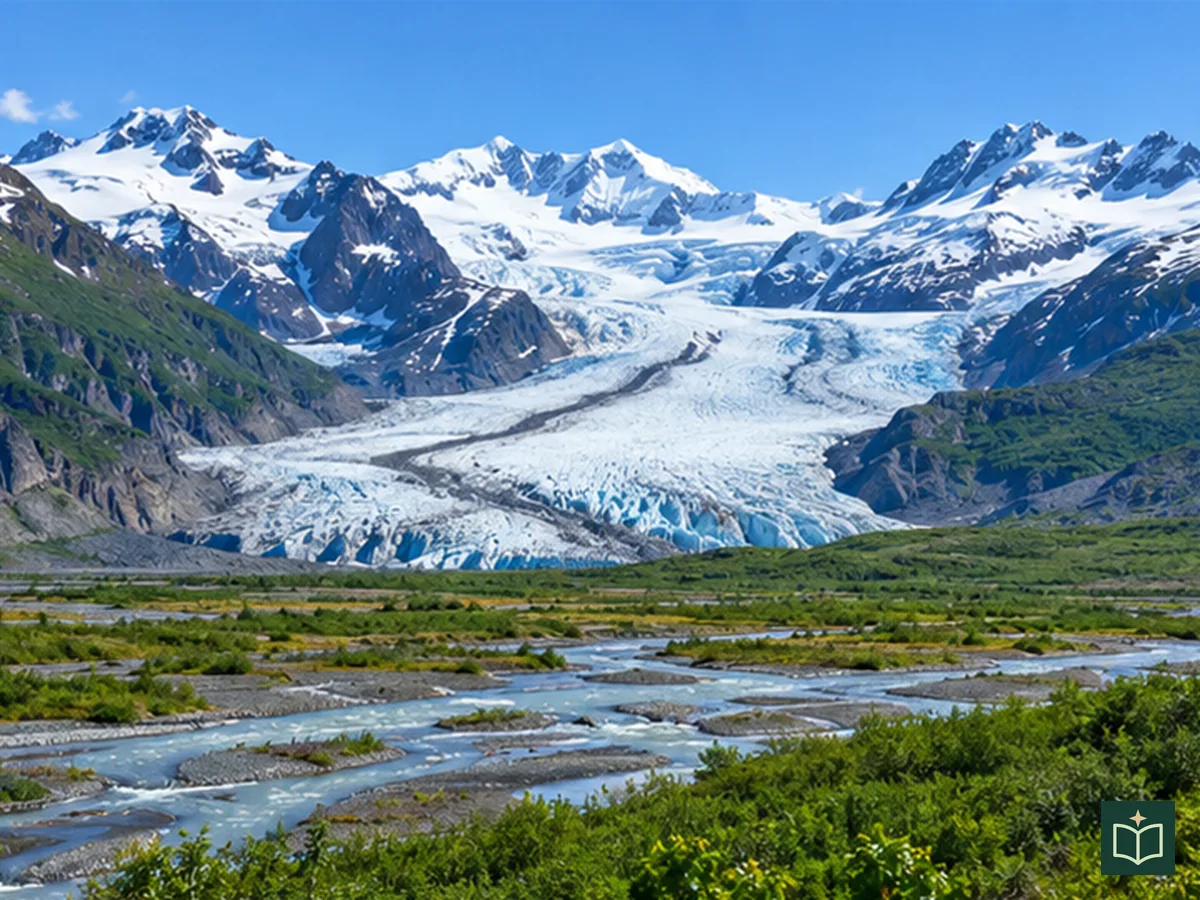
Wrangell–St Elias, in south-eastern Alaska, covers about 53,300 square kilometres, larger than Switzerland and around two-thirds of the size of the UAE. It contains nine of the sixteen highest peaks in the United States, including Mount Saint Elias, which rises to about 5,489 metres only a short distance from the sea. Huge glaciers flow from its icefields, among them the Malaspina, a piedmont glacier that spreads out across a coastal plain. The park also holds old copper mining towns such as Kennecott, abandoned in the 1930s. Only two gravel roads enter the park, so much of it can be reached only by small aircraft.
The Alaskan wilderness law of 1980
Most of the largest parks were created or enlarged by the Alaska National Interest Lands Conservation Act of 1980, which more than doubled the area of the national park system in a single stroke. Gates of the Arctic, north of the Arctic Circle in the Brooks Range, has no roads or established trails and is one of the least visited parks in the country. Kobuk Valley protects sand dunes in the Arctic and the migration routes of caribou. Lake Clark and Katmai, on and near the Alaska Peninsula, are known for active volcanoes, and Katmai’s brown bears gather each summer to catch salmon at Brooks Falls.
Denali and Katmai
Denali surrounds North America’s highest mountain, which rises to about 6,190 metres. The park is crossed by a single road, and private vehicles are restricted on most of it to protect wildlife and the wilderness character of the area. Katmai was established after a huge volcanic eruption in 1912 at Novarupta, the largest of the twentieth century, which buried a valley in ash and created the Valley of Ten Thousand Smokes, named for the steam vents that rose from the hot deposits for years afterwards. Grizzly bears, moose, caribou and wolves roam Denali’s valleys. Both parks have become important places for scientific research on glaciers, volcanoes and wildlife.
Beyond Alaska
Death Valley, on the border of California and Nevada, is the largest national park outside Alaska. It contains the lowest point in North America, about 86 metres below sea level, and holds the world’s highest accepted air temperature, along with salt flats, sand dunes and colourful canyons. Yellowstone, spread across Wyoming, Montana and Idaho, sits above a volcanic hotspot and contains more than half of the world’s geysers. Florida’s Everglades, the only subtropical wilderness of its kind in the United States, is a slow-moving river of grass and mangroves that shelters alligators, crocodiles and manatees. All three draw visitors from around the world, including many from the Gulf.
Bigger parks elsewhere
Large as they are, America’s parks are not the world’s biggest. Northeast Greenland National Park covers about 972,000 square kilometres, more than the ten parks in this table combined several times over, and it is mostly covered by the ice sheet. National parks elsewhere vary widely in purpose and rules. In the UAE, protected areas are smaller but important for the region’s wildlife, from the mangroves and seagrass of Abu Dhabi’s coast to the mountains of the east. The National Park Service model, which combines protection with public access, has influenced park systems in many countries, including across the Middle East.
Sources & further reading
- US National Park Service ↗
- NPS · Wrangell–St Elias National Park and Preserve ↗
- Britannica · National park ↗
Figures are rounded and widely published; check the linked organisations for the latest editions. These organisations do not endorse this website.