Measuring a giant
Measuring a very tall tree is harder than it sounds. From the ground, the top is hidden by foliage and simple angle measurements can easily be several metres out. Reliable heights come from climbers who lower a tape from the highest point to the base, or from laser rangefinders and airborne laser scanning, known as lidar, which maps forests in three dimensions. This ranking lists the tallest reliably measured living tree of each species, so the table shows ten different kinds of tree. Many coast redwoods are taller than the best trees of other species, but only the tallest of them, Hyperion, appears here.
Hyperion and the redwoods
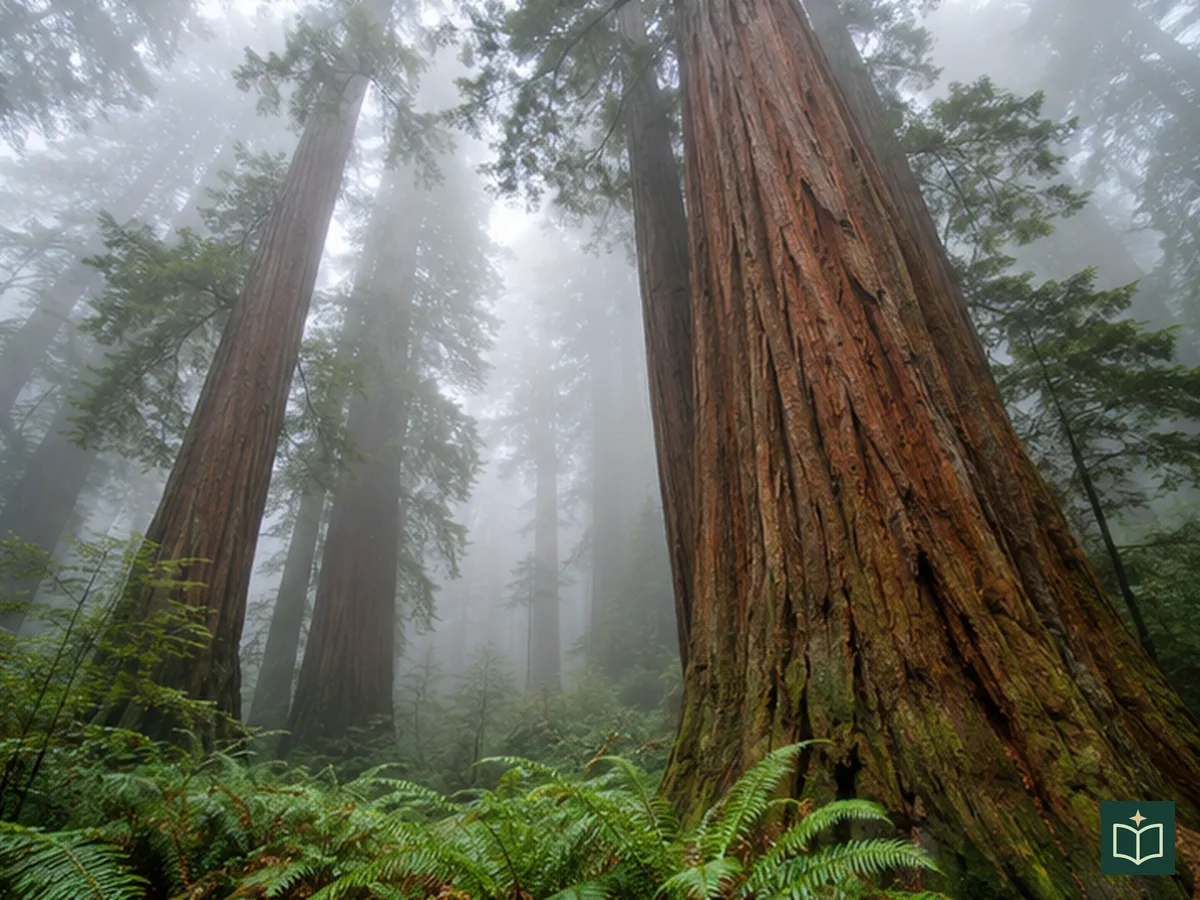
Hyperion was found in 2006 by two naturalists exploring a remote valley in Redwood National Park, California. It stands about 116 metres tall, roughly as high as a 35-storey building, and nearly six times the height of a mature date palm. Coast redwoods thrive in a narrow strip of the Pacific coast where summer fog supplies moisture and reduces water loss, allowing them to keep growing for centuries. Visits to Hyperion are banned because trampling damaged the soil around its roots, and park authorities warn of fines for anyone who leaves the trails to find it. Several other redwoods nearby exceed 113 metres.
New giants from Asia
Recent surveys have added tropical and Asian trees to the list. In 2019 researchers using lidar identified Menara, a yellow meranti in the Danum Valley of Sabah, Borneo, as the tallest known tropical tree; it was measured by a climber at just over 100 metres, though later measurements gave about 97.6 metres. In 2023 a team from Peking University measured a South Tibetan cypress of about 102.3 metres in the deep Yarlung Tsangpo canyon in Tibet, the tallest tree known in Asia. These finds suggest that more very tall trees may stand in remote valleys that have never been surveyed from the air.
Australia’s tall eucalypts
Australia’s mountain ash was long regarded as the world’s tallest flowering plant. The tree known as Centurion, in Tasmania, was once measured at about 100.5 metres but lost part of its crown, and now stands about 96 metres. Tasmania also holds the tallest known southern blue gum and manna gum, both above 91 metres. Nineteenth-century reports of even taller eucalypts in Victoria were never confirmed, and many of the largest trees were felled for timber before they could be measured. Eucalypt forests depend on fire to regenerate, but very intense bushfires can kill even the tallest trees. Undisturbed, a mountain ash can live for around four hundred years.
Why trees stop growing
A tree has no pump. Water evaporates from its leaves, and the resulting tension pulls a continuous column of water up from the roots through narrow tubes in the wood. The taller the tree, the stronger the pull needed to overcome gravity and friction, and the greater the risk that air bubbles will break the column. Studies of the tallest redwoods found that their highest leaves are small and thick and live under constant water stress. Researchers estimated that, under ideal conditions, coast redwoods could reach roughly 122 to 130 metres before water transport fails, so Hyperion is not far from the physical limit.
Tall trees and the desert
In dry places, the opposite strategy wins. The ghaf, the UAE’s national tree, rarely grows taller than about 15 metres but sends roots deep into the ground in search of water. Desert trees invest in roots rather than height, because the competition is for water, not for light. In tall forests, by contrast, trees race upwards to reach the sunlight above the canopy. Tall forests also store large amounts of carbon in their trunks, which is one reason scientists study them. Old coast redwood forests hold some of the highest amounts of carbon per hectare of any forest type on Earth.
Sources & further reading
Figures are rounded and widely published; check the linked organisations for the latest editions. These organisations do not endorse this website.