Where the plant came from
Coffea arabica, the species behind most fine coffee, is native to the highland forests of south-western Ethiopia. A popular legend tells of a goat herder named Kaldi who noticed his animals became lively after eating coffee berries, but the story appears only in much later writings and cannot be verified. What historians can document is that the plant was cultivated across the Red Sea in Yemen, where terraced mountain slopes provided suitable conditions. It was there that the roasted seed was turned into a drink with a recognisable history of its own, written about by contemporary scholars. The leap from wild plant to daily drink happened in Arabia.
Sufi nights in Yemen
The earliest reliable accounts link coffee drinking to Sufi communities in Yemen in the fifteenth century. Members of these religious orders drank it to stay alert during night-time prayers and devotions. The drink was called qahwa, a word that may earlier have referred to wine, and from it come the Turkish kahve, the Italian caffè and the English coffee. From Yemen, the habit spread to Mecca and Medina, carried by pilgrims and scholars, and to Cairo, where students and merchants adopted it. By the early sixteenth century, coffee was part of daily life in several major cities of the Islamic world.
The coffeehouse arrives
Coffee created a new kind of public space. Coffeehouses served the drink to customers who came to talk, play games, listen to storytellers and hear news. In Istanbul, coffeehouses were established in the mid-sixteenth century and became popular quickly. Because they gathered people outside the home and the mosque, some authorities viewed them with suspicion. There were attempts to ban coffee, including a well-known prohibition in Mecca in 1511, but bans rarely lasted long. Coffee’s spread was driven by its stimulating effect, its role in hospitality and the social life that formed around it. The coffeehouse soon became an institution.
Mocha and the world market
For more than a century, Yemen dominated world supply, and the Red Sea port of al-Makha, known in English as Mocha, gave its name to a style of coffee. Merchants from Cairo, India and later Europe bought beans there. European travellers encountered coffee in Ottoman lands, and coffeehouses opened in Venice in the seventeenth century and in London in 1652. Yemen’s near-monopoly ended when the Dutch began cultivating coffee in Java in the late seventeenth century, followed by French plantations in the Caribbean and later large-scale production in Brazil, often relying on enslaved labour. Coffee had become a colonial crop.
Arabic coffee today
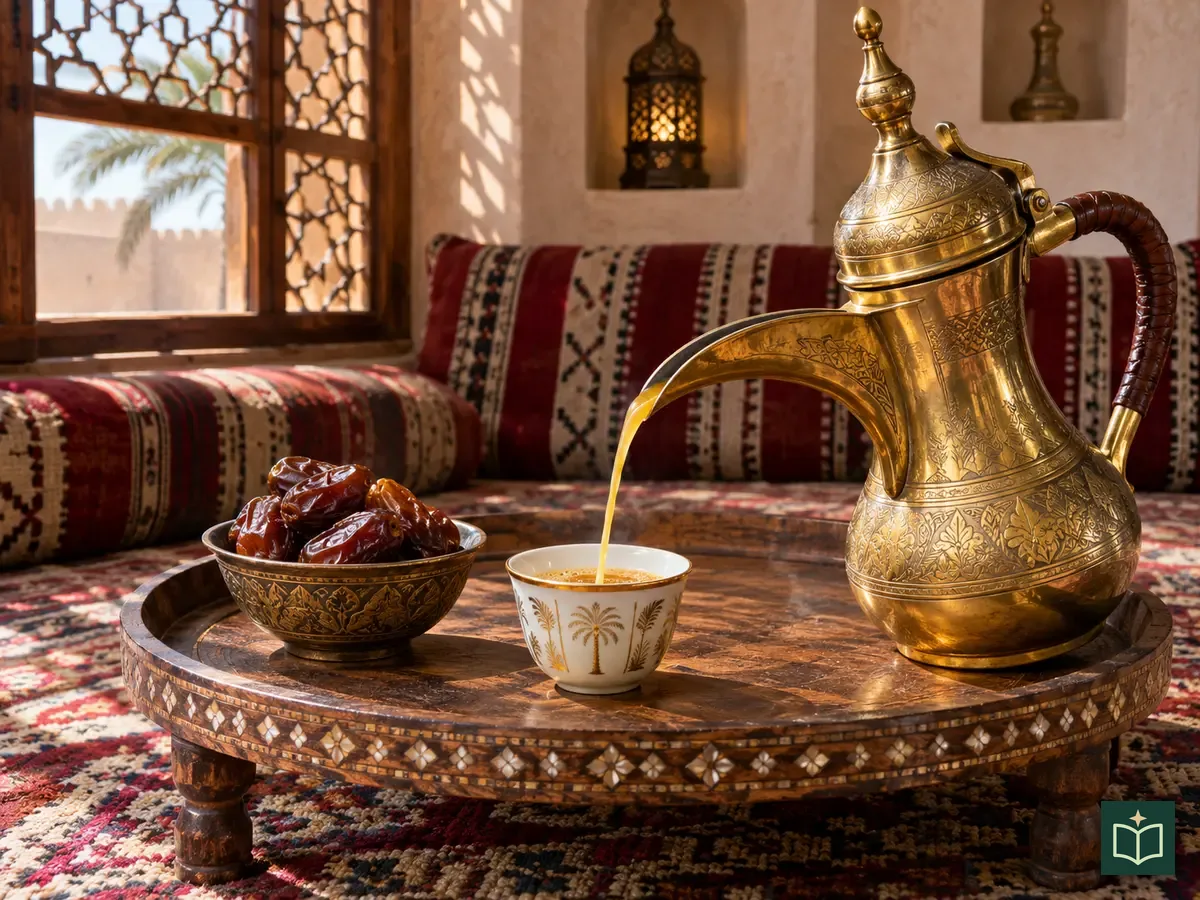
In the Gulf, coffee is above all a gesture of hospitality. Arabic coffee, lightly roasted and often flavoured with cardamom, is poured from a dallah into small cups and served to guests, usually alongside dates. Customs govern who is served first and how a guest signals they have had enough, traditionally by gently shaking the cup. In 2015, UNESCO added Arabic coffee as a symbol of generosity to its list of intangible cultural heritage, in a joint nomination by the UAE, Saudi Arabia, Oman and Qatar. The ritual links modern majlis gatherings to the coffee culture of earlier centuries. Each small cup carries centuries of custom.
Myths and why it matters
Several popular stories about coffee are best treated as legend, including the dancing goats and some dramatic tales of smuggled seedlings. The documented history is remarkable enough. A plant from one region of Africa became, through Arabian cultivation and Islamic trade networks, one of the world’s most traded agricultural products. It reshaped social life by creating spaces for conversation and commerce, and it later became bound up with colonial plantations and their human costs. When you drink a cup today, you are taking part in a habit first developed in the mountains and cities of Yemen more than five centuries ago.
Sources & further reading
Figures are rounded and widely published; check the linked organisations for the latest editions. These organisations do not endorse this website.