The scholar from Khwarazm
Muhammad ibn Musa al-Khwarizmi lived from roughly 780 to 850 CE. His name suggests family origins in Khwarazm, a region south of the Aral Sea in Central Asia, in today’s Uzbekistan and Turkmenistan. He worked in Baghdad during the reign of the Abbasid caliph al-Ma’mun, a period when the city was one of the world’s great centres of learning and scholars were supported to study mathematics, astronomy and geography. Al-Khwarizmi wrote on all three. He produced astronomical tables, a geography that listed coordinates of cities, and a treatise on Indian numerals. His most influential work, however, was a book about equations that shaped mathematics for centuries.
The book that named a subject
Around 820 CE, al-Khwarizmi wrote al-Kitab al-mukhtasar fi hisab al-jabr wa’l-muqabala, often translated as The Compendious Book on Calculation by Restoring and Balancing. The word al-jabr, meaning restoring or reunion, became algebra in European languages. The book did not use symbols like x or y. Everything, including the unknown quantity, called the root or thing, was written out in words. Al-Khwarizmi explained that his aim was practical: he wanted to provide methods people needed for inheritance, legal cases, trade, surveying and the digging of canals. That practical focus helps explain why the book became so widely copied and taught. It was a manual as much as a treatise.
How restoring and balancing work
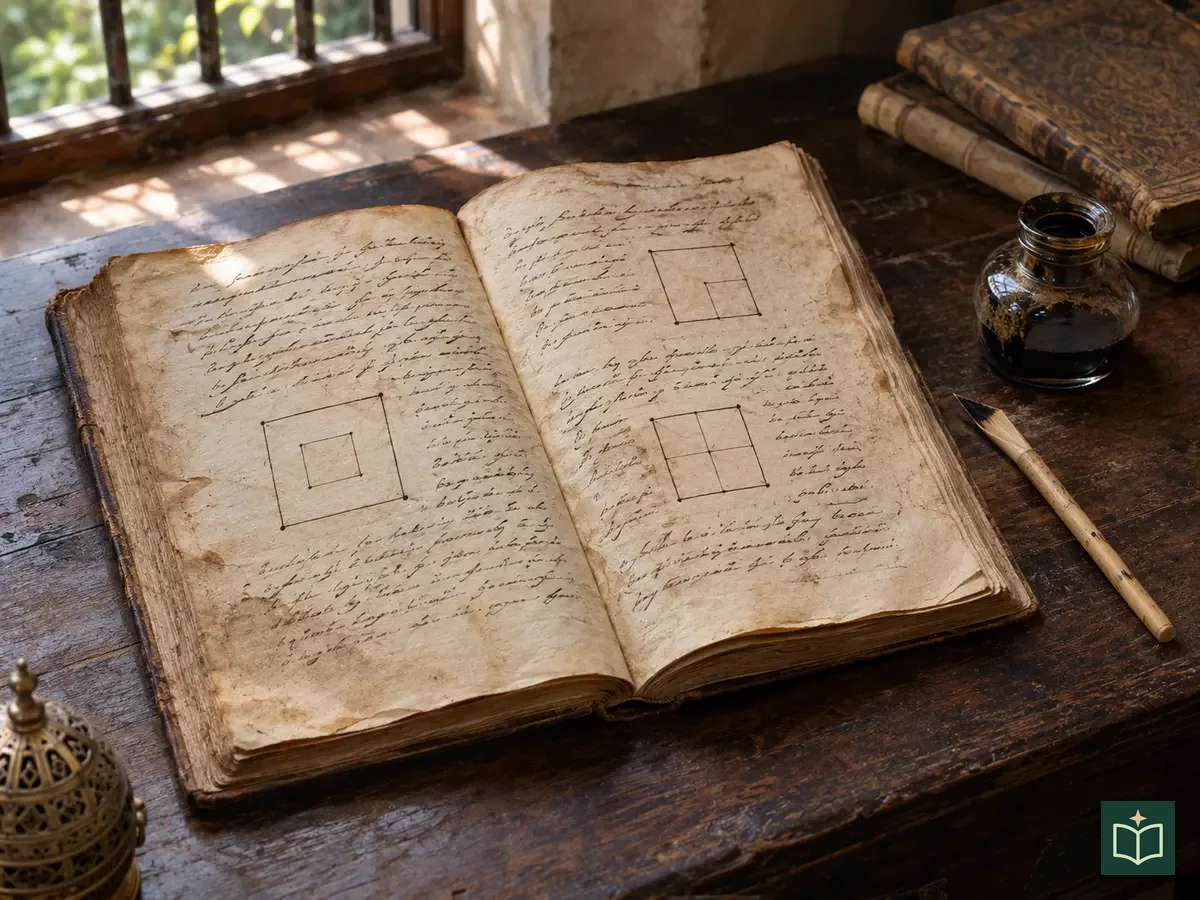
The two operations in the title are still how students solve equations. Restoring, al-jabr, means removing a subtracted quantity from one side by adding it to both sides. Balancing, al-muqabala, means cancelling equal quantities that appear on both sides. With these moves, al-Khwarizmi showed that any linear or quadratic equation could be reduced to one of six standard types, such as squares equal to roots, or squares and roots equal to numbers. For each type he gave a step-by-step procedure, and for quadratics he justified it with a geometric picture, completing a square drawn on the page to show why the method works.
From his name to algorithm
Al-Khwarizmi’s separate work on arithmetic with Indian numerals reached Europe in Latin translation, where the opening words read Dixit Algorizmi, meaning Algorizmi said. His name became attached to the new method of calculating with written digits, known as algorism, and eventually to the modern word algorithm, meaning any precise step-by-step procedure. His algebra was translated into Latin in the twelfth century, including by Robert of Chester in 1145. Through these translations, European scholars learned both the decimal place-value system and systematic methods for solving equations, which became foundations for later mathematics, science and engineering. Few scholars have left such a lasting mark on everyday vocabulary.
What he did not do
It is sometimes said that al-Khwarizmi invented algebra from nothing. That overstates the case. Babylonian scribes solved quadratic problems thousands of years earlier, Greek mathematicians such as Diophantus worked on equations, and Indian mathematicians including Brahmagupta developed rules for unknowns and zero. Al-Khwarizmi’s achievement was to organise these ideas into a general, teachable system, treating equations as objects of study in their own right rather than as isolated puzzles. He also did not use negative numbers as solutions. Later mathematicians in the Islamic world, such as Abu Kamil and Omar Khayyam, extended his work considerably, including on cubic equations. He was a systematiser of genius.
Why it matters today
Every time software sorts a list, routes a delivery or recommends a film, it runs an algorithm, a word that carries a ninth-century Baghdad scholar’s name. Algebra itself underpins physics, economics, engineering and computer science. Al-Khwarizmi’s story also shows how knowledge builds across cultures: he drew on Indian, Greek and Mesopotamian traditions, wrote in Arabic, and was read in Latin by Europeans who carried his methods forward. For students in the Gulf and beyond, his name is a reminder that a large part of the mathematics they learn was shaped in the Arabic-speaking world, during a period of open exchange between languages and traditions.
Sources & further reading
Figures are rounded and widely published; check the linked organisations for the latest editions. These organisations do not endorse this website.