Forests in the clouds
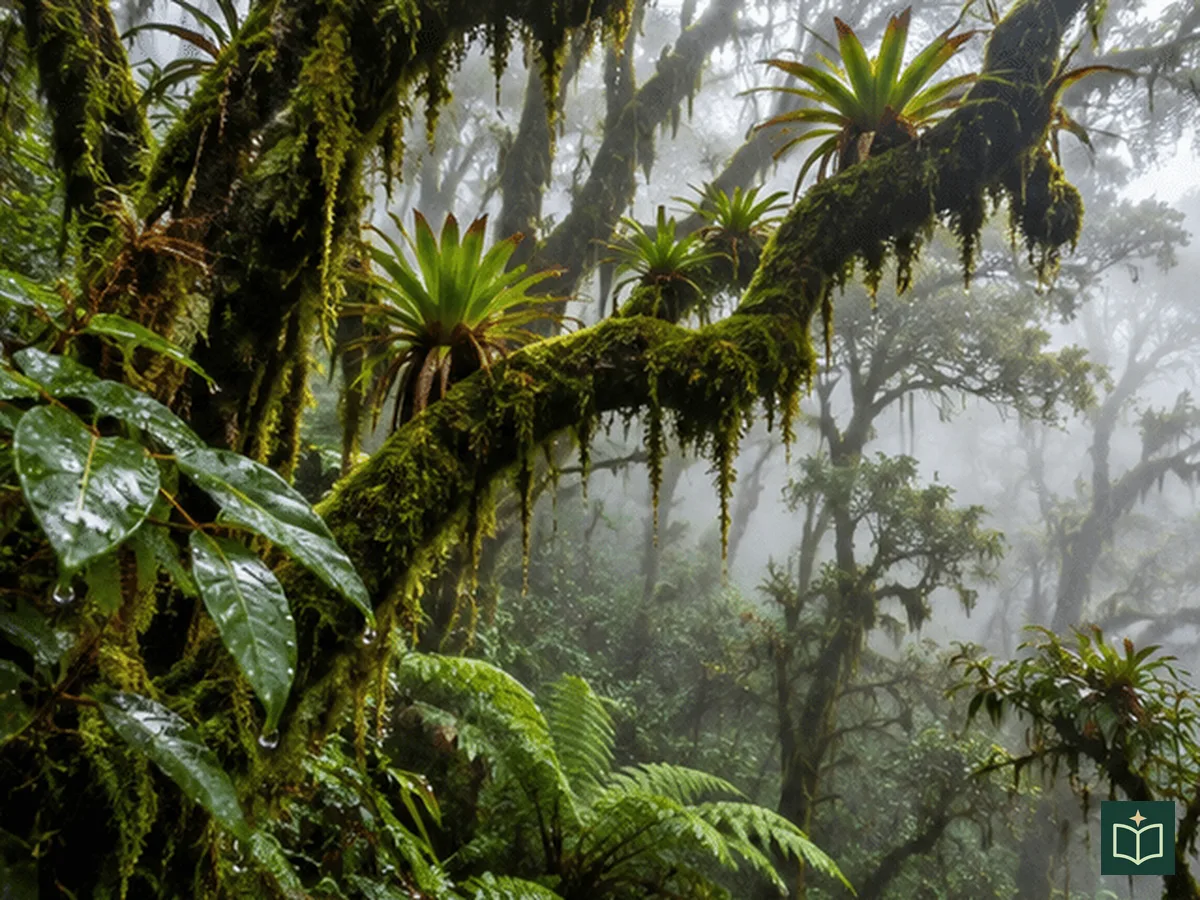
On many tropical and subtropical mountains there is a band, often somewhere between about 1,000 and 3,000 metres, where cloud settles against the slopes for much of the year. The forest growing there looks unlike lowland jungle. Trees are often shorter and gnarled, their trunks and branches buried under mosses, ferns, orchids and bromeliads. Everything drips. These are cloud forests, and their defining feature is that they are bathed in low cloud or fog so often that the mist itself becomes a major source of water. They are found in the Andes, Central America, East Africa, Southeast Asia and on islands such as the Canaries and Hawaii.
How a forest combs the air
Cloud is made of droplets too small to fall as rain. They drift with the wind until they hit something. In a cloud forest, that something is a dense mesh of leaves, needles, mosses and hanging epiphytes. Droplets collide with these surfaces, merge into larger drops and drip to the ground or run down trunks. Scientists call this fog drip or horizontal precipitation, and an ordinary rain gauge in a clearing misses most of it. Studies on exposed ridges have found that fog can add a substantial fraction on top of measured rainfall, and in drier seasons it may be the main source of water reaching the soil.
Water towers and biodiversity
Because they capture extra water and lose little to evaporation in cool, cloudy conditions, cloud forests act as natural water towers. Mosses and epiphytes soak up water like sponges and release it slowly, keeping streams flowing through dry spells. Many towns and farms downstream depend on that steady supply. The constant moisture and isolated mountain habitats also produce remarkable biodiversity, with many species found on a single range and nowhere else. Monteverde in Costa Rica is famous for orchids, hummingbirds and the resplendent quetzal. In the Andes, the yungas cloud forests on the eastern slopes harbour many endemic frogs, birds and plants.
Dhofar’s monsoon woodland
Arabia has its own fog-fed forest. Each summer, from about June to September, the south-west monsoon carries moist air across the cool, upwelling waters off southern Oman. The air chills, forms a thick layer of low cloud and drizzle, and is pushed against the escarpment of the Dhofar mountains behind Salalah. This season is called the khareef. On the seaward slopes, where the cloud lingers, a dense deciduous woodland grows, dominated by trees found almost nowhere else. Research there has shown that trees intercept large amounts of fog water. Just over the crest, beyond the cloud, the land turns dry, the habitat where frankincense trees grow.
Fragile by nature
Cloud forests depend on cloud forming at the right height, and that makes them unusually sensitive. Clearing forest on lower slopes can warm and dry the air moving uphill, lifting the cloud base. Studies have linked rising cloud levels to declines in amphibians in Central America, though disease played a major role as well. Climate change may push the cloud band higher on many mountains, squeezing the habitat towards summits where there is less room. Clearing for pasture, crops and roads has already removed large areas. Because these forests are small and scattered, losing even one patch can wipe out species found only there.
Learning from the forest
People have long copied the cloud forest’s trick. In Chile’s Atacama, Peru and Morocco, fine mesh nets strung on hillsides catch fog and supply water for villages and small farms. Oman has experimented with fog collectors in Dhofar during the khareef. In the Canary Islands, the laurel forests of La Gomera, protected in Garajonay National Park, are a reminder of the fog-fed forests that once covered much of southern Europe millions of years ago. Protecting cloud forests protects water supplies as well as wildlife, which is why some conservation programmes, notably in Latin America, pay landowners to keep these slopes forested.
Sources & further reading
- UNEP-WCMC · Cloud forest agenda ↗
- Britannica · Cloud forest ↗
- UNESCO World Heritage · Garajonay National Park ↗
Figures are rounded and widely published; check the linked organisations for the latest editions. These organisations do not endorse this website.