Four families of peaks
Mountains look endlessly varied, but geologists group most of them into four families according to the force that raised them. Fold mountains form when the crust is squeezed and rock layers crumple. Fault-block mountains form when the crust is stretched and breaks into blocks, some lifted and some dropped. Volcanic mountains are built from lava and ash piled up around a vent. Dome mountains form when molten rock or other forces push the crust upwards into a broad bulge without breaking through. Many real ranges combine more than one process, but the classification is a powerful first step in reading any mountainous landscape.
Fold mountains
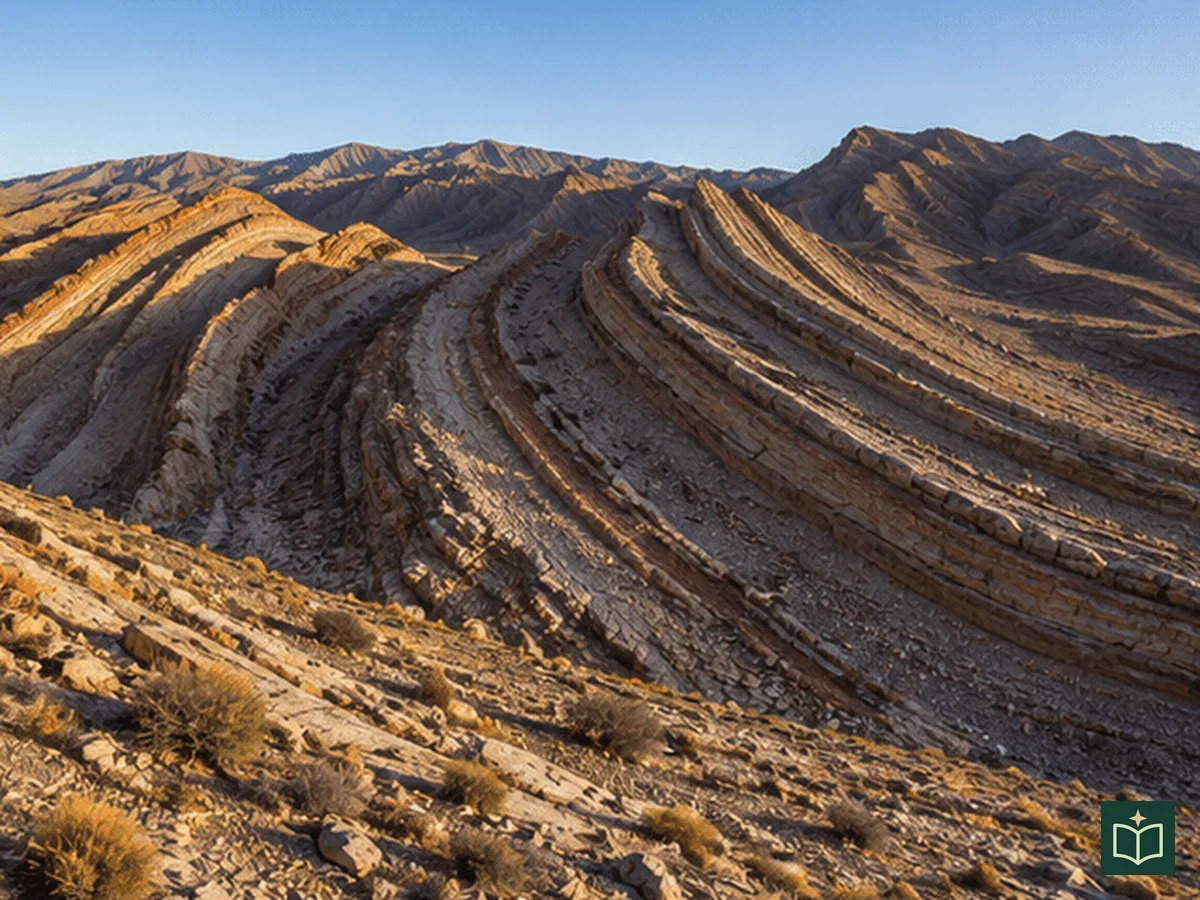
Fold mountains are the giants of the planet. They form where tectonic plates converge and layers of sedimentary rock, often laid down on ancient sea floors, are compressed like a rug pushed against a wall. The layers bend into upfolds called anticlines and downfolds called synclines, and slabs of rock may be stacked on top of each other along thrust faults. The Himalaya, the Alps, the Andes and the Rockies are all fold-and-thrust belts. Closer to the Gulf, Iran’s Zagros Mountains are a textbook example: seen from space, their long parallel ridges look like the folds of a crumpled cloth, still being squeezed as Arabia pushes north-east into Eurasia.
Fault-block mountains
Where the crust is pulled apart instead of squeezed, it breaks along faults. Blocks of rock tilt or drop, leaving others standing high. The raised blocks, called horsts, form mountains, and the dropped blocks, called grabens, form valleys. Fault-block ranges often have one steep face, the exposed fault scarp, and one gentler slope. California’s Sierra Nevada is a giant tilted block with a sheer eastern front. Across Nevada and Utah, the Basin and Range region alternates dozens of narrow ranges and flat valleys, a pattern produced as the crust stretched. The Teton Range in Wyoming rises abruptly from its valley floor in the same way, along a fault that is still active.
Volcanic mountains
Volcanic mountains are built rather than raised. Each eruption adds lava, ash or both, and over thousands of years a cone or shield grows. Steep, symmetrical stratovolcanoes such as Mount Fuji and Kilimanjaro form from alternating layers of sticky lava and ash. Broad shield volcanoes, such as those of Hawaii, form from runny lava that spreads widely. Mauna Kea rises about 4,200 metres above sea level but roughly 10,000 metres from its base on the sea floor, making it taller than Everest when measured that way. Most volcanoes sit at plate boundaries, but hotspots such as Hawaii build chains of volcanoes in the middle of plates.
Dome mountains
Dome mountains form when the crust is pushed upwards in a broad bulge. Often the cause is magma that rises but cools underground, lifting the overlying layers like a blister. Erosion later strips away the softer outer rocks, exposing a hard core surrounded by rings of tilted layers. The Black Hills of South Dakota are a classic eroded dome, with a granite core ringed by ridges of sedimentary rock. Smaller domes called laccoliths, studied in Utah’s Henry Mountains in the nineteenth century, helped geologists understand the process. Salt can also push up domes, and in the Gulf rising salt has lifted several islands above the sea.
Why classification helps
Recognising the type of mountain tells you a great deal at a glance. Fold mountains point to colliding plates and often hold fossils from ancient seas high on their summits. Fault-block ranges signal stretching crust and the risk of earthquakes along their fronts. Volcanic mountains bring fertile soils and the hazard of eruptions. Domes reveal the hidden work of magma or salt beneath the surface. The same scheme also explains why mountains are not permanent. Once uplift stops, erosion wins, and over tens of millions of years even the highest ranges, the Himalaya included, are worn down to rolling hills and plains.
Sources & further reading
- USGS · Mountains and plate tectonics ↗
- Britannica · Mountain ↗
- National Park Service · Mountain building ↗
Figures are rounded and widely published; check the linked organisations for the latest editions. These organisations do not endorse this website.