Ground that behaves like a fluid
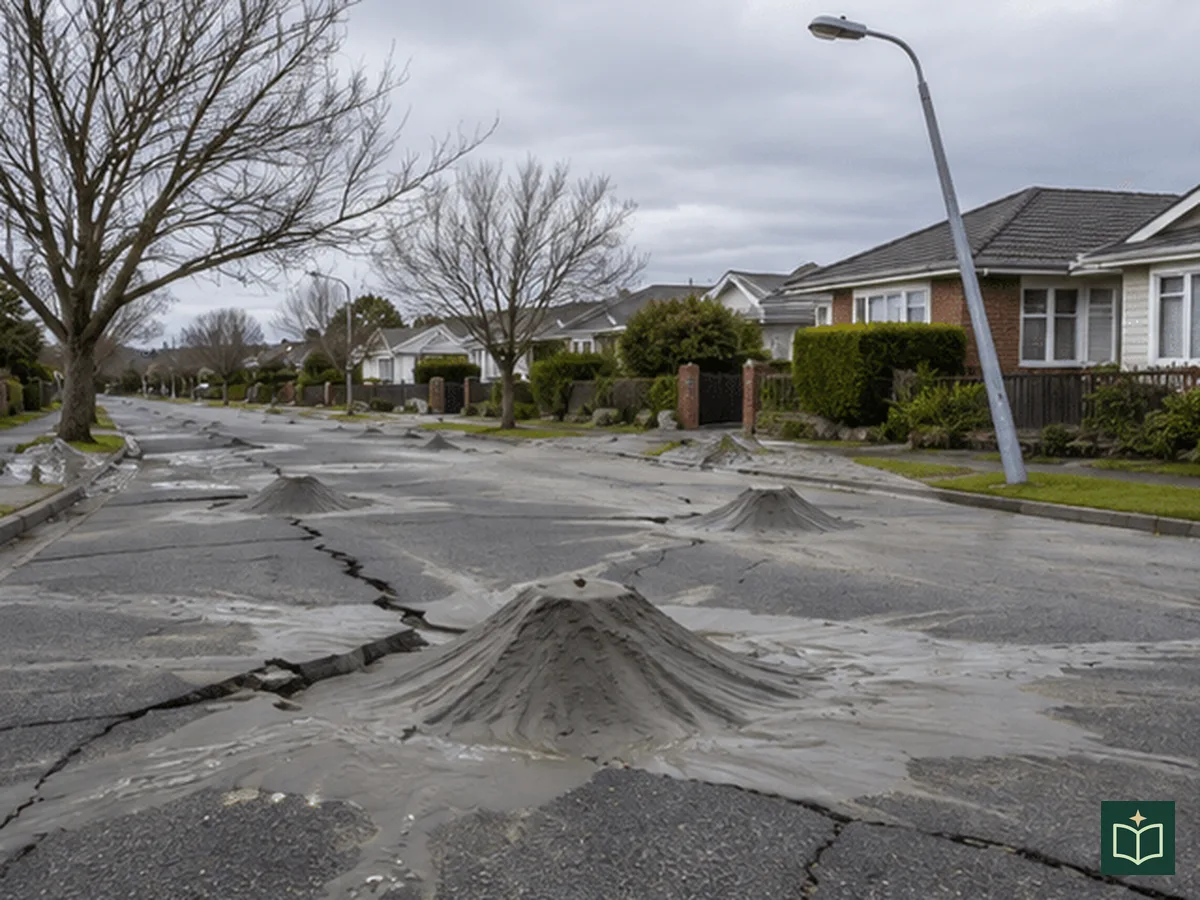
Most earthquake damage comes from shaking, but some of the most dramatic comes from the ground itself giving way. Soil liquefaction happens when loose, sandy soil saturated with water temporarily loses its strength and behaves like a thick liquid. Buildings that were standing firm moments earlier sink, tilt or topple without breaking apart. Buried tanks and pipes float to the surface. Sand and water spurt from cracks in fountains called sand boils, and the ground can slide sideways on even gentle slopes. Once the shaking stops, the water drains and the soil becomes solid again, often leaving buildings stuck at alarming angles.
How grains lose their grip
Sand is strong because its grains press against one another, and friction at those contacts carries the weight above. The water filling the gaps between grains takes no share of that load in normal conditions. Strong shaking changes this. Loose grains try to rearrange into a tighter packing, squeezing the pore spaces. If the water cannot drain away quickly, its pressure rises. As water pressure climbs, it pushes the grains apart and the contact forces between them fall. When water pressure equals the weight of the soil above, the grains are effectively floating, friction vanishes and the soil has almost no strength.
A worked example
Engineers describe this with the idea of effective stress: the weight carried by the grains is the total weight of soil above, minus the water pressure. Take sand five metres down below the water table. Saturated sand weighs roughly 20 kilonewtons per cubic metre, so the total stress is about 100 kilopascals. The water pressure at that depth is about 49 kilopascals, leaving roughly 51 kilopascals carried by grain contacts. If shaking raises the water pressure by about 51 kilopascals, effective stress drops to zero and the sand liquefies. Loose, young, uniform sand with a shallow water table is the most vulnerable combination.
Lessons from Niigata to Christchurch
Liquefaction became a major field of study after 1964. That year, an earthquake struck Niigata in Japan, and apartment blocks built on river sand tilted over almost intact, one by about 80 degrees. In 1989 the Loma Prieta earthquake caused severe damage in San Francisco’s Marina District, partly built on fill that included rubble from the 1906 disaster. In 1995 the Kobe earthquake liquefied the city’s artificial port islands, crippling one of the world’s busiest ports. In 2010 and 2011, earthquakes in Christchurch, New Zealand, liquefied large areas of the city, and thousands of homes in the worst-hit zones were eventually abandoned.
Why reclaimed land is vulnerable
Reclaimed land is often exactly the type of ground that liquefies: loose sand pumped or dumped into the sea and saturated with water from the start. Many coastal cities, from Tokyo Bay to Hong Kong, are partly built on it. The Gulf has some of the world’s largest reclamation projects, including Dubai’s palm-shaped islands and new districts in Bahrain, Qatar and Abu Dhabi. The UAE itself sits on relatively stable ground, but large distant earthquakes are occasionally felt there, and building codes treat seismic design seriously. For that reason, the sand under major reclamation projects is usually compacted before construction begins.
Engineering the ground
Engineers have several ways to make vulnerable ground safer. Vibro-compaction uses large vibrating probes to shake loose sand into a denser arrangement before buildings go up. Stone columns drilled into the soil both stiffen it and give water a fast escape route. Deep piles carry a building’s weight past weak layers to firmer ground below. Drains can lower the water table, and grouting can bind grains together. Site investigation comes first: tests that push probes into the ground reveal how loose the sand is. Liquefaction cannot be stopped from happening in nature, but well-prepared ground can turn a potential collapse into minor settlement.
Sources & further reading
Figures are rounded and widely published; check the linked organisations for the latest editions. These organisations do not endorse this website.