One chip that is really several
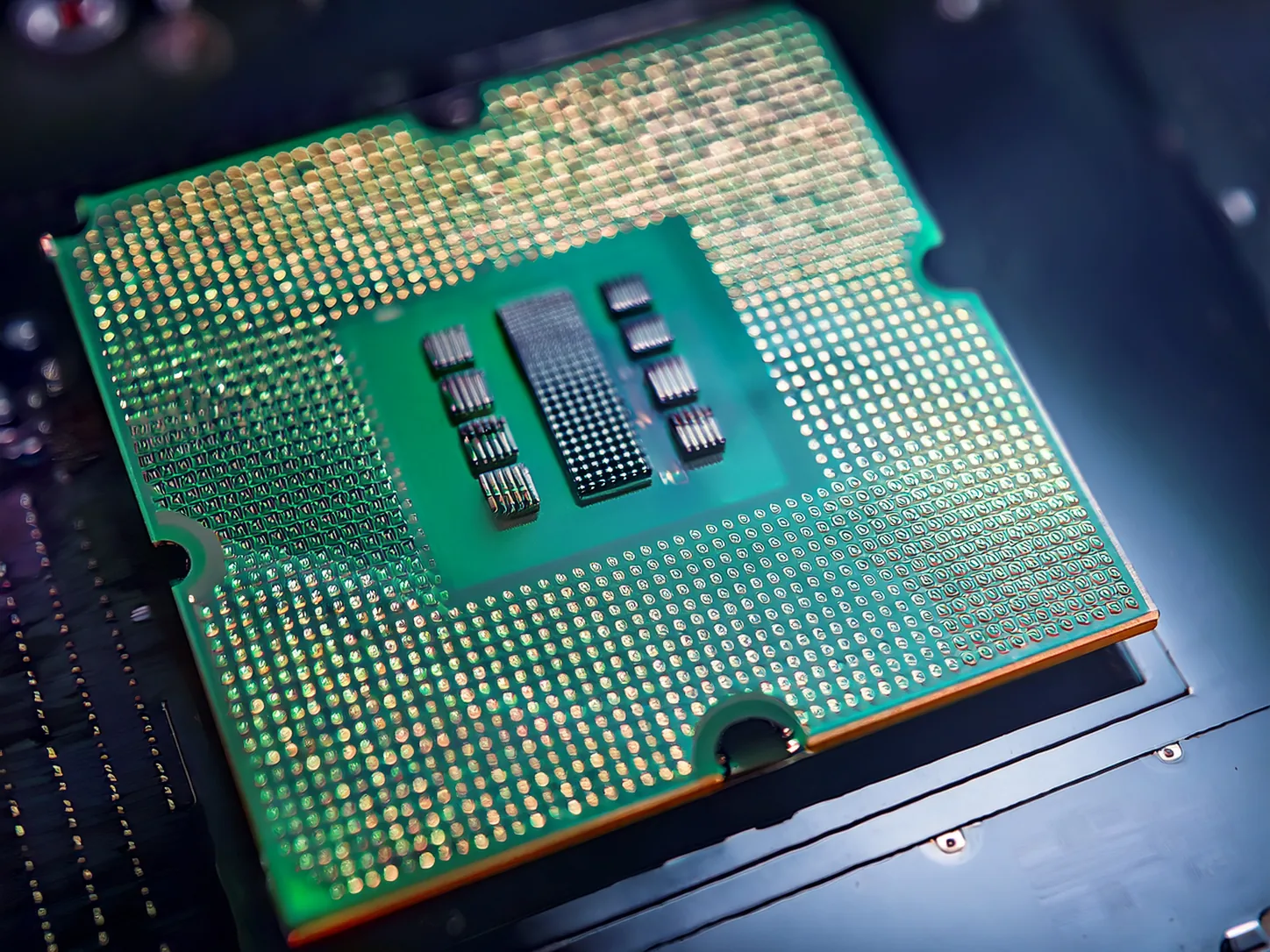
For decades, a processor meant a single piece of silicon, called a die, cut from a wafer. Many of today's most powerful processors are different. Lift the lid and you find several dies sitting side by side or stacked, joined so closely that software sees one chip. These pieces are called chiplets. AMD made the approach mainstream with server and desktop processors from 2019, combining several compute dies with a separate input-output die. Intel, Apple, Nvidia and others now use versions of it, especially for data-centre and AI accelerators. The idea is not to make computing different, but to make large chips economical to manufacture.
The arithmetic of defects
Every wafer has a scattering of tiny defects, such as specks of contamination or flaws in a layer. A die containing a defect in a critical spot may not work. The larger the die, the more likely it is to catch one. A widely used simple model gives the share of good dies as an exponential that falls with die area times defect density. Take an illustrative defect density of 0.1 per square centimetre. An 8-square-centimetre die would then come out good only about 45 per cent of the time. Split the same design into four 2-square-centimetre chiplets, and each has about an 82 per cent chance of being good.
Why that saves money
With the large single die, more than half of the expensive silicon would be thrown away or sold as cut-down products. With chiplets, a defect ruins only one small piece, and good chiplets can be tested first and combined in any working set. This known-good-die approach means far less waste. There is also a physical ceiling. Lithography machines expose only an area of about 26 by 33 millimetres, roughly 858 square millimetres, at a time, so no conventional die can be bigger. The largest AI processors already reach that limit. To go further, chipmakers must join several dies together, and chiplets turn that necessity into a design strategy.
Mixing and matching
Chiplets also allow each part to be made on the most suitable process. The cutting-edge processes needed for fast computing cores are extremely expensive, while circuits that handle input and output, such as memory and connections to the rest of the computer, gain little from them. Building those circuits on an older, cheaper process saves money without hurting performance. Companies can also reuse proven chiplets across products, combining two, four or eight compute dies to create a whole range of processors from the same parts. High-bandwidth memory, stacked in towers beside AI processors, is another form of the same thinking: specialised dies placed as close together as possible.
Packaging becomes critical
The catch is communication. Signals crossing between dies use more energy and take longer than signals within one die. Advanced packaging tackles this with very fine, dense connections. Some designs place dies on a slice of silicon called an interposer, threaded with thousands of tiny wires; others embed small silicon bridges or stack dies directly on top of each other. Packaging, once a cheap final step, has become a strategic technology, and companies are investing heavily in it. An industry standard called UCIe, launched in 2022, aims to let chiplets from different manufacturers connect, much as standard sockets let parts from different makers work together on a circuit board.
Limits and trade-offs
Chiplets are not free. Joining dies adds packaging cost, design complexity and some power overhead, and heat from tightly stacked dies is hard to remove. For small chips, such as those in many phones, a single die remains simpler and more efficient. A common misconception is that chiplets are a fallback for companies that cannot make big chips. In practice they are a deliberate trade, chosen when a design is large enough that yield, cost and flexibility outweigh the overhead. As shrinking transistors becomes slower and costlier, gains increasingly come from how chips are assembled rather than only from how small their features are. Chiplets sit at the centre of that shift.
Sources & further reading
Figures are rounded and widely published; check the linked organisations for the latest editions. These organisations do not endorse this website.