Cement and concrete
Cement is the grey powder that binds sand and gravel into concrete, the most used manufactured material on Earth. Concrete itself is mostly aggregate and water; cement makes up only about a tenth to a seventh of its weight, yet it accounts for most of concrete’s carbon footprint. The world produces around four billion tonnes of cement a year, with China making about half. Demand follows construction, so it is highest in fast-growing economies building housing, roads, ports and towers. Because concrete is cheap, strong, fire-resistant and made from widely available ingredients, there is no simple substitute for it at that scale, which makes cement one of the hardest industries to decarbonise.
Inside the kiln
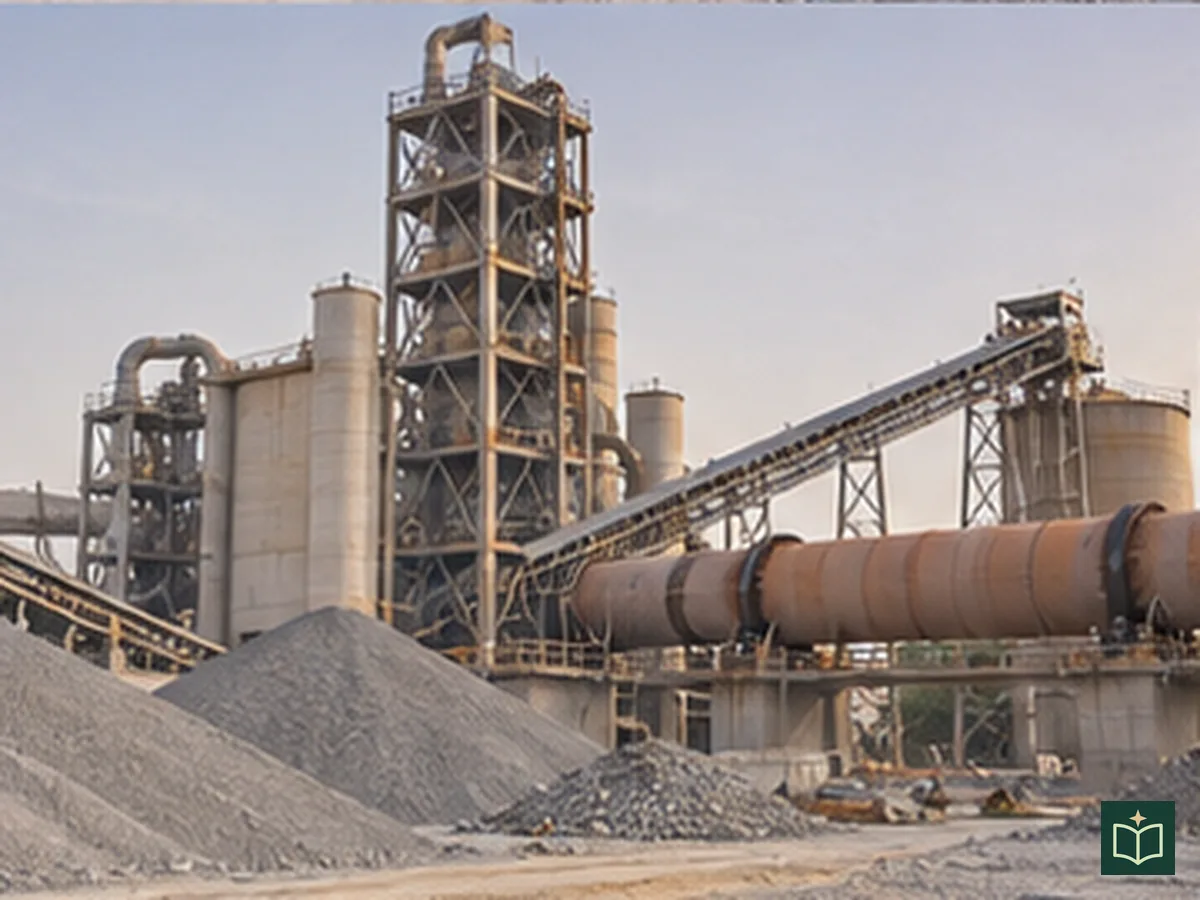
A modern cement plant is dominated by a preheater tower and a long, slightly inclined steel tube, the rotary kiln, which turns slowly as material moves through it. The raw mix, mostly limestone with clay or shale supplying silica, alumina and iron, is ground into powder and fed through the tower, where hot gases rising from the kiln warm it. In the kiln, a flame at the lower end heats the material to about 1,450°C, where it partly melts and fuses into grey nodules called clinker. The clinker is cooled rapidly, then ground with a few per cent of gypsum to control setting time. A modern dry kiln needs roughly three to four gigajoules of heat per tonne of clinker.
Carbon from the rock
The key reaction is calcination. Limestone is calcium carbonate, and when heated above about 900°C it splits into calcium oxide, or lime, and carbon dioxide. That carbon dioxide comes from the stone itself, not the fuel. Simple chemistry sets the scale: clinker is about 65 per cent lime by weight, and each tonne of lime releases its share of carbon dioxide, giving roughly half a tonne of process carbon dioxide per tonne of clinker. Burning fuel to reach kiln temperatures adds more, and electricity for grinding adds a little. Overall, around 60 per cent of a typical plant’s direct emissions come from calcination, approaching two-thirds in efficient plants, with most of the rest from fuel.
Why it is hard to cut
The heat part can, in principle, be cleaned up with alternative fuels, biomass, waste or, in future, electric or hydrogen heating, though reaching 1,450°C with these is challenging. The process emissions are harder, because they are fixed by chemistry: as long as clinker is made from limestone, carbon dioxide will be released. Plants are also long-lived, often operating for forty years or more, and cement is a low-value, heavy product that is usually made close to where it is used. Margins are thin, so costly new technology is difficult to adopt without regulation, carbon pricing or buyers willing to pay a premium for lower-carbon concrete in public and private projects.
Routes to lower-carbon cement
Several routes are being pursued together. The quickest is using less clinker per tonne of cement by blending in other materials, such as slag from steelmaking, fly ash from coal plants, ground limestone, and calcined clay, which is widely available. Kilns can switch to lower-carbon fuels and recover waste heat. Carbon capture is seen as essential for the remaining process emissions, and several plants in Europe and elsewhere have begun large capture projects. New cement chemistries that need less limestone are in development. Finally, designers can use less cement altogether through better mix design, efficient structural forms and longer-lasting buildings. Concrete also reabsorbs a modest share of carbon dioxide over decades as it slowly carbonates.
A Gulf perspective
The Gulf builds with large volumes of concrete, and several Gulf countries have substantial domestic cement industries supplied by local limestone. The region’s hot climate also shapes concrete practice, since high temperatures speed up setting and require careful curing. Steel slag from regional mills and other industrial by-products can serve as clinker substitutes, and some producers have begun offering lower-carbon cement grades. Carbon capture, already operating in the region for other industries, could in time be applied to cement plants as well. Because cement is used everywhere and traded relatively little, each country largely decides its own path, making national building codes and public procurement powerful tools for reducing cement’s emissions.
Sources & further reading
Figures are rounded and widely published; check the linked organisations for the latest editions. These organisations do not endorse this website.