One family, three shapes
Valleys, canyons and gorges all describe long stretches of low ground between higher land, usually with a river or stream running through, or once running through. Valley is the broad umbrella term. It can mean anything from a gentle green lowland several kilometres wide to a steep mountain cleft. Canyons and gorges are particular kinds of valley, defined mainly by steepness and proportion. A canyon is typically deep, with steep, often stepped walls, and is common in dry regions. A gorge is narrow, with near-vertical sides close together. The terms overlap, and local tradition often overrides definitions, but shape and origin provide a useful guide.
How rivers and ice carve valleys
Rivers carve valleys by cutting down into their beds while rain, frost and landslides wear back the slopes on either side. In mountains, where rivers cut quickly, this produces a V-shaped profile. Over time, as slopes ease and the river meanders, a valley can widen into a broad floodplain. Glaciers create a different shape. A thick tongue of ice grinds away the floor and walls of a valley, deepening and straightening it into a U shape with steep sides and a flat bottom, as seen in Yosemite or the Alps. Other valleys form where the Earth's crust pulls apart and blocks drop down, such as the Great Rift Valley in East Africa.
What makes a canyon
Canyons usually form where a river cuts downward faster than its walls are worn back. This happens most readily in dry climates, where little rain falls to erode the slopes, and where the land is being slowly uplifted, giving the river renewed cutting power. Layered sedimentary rocks often weather into steps and cliffs, giving canyons their banded look. The Grand Canyon in Arizona, carved by the Colorado River, is about 446 kilometres long, up to about 29 kilometres wide and roughly 1.8 kilometres deep, exposing nearly two billion years of geological history in its walls. Many other famous canyons also lie in arid or semi-arid land.
What makes a gorge
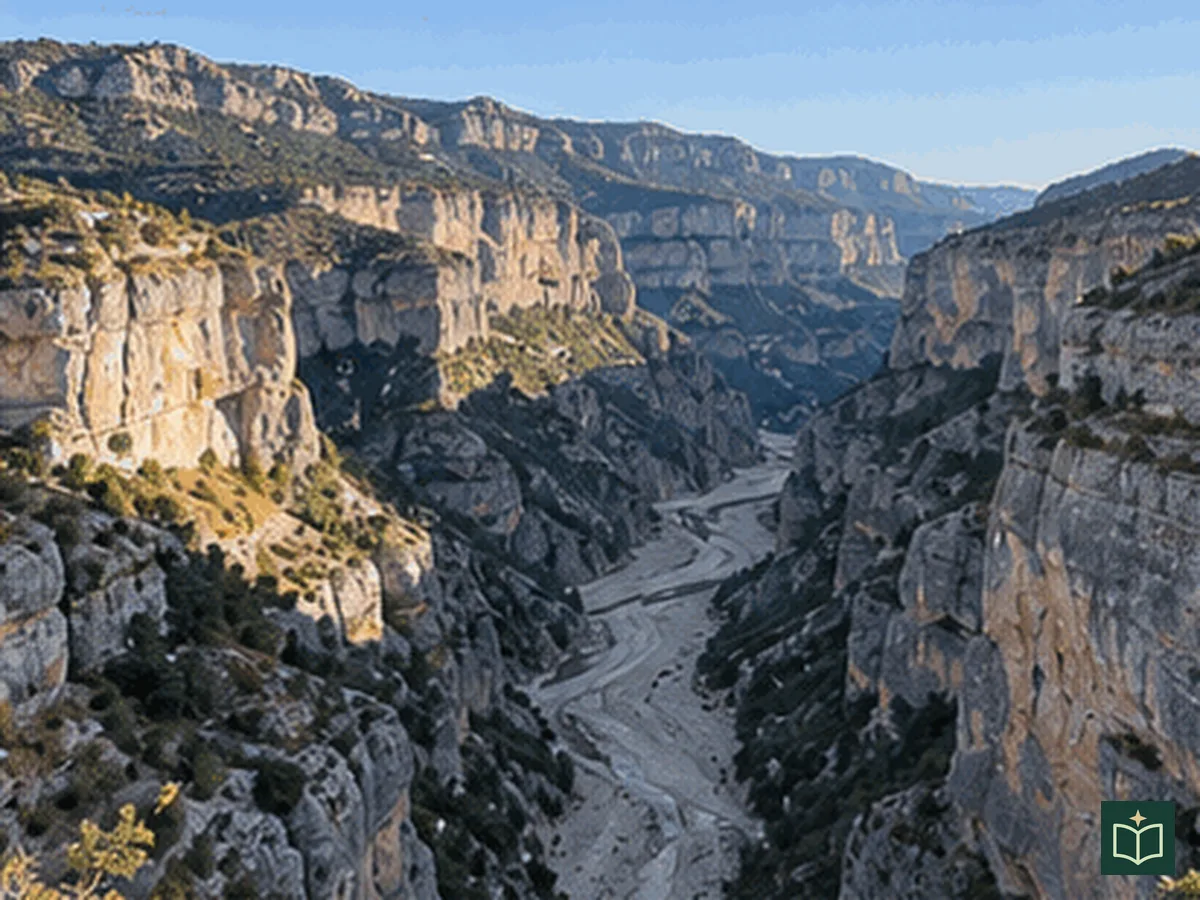
A gorge is generally narrower and smaller than a canyon, with walls that rise steeply and close together. Gorges often form where a river cuts through especially hard rock, where a waterfall retreats upstream, or where meltwater from ancient glaciers carved quickly through a ridge. Limestone gorges can also form when the roof of a cave system collapses. Cheddar Gorge in England and the Gorges du Verdon in France are well-known examples. The word comes from the French for throat, an apt image for a tight passage. However, some very large features are called gorges, such as the Three Gorges on China's Yangtze, so the label is not strictly about size.
Wadis and canyons of Arabia
In the Arabian Peninsula, valleys are usually called wadis, a term for a river valley that is dry most of the year but can flood violently after heavy rain. The Hajar Mountains of the UAE and Oman are cut by many wadis, some of which narrow into gorges between steep limestone walls. Wadi Ghul, below Jebel Shams in Oman, is often called the Grand Canyon of Arabia, with cliffs dropping roughly 1,000 metres. These landscapes show that occasional floods can be powerful carvers. Flash floods carry boulders and gravel that scour the beds, which is why hikers in wadis are warned to watch the weather even when skies overhead look clear.
Why names are inconsistent
Ultimately, which word is used often depends on language, history and local habit rather than strict measurements. In the American West, canyon, from the Spanish cañón, became the standard word for deep valleys. In Britain and France, gorge is more common. Some features called canyons are narrow slots only a metre or two wide, and some called gorges are vast. Geographers therefore treat the terms as descriptions rather than rigid categories. The useful questions are how wide the feature is relative to its depth, how steep its walls are, and what carved it. Those answers reveal the history of a landscape far more than whichever name appears on the map.
Sources & further reading
- US National Park Service · Grand Canyon geology ↗
- National Geographic Education · Canyon ↗
- Britannica · Valley ↗
Figures are rounded and widely published; check the linked organisations for the latest editions. These organisations do not endorse this website.