Two things light can do
Whenever light reaches the boundary between two materials, such as air and water, part of it may bounce back and part may pass through. Reflection is the bounce. Refraction is the change in direction of the light that continues into the new material. Most surfaces do both at once. A window lets most light through, which is why we see the street outside, but at night, with a bright room behind us, its weak reflection becomes obvious. A calm lake mirrors the sky while also letting us see stones near the shore. Which effect dominates depends on the materials, the angle at which light arrives and the smoothness of the surface.
The rule of reflection
Reflection follows one simple law: the angle at which light leaves a surface equals the angle at which it arrived, both measured from a line perpendicular to the surface. A smooth, polished surface such as a mirror or still water reflects all the rays in an orderly way, producing a clear image. This is called specular reflection. A rough surface, such as paper, painted walls or sand, scatters light in many directions, called diffuse reflection. That scattered light lets us see the object itself rather than an image of something else. Mirrors are usually glass backed with a thin metal coating, often aluminium or silver, which reflects most visible light.
Why light bends
Refraction happens because light travels at different speeds in different materials. In a vacuum it moves at nearly 300,000 kilometres per second. In water it slows to about 225,000, and in ordinary glass to around 200,000. The ratio of these speeds is the refractive index: about 1.33 for water, 1.5 for glass and 2.4 for diamond. When light enters a slower material at an angle, one side of the beam slows before the other, so the beam swings round, much as a car veers when one wheel hits sand. Entering a slower material, light bends towards the perpendicular; leaving it, light bends away. Snell's law describes the exact amount.
The broken straw
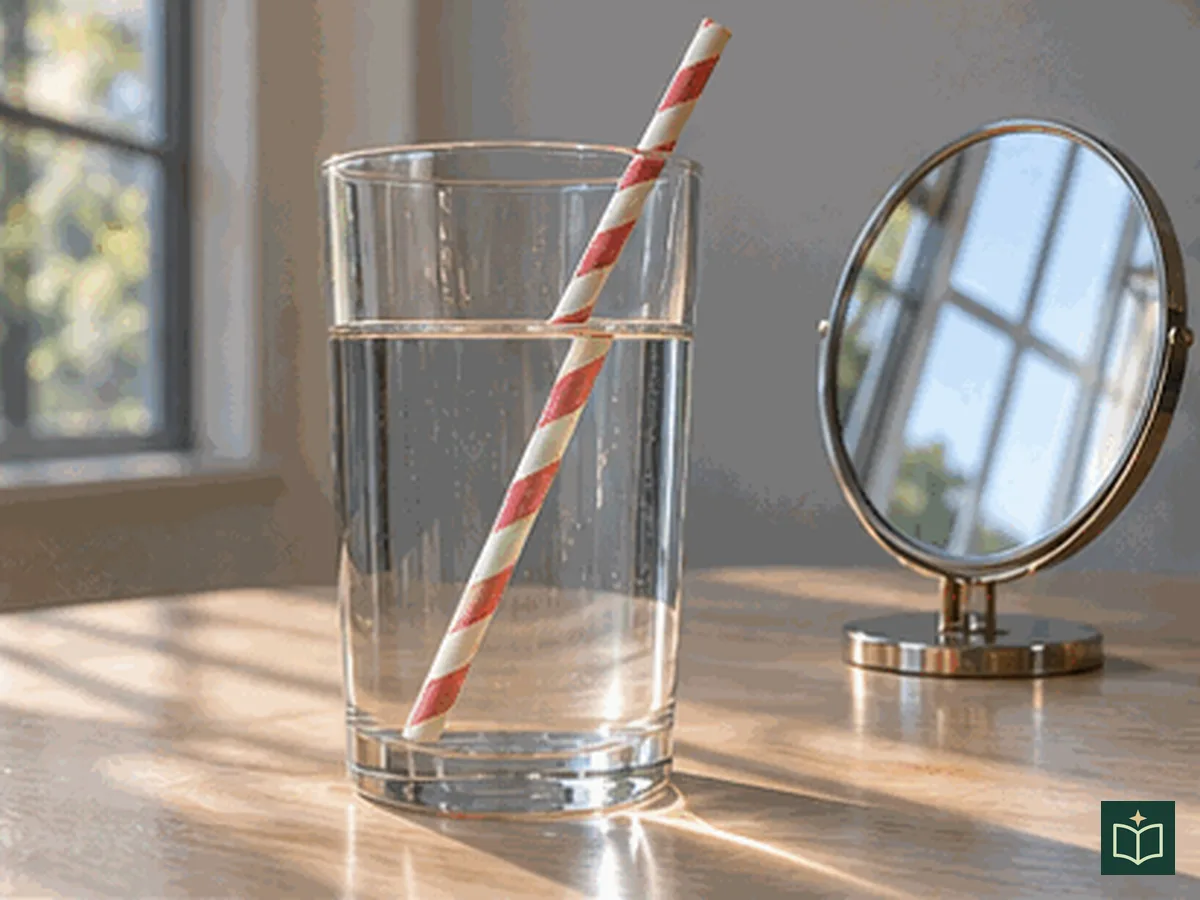
Put a straw in a glass of water and look from the side: it appears bent or snapped at the surface. The straw is straight. Light from the submerged part bends as it leaves the water, and our brains assume light always travels in straight lines, so they trace it back to a false position. The same effect makes pools look shallower than they are. Viewed from directly above, a pool two metres deep appears to be only about 1.5 metres deep, roughly three-quarters of its true depth. Swimmers and children should keep this in mind. Spearfishers learn to aim below the apparent position of a fish for the same reason.
When bending becomes bouncing
Refraction can turn into reflection. When light inside water or glass reaches the surface at a shallow enough angle, it cannot escape and reflects back completely. This total internal reflection happens beyond a critical angle, about 49 degrees for water and roughly 42 degrees for common glass. It is why the underside of the water surface looks like a silvery mirror to divers. Optical fibres exploit it: light zigzags along a thin glass strand, reflecting off the inner walls for kilometres with little loss, carrying the internet across oceans. Diamonds are cut so that light entering the top reflects internally and returns towards the viewer, giving them their sparkle.
Both at work every day
Many everyday tools use one effect or the other. Mirrors, car reflectors and the reflective strips on road signs rely on reflection. Spectacles, contact lenses, cameras, microscopes and the lens in the human eye rely on refraction to focus light. Because different colours bend by slightly different amounts, refraction also splits white light into a spectrum in prisms and raindrops. Shimmering heat haze over a desert road is refraction too, as light bends through layers of air at different temperatures. Recognising which effect is at work helps explain why things look as they do, from a dazzling sea at sunset to a spoon that seems to bend in a glass.
Sources & further reading
Figures are rounded and widely published; check the linked organisations for the latest editions. These organisations do not endorse this website.