A city in the floodplain
Cahokia lies in southern Illinois, across the Mississippi River from modern St Louis, in a broad floodplain known as the American Bottom. It was built by people of the Mississippian culture, which spread across much of what is now the south-eastern and midwestern United States. Settlement there grew dramatically around 1050 CE and flourished until about 1200, before declining. At its height, Cahokia was the largest urban centre in North America north of Mexico. Population estimates vary widely, but many archaeologists suggest something in the range of 10,000 to 20,000 people in and around the central city, comparable to some European towns of the time.
Mounds of earth
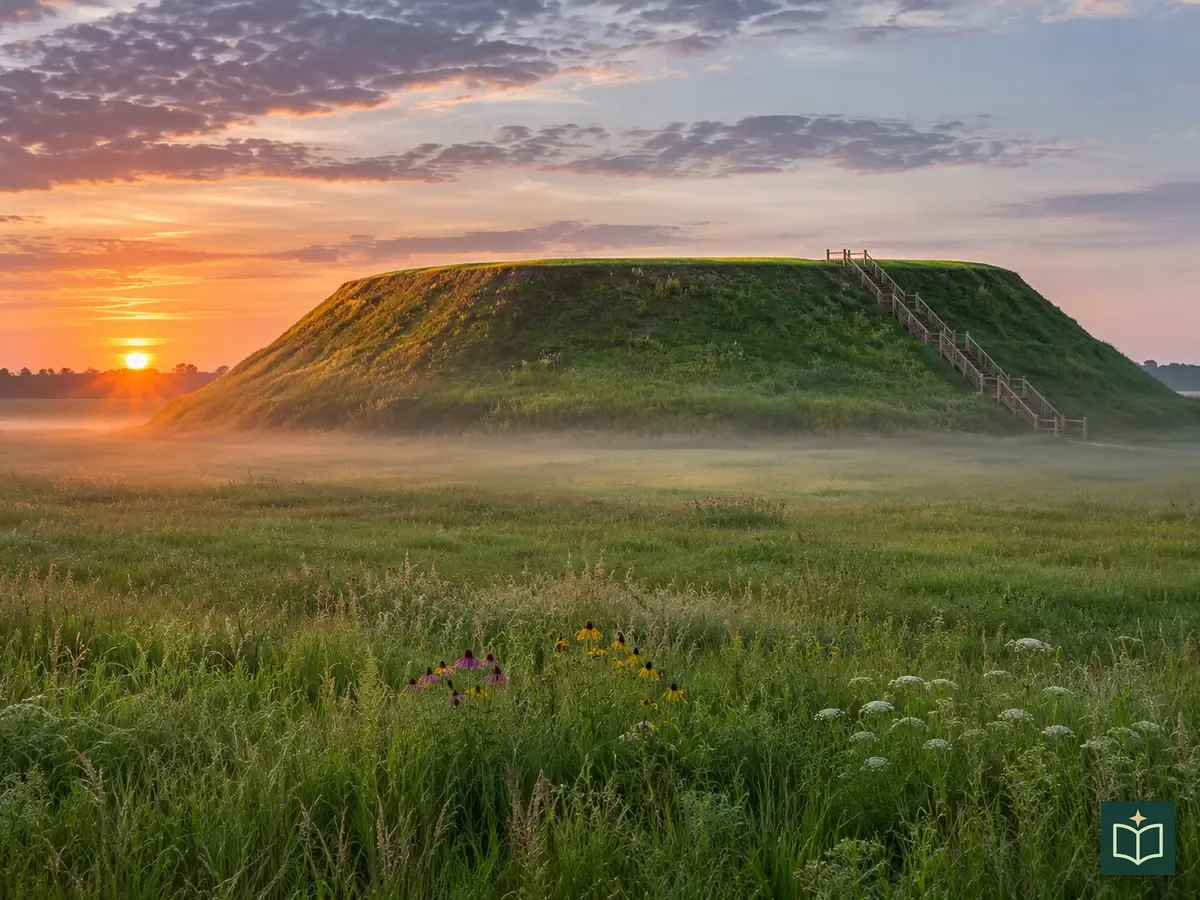
Cahokia is famous for its mounds, of which around 120 were originally built, many still visible today. Some were flat-topped platforms supporting temples or the homes of leaders; others were conical burial mounds or ridge-topped markers. The largest, Monks Mound, rises about 30 metres and covers roughly 6 hectares at its base, making it the largest prehistoric earthwork in the Americas north of Mexico. It was built in stages, using soil dug from nearby borrow pits and carried in baskets. Builders mixed different soils carefully to improve drainage and stability, showing a sophisticated understanding of materials and engineering. It remains an engineering landmark.
A planned centre
At the heart of Cahokia lay the Grand Plaza, a large open space that was deliberately levelled and probably used for ceremonies, gatherings and games such as chunkey, which involved rolling a stone disc. Monks Mound overlooked the plaza from the north. At one stage, a wooden palisade with bastions enclosed the central area, suggesting concerns about conflict or a desire to separate elite space. Archaeologists also found circles of large wooden posts, nicknamed Woodhenge, which appear to have marked the positions of sunrise at solstices and equinoxes, functioning as a solar calendar for the agricultural and ceremonial year. The city was carefully designed.
Economy and society
Cahokia’s growth depended on farming, especially maize, along with squash, native seed crops, hunting and fishing. Its location near the confluence of major rivers, including the Mississippi, Missouri and Illinois, connected it to trade networks that brought shells from the Gulf of Mexico, copper from the Great Lakes and stone from distant quarries. Burials such as those in Mound 72 included rich grave goods and evidence of human sacrifice, showing social hierarchy and powerful leaders. Cahokia’s influence, in art, religion and architecture, spread across a wide region of the Mississippian world, though how it governed beyond the city is debated.
Why Cahokia emptied
By around 1350, Cahokia had been largely abandoned. There was no single cause. Proposed factors include flooding, droughts and climate shifts, depletion of local wood and other resources, social and political tensions and warfare in the region. Recent research suggests the decline was gradual rather than a sudden collapse, as people moved away over generations. Indigenous nations of the region, including those of the Osage, Ponca and others, maintain historical and cultural connections to the Mississippian world. Europeans arriving centuries later found the mounds overgrown and some assumed, wrongly, that they had been built by a vanished non-Native people. That assumption was false.
Recognition and legacy
Much of Cahokia was damaged by farming, highways and urban development in the nineteenth and twentieth centuries. The surviving core is protected as Cahokia Mounds State Historic Site, and UNESCO inscribed it as a World Heritage Site in 1982. An interpretive centre on site explains the city’s layout and history to visitors. Cahokia challenges a persistent misconception that Indigenous North Americans lived only in small, mobile groups before European arrival. In fact, it was a planned city with monumental architecture, astronomical knowledge and wide-ranging trade, one of many complex societies that flourished in the Americas long before 1492. Its story is still being uncovered.
Sources & further reading
Figures are rounded and widely published; check the linked organisations for the latest editions. These organisations do not endorse this website.