Why Rome needed aqueducts
As Rome grew from a town into a city of perhaps a million people at its peak, local wells, springs and the polluted River Tiber could not meet demand. The first aqueduct, the Aqua Appia, was built in 312 BCE. Over the following five centuries, eleven major aqueducts were constructed to supply the city, the last in the early third century CE. They carried water from springs and rivers in the hills, some more than 50 kilometres away. Other Roman cities across the empire, from Spain to Syria and North Africa, built their own aqueducts, making running water a hallmark of Roman urban life.
Gravity and gradient
Roman aqueducts had no pumps. They relied entirely on gravity, so the channel had to descend steadily from source to city. If the slope was too steep, fast water could erode the channel; if too gentle, the flow might stagnate. Engineers surveyed routes with instruments such as the chorobates, a long levelling table, and the groma, used to set out straight lines. Gradients were often very small. The aqueduct that crossed the Pont du Gard to supply Nîmes in southern France ran about 50 kilometres and dropped only around 12 metres in total, an average of roughly 25 centimetres per kilometre, a remarkable feat of surveying.
Mostly underground
Popular images show tall arches marching across the countryside, but most of an aqueduct’s length was underground, running in covered channels cut into rock or built of masonry just below the surface. This protected the water from contamination, evaporation and attack, and kept it cool. Arches were used only where the route crossed valleys or low ground, and tunnels carried water through hills. Inspection shafts allowed workers to enter for cleaning. Water carried dissolved minerals that formed thick limestone deposits inside channels, which had to be removed regularly. Some deposits were so thick that later builders reused them as decorative stone.
The Pont du Gard
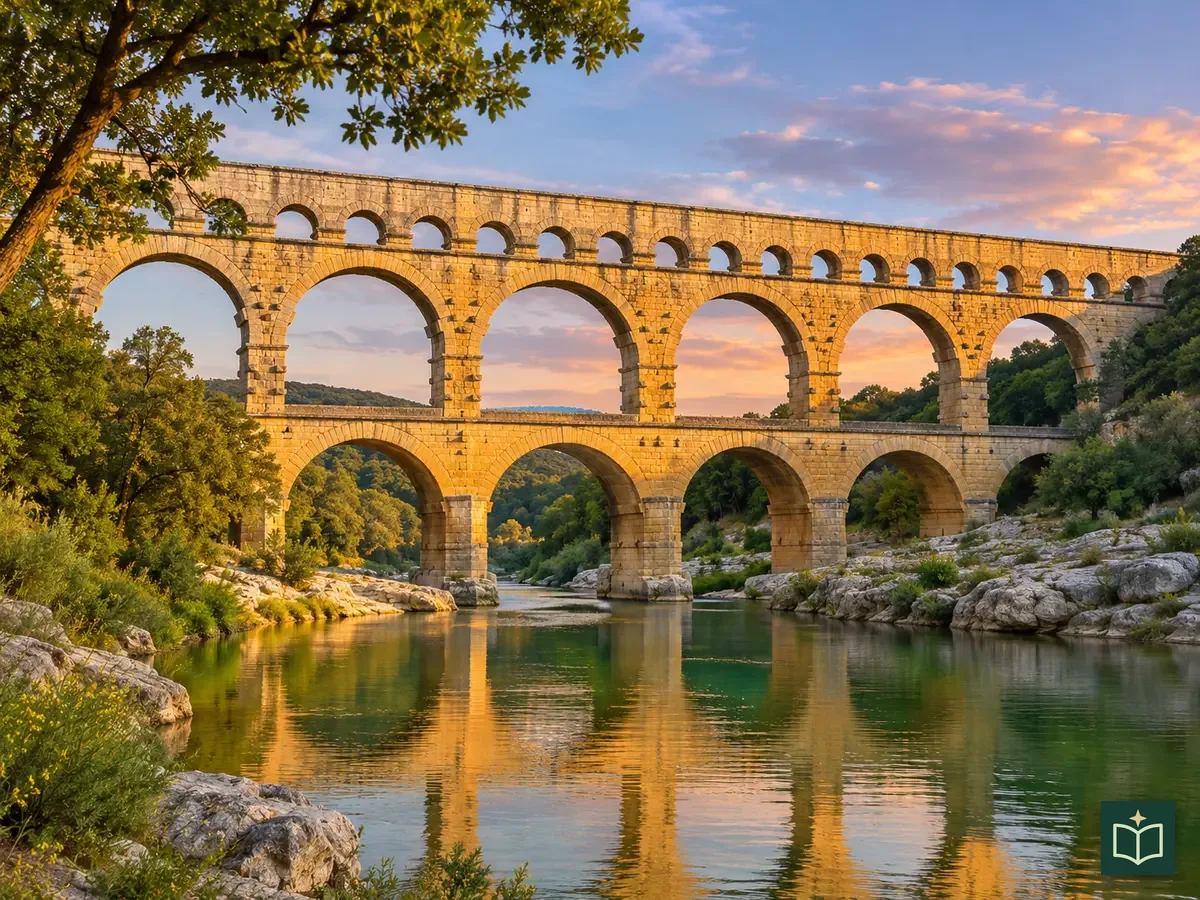
The most famous surviving aqueduct bridge is the Pont du Gard near Nîmes, built in the first century CE. Its three tiers of arches rise to about 49 metres above the River Gardon, making it the tallest of all Roman aqueduct bridges. The large stone blocks were laid without mortar, and the top tier carried the water channel. The bridge survived largely because it was later used as a road bridge and because of its sturdy construction. UNESCO inscribed it as a World Heritage Site in 1985. Other impressive survivors include the aqueduct of Segovia in Spain, still standing in the heart of the city.
Running the system
Water arriving in Rome flowed into distribution tanks, called castella, which divided it among public fountains, baths and private users. Most residents collected water from public fountains, while wealthy households paid for private connections. Water ran constantly, with overflow flushing the drains and sewers. Sextus Julius Frontinus, appointed water commissioner in 97 CE, wrote a treatise on Rome’s aqueducts, describing their sources, lengths and management, and complaining about illegal tapping and fraud. A common question is whether lead pipes poisoned Romans. Lead was used for pipes, but constant flow and mineral deposits often limited contact, and the health effects are debated.
Legacy
Roman aqueducts were among the ancient world’s greatest infrastructure projects, and they set a standard of urban water supply not matched in much of Europe for many centuries after the empire’s decline. Some were repaired and reused into modern times; Rome’s Aqua Virgo still feeds famous fountains through a successor system. The principles they used, careful surveying, gravity flow and protected channels, remain in use. Many modern water systems, including in hilly regions, still move water by gravity wherever possible to save energy. Aqueducts also show that public health, engineering and political power were closely linked in the Roman world.
Sources & further reading
Figures are rounded and widely published; check the linked organisations for the latest editions. These organisations do not endorse this website.