A curator’s idea
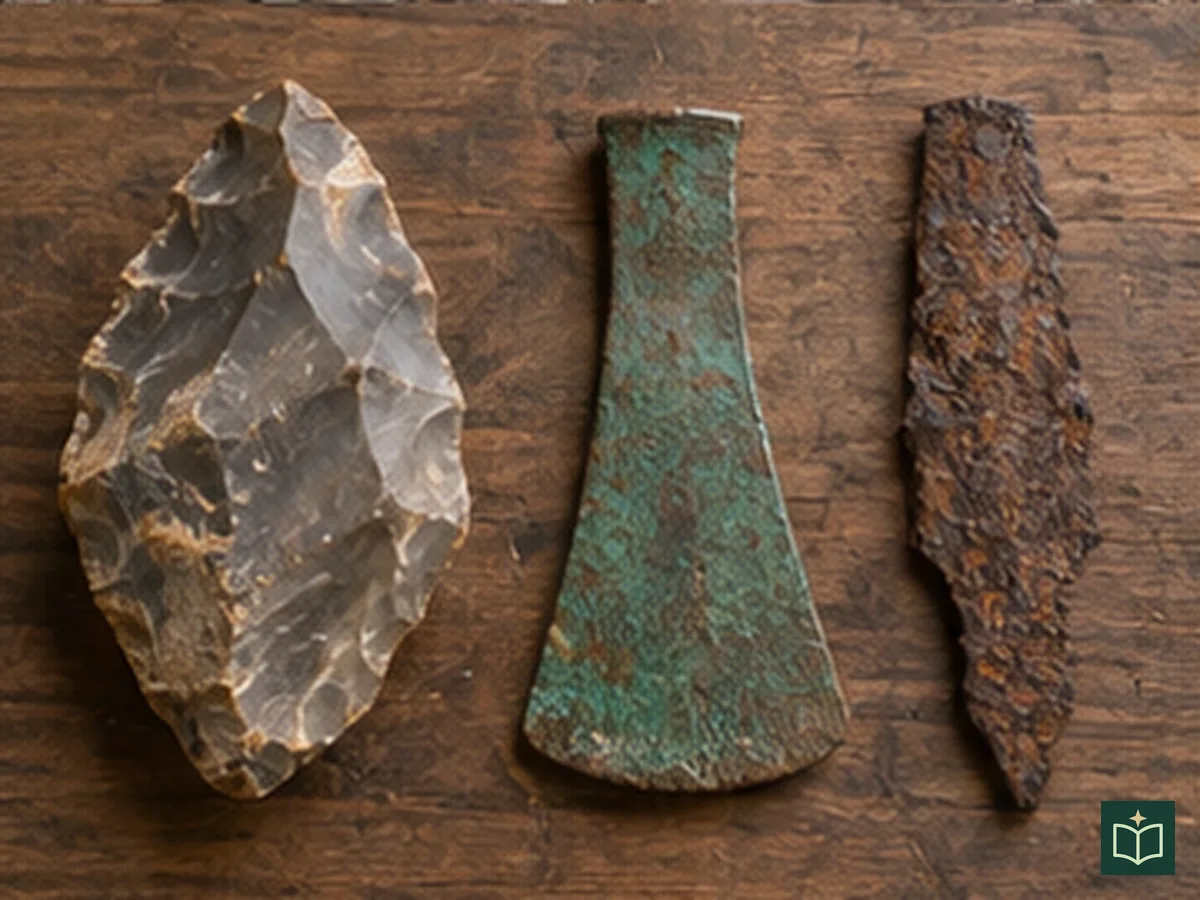
The idea of dividing prehistory into ages of stone, bronze and iron was formalised in Denmark. In the early nineteenth century Christian Jürgensen Thomsen, in charge of the collection that became the National Museum of Denmark, needed a way to arrange thousands of undated objects. He grouped them by material and noticed that the categories tended to occur together in graves and hoards in a consistent order. His displays, opened to the public in 1819, and a guidebook published in 1836 spread the scheme. Ancient writers, including the Roman poet Lucretius, had imagined similar stages, but Thomsen turned it into a working tool. His successor, Jens Worsaae, confirmed the sequence through excavation.
The Stone Age
The Stone Age is by far the longest period, covering almost all of human history. The oldest known stone tools, from Lomekwi in Kenya, are about 3.3 million years old. In 1865 the British writer John Lubbock divided the period into the Palaeolithic, or Old Stone Age, of hunter-gatherers using flaked stone, and the Neolithic, or New Stone Age, associated with farming, polished stone tools and settled villages. A transitional Mesolithic was added later. The Neolithic began in the Fertile Crescent of the Middle East around 11,000 years ago and later elsewhere. Stone Age people also used wood, bone, fibre and leather extensively, but these materials survive far less well.
Copper, then bronze
Metalworking began with copper, which can be found in native form and hammered into shape, and later smelted from ore. Many archaeologists add a Copper Age, or Chalcolithic, before the Bronze Age. Bronze is an alloy, usually about nine parts copper to one part tin, and it is harder and casts better than pure copper. In the Near East the Bronze Age began around 3300 BC; in China and in Britain it began in the late third millennium BC. Because tin deposits are rare, bronze depended on long-distance trade, linking regions across Eurasia. The copper of ancient Magan, in today’s UAE and Oman, supplied Mesopotamian cities during this period.
The coming of iron
Iron ore is far more common than copper or tin, but iron is harder to work. Early smiths could not melt it, since iron melts at about 1,538°C, so they heated ore with charcoal in furnaces called bloomeries to produce a spongy mass that was then hammered to remove impurities. Iron objects were made occasionally for centuries, but the Iron Age in the eastern Mediterranean and Near East is usually dated from about 1200 BC, after the collapse of many Bronze Age trading networks. Iron reached central and western Europe around 800 BC. Once the technique spread, cheap and widely available iron tools transformed farming, forest clearance and warfare.
Not the same everywhere
The three ages describe a sequence observed in Europe and the Near East, but the world did not follow one timetable. In much of sub-Saharan Africa, people moved more or less directly from stone to iron, without a distinct Bronze Age; iron-working was established in parts of West and Central Africa in the first millennium BC. In the Americas, societies worked gold, silver and copper, and Andean smiths made bronze, but iron was not smelted before European contact. In Australia, people lived without metallurgy until European colonisation, while developing sophisticated stone, wood and fibre technologies. Using the labels outside their original context can therefore suggest a ranking of societies that archaeologists today reject.
Still useful, with care
Despite its limits, the three-age system remains embedded in archaeology, museum displays and school curricula. It provides a convenient shorthand for broad technological stages and a framework for organising finds. Archaeologists now combine it with radiocarbon dating, regional cultural names and more detailed periods, such as the Late Bronze Age or Early Iron Age, that fit local evidence. The system also reminds us that materials can reshape societies: access to copper, tin and iron influenced trade routes, warfare and the rise of states. When you see the labels in a museum, think of them as an old curator’s sorting method that still works, as long as we remember where it came from.
Sources & further reading
Figures are rounded and widely published; check the linked organisations for the latest editions. These organisations do not endorse this website.