A kingdom on the Musi River
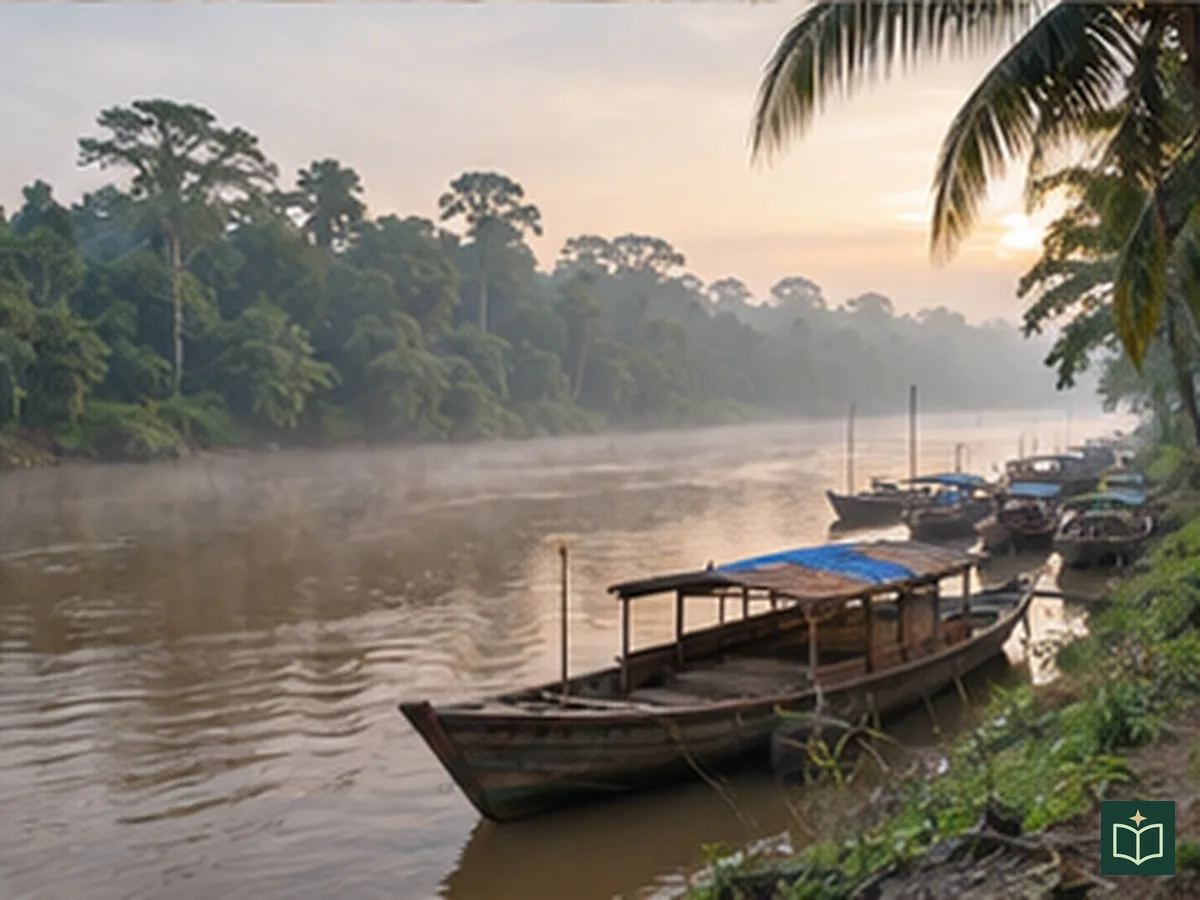
Srivijaya was centred on Palembang, on the Musi River in south-eastern Sumatra, in today’s Indonesia. Its earliest dated records are stone inscriptions in Old Malay, written in a script of South Indian origin, from the 680s. The Kedukan Bukit inscription of 683 describes a ruler leading a large expedition and founding a settlement, and others from the following years warn subjects against disloyalty and promise rewards for obedience. From these beginnings Srivijaya extended its influence over much of Sumatra and the Malay Peninsula. Rather than a tightly governed territory, it was probably a network of ports and river chiefs bound to the ruler by oaths, trade and shared benefits.
Why location mattered
The key to Srivijaya’s wealth was geography. Ships travelling between the Indian Ocean and the South China Sea had two main routes through the Malay world: the Strait of Malacca, between Sumatra and the Malay Peninsula, and the Sunda Strait, between Sumatra and Java. Srivijaya controlled both. Sailing in this period depended on the monsoons, which reverse direction seasonally, so merchants often had to wait months in port for favourable winds. Srivijaya offered safe harbours, supplies and markets, and it is thought to have used its fleet to suppress piracy and to steer ships towards its own ports, where goods could be taxed and exchanged.
Goods of the archipelago
Srivijaya’s ports handled trade from across Asia. Chinese silk and ceramics, Indian textiles and Middle Eastern glass and goods passed through, alongside products of the archipelago itself: camphor, aromatic woods, resins, spices, gold and forest goods. Arab and Persian writers knew the kingdom by names such as Zabaj and Sribuza and described its riches. Srivijaya sent regular missions to the Chinese court, presenting goods and receiving recognition, which helped secure favourable access to the vast Chinese market. Shipwrecks of the period found in Indonesian waters, carrying thousands of Chinese ceramics, illustrate the volume of maritime commerce that passed through the region in these centuries.
A centre of Buddhist learning
Srivijaya was also a centre of Buddhism. The Chinese monk Yijing stayed there in 671 on his way to India, and again for several years in the late 680s and 690s, studying Sanskrit and copying and translating texts. He reported that more than a thousand Buddhist monks lived there and advised Chinese pilgrims to study in Srivijaya before travelling on to India. The kingdom’s ties reached the great monastery of Nalanda in north-eastern India, where an inscription records a monastery founded with Srivijayan support in the ninth century. In the eleventh century the Indian teacher Atisha, later influential in Tibet, spent years studying under a master in Sumatra.
Decline and rediscovery
Srivijaya’s dominance faced challenges. In 1025 the Chola dynasty of southern India launched a naval raid that struck Srivijaya’s ports and captured its ruler, weakening its grip on the straits. The centre of power later shifted to Jambi, further north, and rival ports and kingdoms in Java and the Malay Peninsula competed for trade. By the thirteenth century Srivijaya had faded. It left few monumental buildings, partly because much of Palembang was built of wood on a river floodplain. For centuries it was largely forgotten, until the French scholar George Coedès, in 1918, used inscriptions and Chinese and Arab sources to show that it had been a major power.
A long legacy
Srivijaya foreshadowed later powers in the region. Its successor, in a sense, was the Sultanate of Malacca, founded around 1400, which also grew rich by controlling the strait. Today the Strait of Malacca remains one of the world’s busiest shipping lanes, carrying a large share of seaborne trade between Asia, the Middle East and Europe, including much of the oil shipped from the Gulf to East Asia. Singapore’s rise as a port follows the same logic of position and services. Srivijaya also carried the Malay language across the region, and modern Indonesian and Malaysian national identities draw on its memory as an early maritime state.
Sources & further reading
Figures are rounded and widely published; check the linked organisations for the latest editions. These organisations do not endorse this website.