A trade of millions
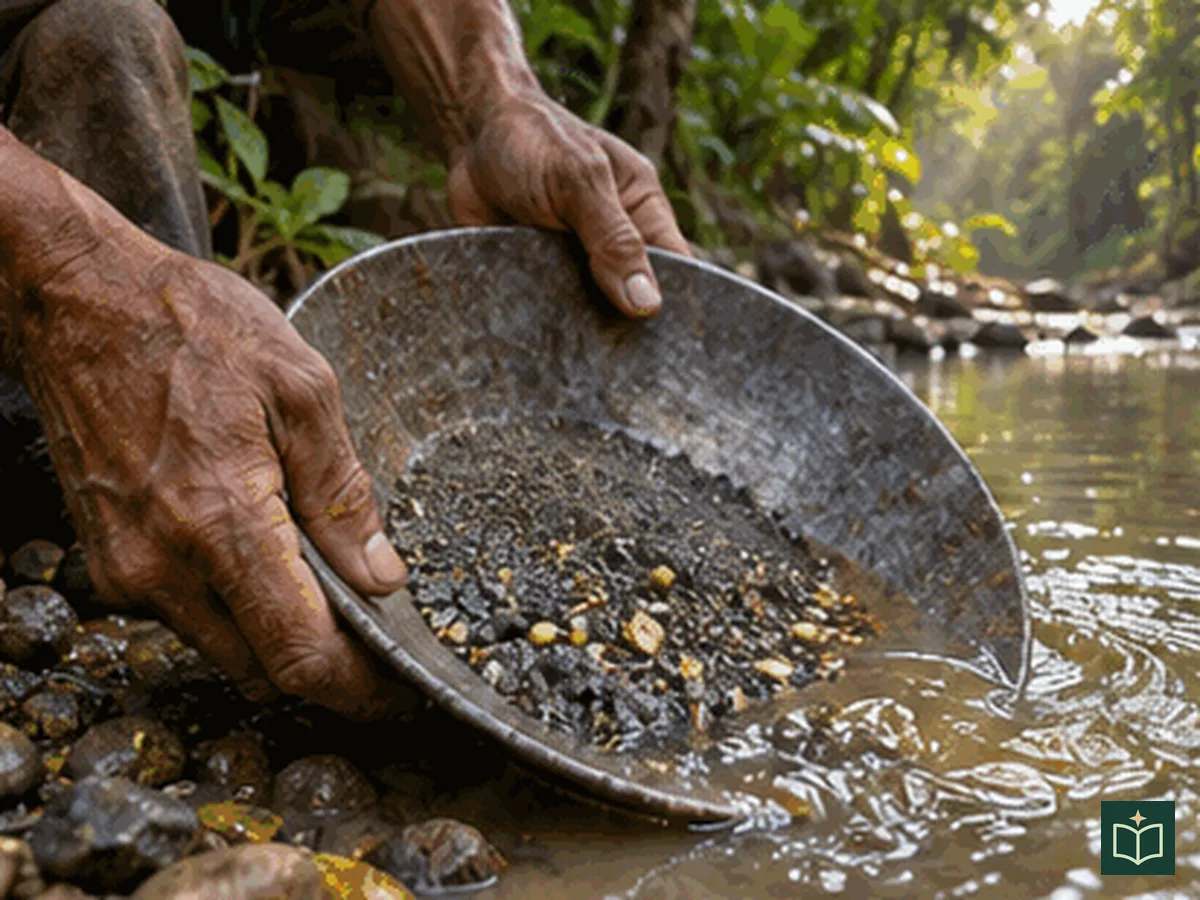
Artisanal and small-scale gold mining, often shortened to ASGM, is gold dug by individuals, families and small groups using hand tools and simple machines. The United Nations Environment Programme estimates that somewhere between 10 and 20 million people work this way in about 70 countries, from the Amazon to the Sahel and Indonesia, and that it supplies roughly a fifth of the world’s newly mined gold. For many rural households it is the best-paid work available, especially when harvests fail. Much of it is informal or unlicensed, which makes it hard to regulate, to tax, or to reach with training and cleaner equipment.
Why mercury works so well
Gold in many small deposits occurs as fine specks that wash straight off a sluice. Mercury solves that problem. The liquid metal wets gold surfaces and dissolves them into a soft, silvery paste called amalgam, while ignoring most other minerals. A miner kneads mercury into a pan of concentrate, squeezes the surplus through a cloth, and is left with a lump that holds most of the gold. Mercury is cheap, easy to buy, needs no electricity and works within minutes, so a miner can sell gold the same day. That speed matters to people paid by the gram who cannot wait weeks for a plant to settle up.
Burning off the poison
The final step is the most dangerous. To free the gold, the amalgam is heated with a blowtorch, on a stove or over charcoal. Mercury boils at about 357 °C, far below the melting point of gold, so it escapes as an invisible vapour and leaves porous sponge gold behind. Done in the open or in town gold shops, the vapour is breathed by miners, buyers and their families. Inhaled mercury damages the nervous system and kidneys; tremors, memory loss and mood changes are common signs. Mercury that settles into rivers is turned by bacteria into methylmercury, which builds up in fish and passes to people who eat them.
A worked example
Field studies suggest that when miners amalgamate only a gravity concentrate, they lose roughly one to one and a half grams of mercury for every gram of gold recovered. Take a small team producing 10 grams of gold a day and losing 1.3 grams of mercury per gram. That is 13 grams of mercury a day, or about 3.9 kilograms over 300 working days. A simple retort, a sealed pot that condenses the vapour back into liquid, can recapture most of it; if it caught 90%, the team’s annual release would fall to about 0.4 kilograms. Whole-ore amalgamation wastes far more.
The Minamata Convention steps in
Mercury’s dangers are why ASGM features prominently in the Minamata Convention on Mercury, the global treaty that entered into force in 2017. Rather than banning mercury use by miners outright, which would likely push the trade further underground, the convention asks affected countries to write national action plans to reduce and, where feasible, eliminate it. It singles out the worst practices for ending: whole-ore amalgamation, open burning of amalgam, burning amalgam in residential areas, and adding cyanide to sediment already laced with mercury. Programmes such as planetGOLD work with miners on licensing, finance and cleaner equipment rather than relying on enforcement alone.
Safer ways to catch gold
Alternatives exist, though none is as cheap or quick as mercury. Better gravity separation, using shaking tables, centrifugal concentrators and carefully designed sluices, can produce a concentrate rich enough to smelt directly. In the borax method, popularised by miners in the Philippines, that concentrate is melted with borax as a flux, which lowers the melting point of the impurities and lets gold pool at the bottom of a crucible. Small cyanide plants recover more gold but bring a different poison. The obstacles are mostly money, training and trust, which is why cooperatives and fair-trade gold schemes that pay a premium for mercury-free metal matter.
Sources & further reading
Figures are rounded and widely published; check the linked organisations for the latest editions. These organisations do not endorse this website.