Names and family trees
Turtles, tortoises and terrapins are all reptiles in the order Testudines, defined by a bony shell fused to the spine and ribs. Scientists use turtle as the general term for every member of the order, which has existed for more than 200 million years. Tortoises are one family within it, Testudinidae, made up of land-dwelling species. Other families include sea turtles, freshwater turtles and soft-shelled turtles. Terrapin is a looser word, mostly used in British English for small freshwater or brackish-water turtles. Usage varies between countries, which adds to the confusion, but the underlying rule is simple: all tortoises are turtles, while most turtles are not tortoises.
Shells, feet and food
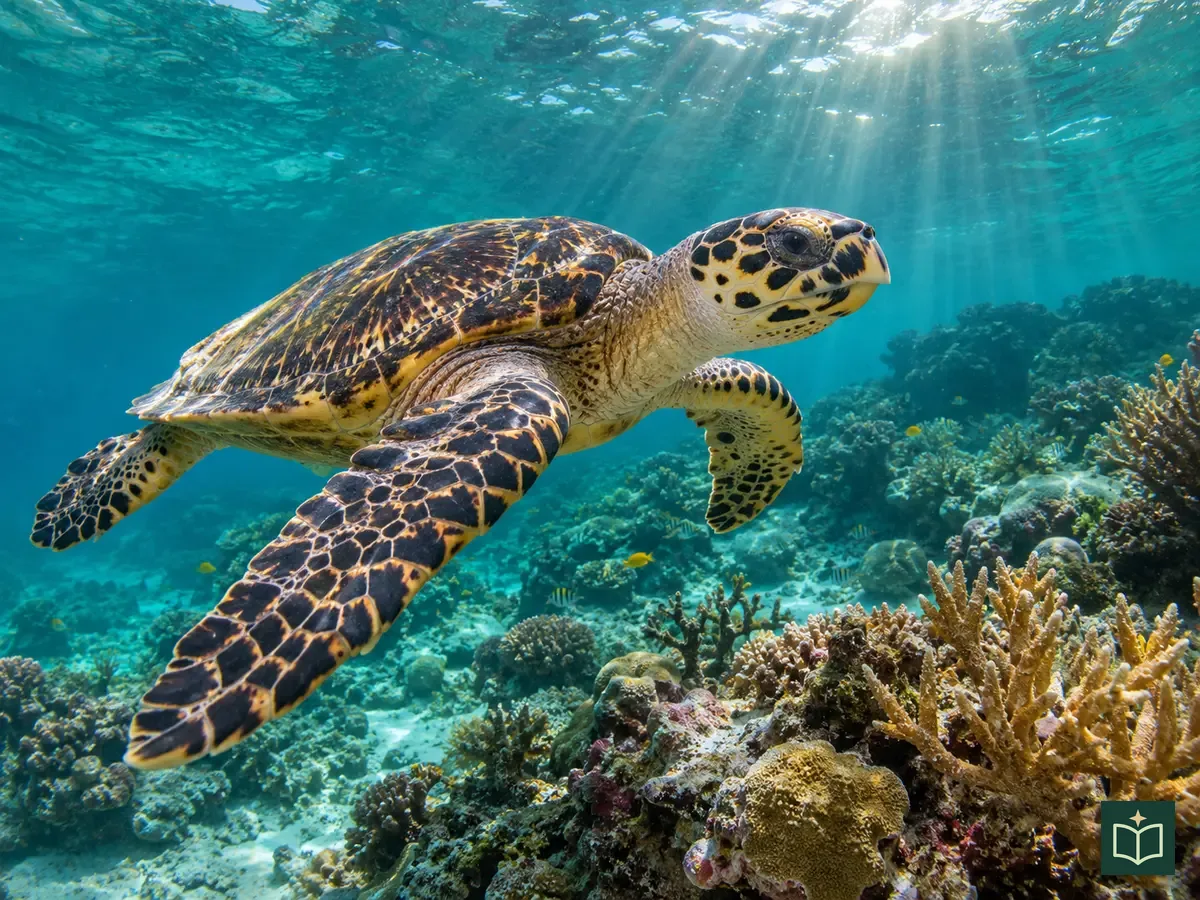
Body shape follows lifestyle. Sea turtles have streamlined, flatter shells and paddle-like flippers that propel them across oceans; they cannot pull their heads into their shells. Freshwater turtles usually have webbed feet with claws, combining swimming with walking along riverbeds and banks. Tortoises have heavy, domed shells that resist predators and sturdy, column-like legs with blunt, elephant-like feet built for walking on land. Diets differ too. Tortoises are mostly herbivores, grazing grasses, leaves, flowers and fruit. Turtles range widely: green sea turtles eat seagrass and algae, hawksbills feed on sponges, and many freshwater turtles eat fish, insects, snails and plants.
Gulf examples
The waters around the UAE host several sea turtles. Green turtles and hawksbill turtles feed on seagrass beds and coral reefs and nest on beaches, including protected sites on offshore islands. Hawksbills in the Gulf cope with some of the hottest sea temperatures recorded for the species. Rescue and rehabilitation programmes in Dubai and Abu Dhabi treat stranded turtles, often affected by cold snaps, plastic or boat strikes, and return them to the sea. Tortoises, by contrast, are mostly encountered in the region as pets or in zoos, such as the African spurred tortoise, the third-largest tortoise species. Each release is carefully recorded.
Where they are similar
Despite their different habitats, turtles and tortoises share a remarkable body plan. In both, the shell has an upper part called the carapace and a lower part called the plastron, covered by horny plates called scutes. Both breathe air with lungs, even sea turtles that spend most of their lives underwater. All lay eggs on land, digging nests in sand or soil, and in many species the nest temperature determines whether hatchlings become male or female. Both have toothless beaks rather than teeth. Both grow slowly, mature late and can live for many decades, with some tortoises known to exceed 150 years.
Common misconceptions
Many people believe a turtle can crawl out of its shell. It cannot; the shell is part of the skeleton, growing with the animal. Another misconception is that tortoises can swim like turtles. Most tortoises are poor swimmers and can drown in deep water, so pet owners should provide only shallow dishes. Some assume all turtles are slow, yet sea turtles swim long distances and freshwater species can be quick. It is also often said that turtles are low-maintenance pets. In reality, they need specific lighting, heat, diet and space, can live for decades and may carry salmonella bacteria, so hygiene matters.
Why it matters
Turtles and tortoises are among the most threatened vertebrates. Around half of species are considered threatened, according to assessments by the International Union for Conservation of Nature, because of habitat loss, collection for food and the pet trade, egg harvesting, fishing nets and plastic pollution. Sea turtles also face rising temperatures, which can skew nests towards producing mostly females. Protecting nesting beaches, controlling trade and reducing bycatch are key conservation tools, and several Gulf countries now monitor and protect their turtle populations. Telling turtles from tortoises helps people support the right care and conservation measures for each group. Both deserve protection.
Sources & further reading
Figures are rounded and widely published; check the linked organisations for the latest editions. These organisations do not endorse this website.