Scale-winged insects
Butterflies and moths form the insect order Lepidoptera, a name meaning scale wings. Their wings are covered in tiny overlapping scales, which produce colours through pigments and through microscopic structures that scatter light. Roughly 180,000 species have been described. Butterflies are a single evolutionary branch within this order, accounting for only about a tenth of the species. Moths are everything else, from tiny leaf-mining species a few millimetres across to the Atlas moth of tropical Asia, whose wings can span more than 25 centimetres. In other words, butterflies are not the opposite of moths; they are a distinctive group that evolved from moth ancestors.
How to tell them apart
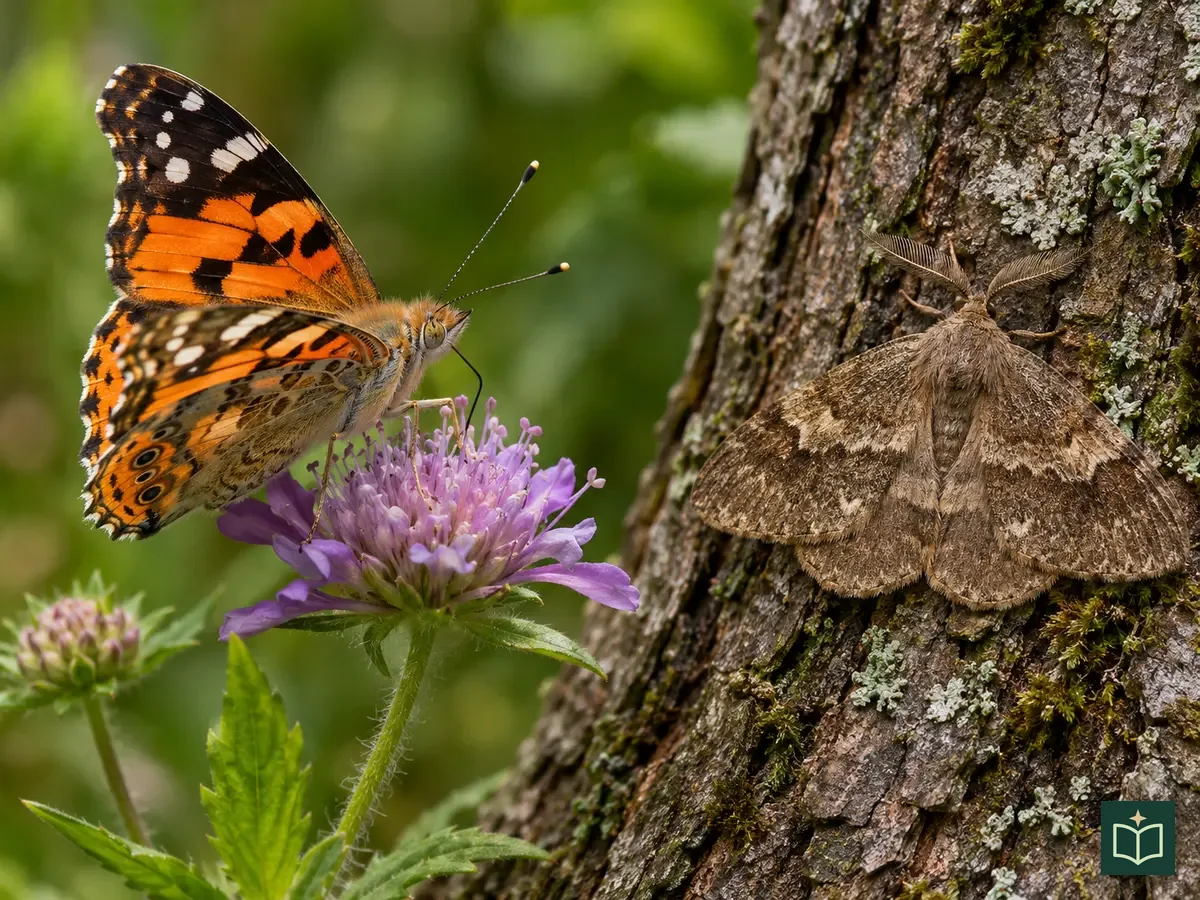
The most reliable everyday clue is the antennae. Butterflies have thin antennae ending in a small club or knob. Moth antennae are usually feathery, especially in males that detect female scent from far away, or thin and tapering without a club. Activity is another guide. Most butterflies fly by day, while most moths are active at dusk or at night, although there are many day-flying moths. Resting posture helps too. Butterflies often close their wings upright over the back, while many moths rest with wings spread flat or folded like a tent. Moths also tend to have stouter, hairier bodies, which help retain heat at night.
Species in the UAE
Even in an arid country, both groups are easy to find. The plain tiger, an orange butterfly with black and white markings, is common in UAE gardens and parks, where its caterpillars feed on milkweed plants and absorb toxins that make the adults distasteful to birds. The painted lady, one of the world's great migrants, passes through the region on journeys between Africa, the Middle East and Europe. Among moths, hawk moths hover at flowers at dusk like small hummingbirds, while the date palm pests known as lesser date moths are a concern for farmers. Outdoor lights in the evening often attract dozens of small moth species.
Where they are similar
Butterflies and moths share most of their biology. Both pass through complete metamorphosis in four stages: egg, larva or caterpillar, pupa and adult. Butterflies form a bare pupa called a chrysalis, while many moths spin a silk cocoon, but the transformation inside is the same. Adults of both feed mainly on liquids such as nectar through a coiled tube called a proboscis. Both have compound eyes and taste with their feet. Caterpillars of both are mostly plant-eaters, and both groups are food for birds, bats, lizards and other animals. Both also pollinate flowers, and many plants depend on moths that visit at night.
Common misconceptions
A common belief is that butterflies are colourful and moths are dull. Many moths are brilliantly coloured, especially day-flying species, and some butterflies are plain brown. Another misconception is that moths eat clothes. Only the larvae of a few species feed on wool or silk; adult moths do not eat fabric, and most moth species have nothing to do with wardrobes. People also assume moths are attracted to light because they love it. In fact, research suggests artificial lights disrupt the way insects orient themselves in flight, causing them to circle lamps. Finally, touching wings removes some scales, which can harm the insect.
Why it matters
Butterflies and moths are important pollinators and a major food source in many ecosystems. Caterpillars feed huge numbers of nesting birds, and night-flying moths pollinate plants that bees rarely visit. Because they respond quickly to changes in habitat, climate and pesticide use, they are widely monitored as indicators of environmental health, and long-term surveys in several countries have recorded declines in some species. Silk, produced by domesticated silkworm moths, has also shaped human history and trade for thousands of years. Learning to tell the two apart is an easy entry point into observing nature, whether in a garden in Dubai or a forest far away.
Sources & further reading
Figures are rounded and widely published; check the linked organisations for the latest editions. These organisations do not endorse this website.