A king at twenty
Alexander was born in 356 BC in Pella, capital of the kingdom of Macedon, north of the Greek city-states. His father, Philip II, built Macedon into the strongest power in Greece, with a professional army armed with long pikes and supported by heavy cavalry. The philosopher Aristotle was among Alexander’s tutors. When Philip was assassinated in 336 BC, Alexander became king at about 20. He quickly crushed revolts in Greece, destroying the city of Thebes as a warning, and took up his father’s plan: an invasion of the Persian Empire, the largest state in the world at the time, stretching from the Aegean Sea to Central Asia.
Three battles for Persia
In 334 BC Alexander crossed into Asia with an army of roughly 40,000 men. He defeated a Persian force at the Granicus River in north-west Anatolia, then, in 333 BC, beat the Persian king Darius III himself at Issus, near today’s border between Turkey and Syria. Rather than chase Darius, Alexander secured the eastern Mediterranean coast, besieging Tyre for seven months, and entered Egypt, where he founded Alexandria in 331 BC. Later that year he defeated Darius decisively at Gaugamela, in northern Iraq. Babylon, Susa and Persepolis fell, and the royal palace at Persepolis burned. Darius was murdered by his own officials in 330 BC while fleeing.
To the edge of India
Alexander now claimed the Persian throne and kept going. He spent years fighting in Bactria and Sogdiana, roughly today’s Afghanistan, Uzbekistan and Tajikistan, and married a local noblewoman, Roxana. In 326 BC he crossed into the Punjab and defeated the Indian king Porus at the Hydaspes River. At the Hyphasis River his exhausted troops, years from home, refused to march further east. Alexander turned back, leading part of the army through the harsh Gedrosian desert in southern Iran with heavy losses. He returned to Babylon, where he was planning, among other things, an expedition around Arabia. He fell ill and died in June 323 BC, aged 32.
The successors’ wars
Alexander left no adult heir: his son by Roxana was born after his death, and his half-brother was considered unfit to rule. His leading generals, known as the Diadochi or successors, at first governed provinces in the name of the royal family, then fought one another for decades. All of Alexander’s close family were killed. By around 275 BC three major dynasties had emerged. The Ptolemies ruled Egypt from Alexandria. The Seleucids held a vast realm from Syria to Iran, governed from new cities such as Antioch and Seleucia on the Tigris. The Antigonids ruled Macedonia and dominated much of Greece. Smaller kingdoms, such as Pergamon and Bactria, also arose.
Greek cities from Egypt to Afghanistan
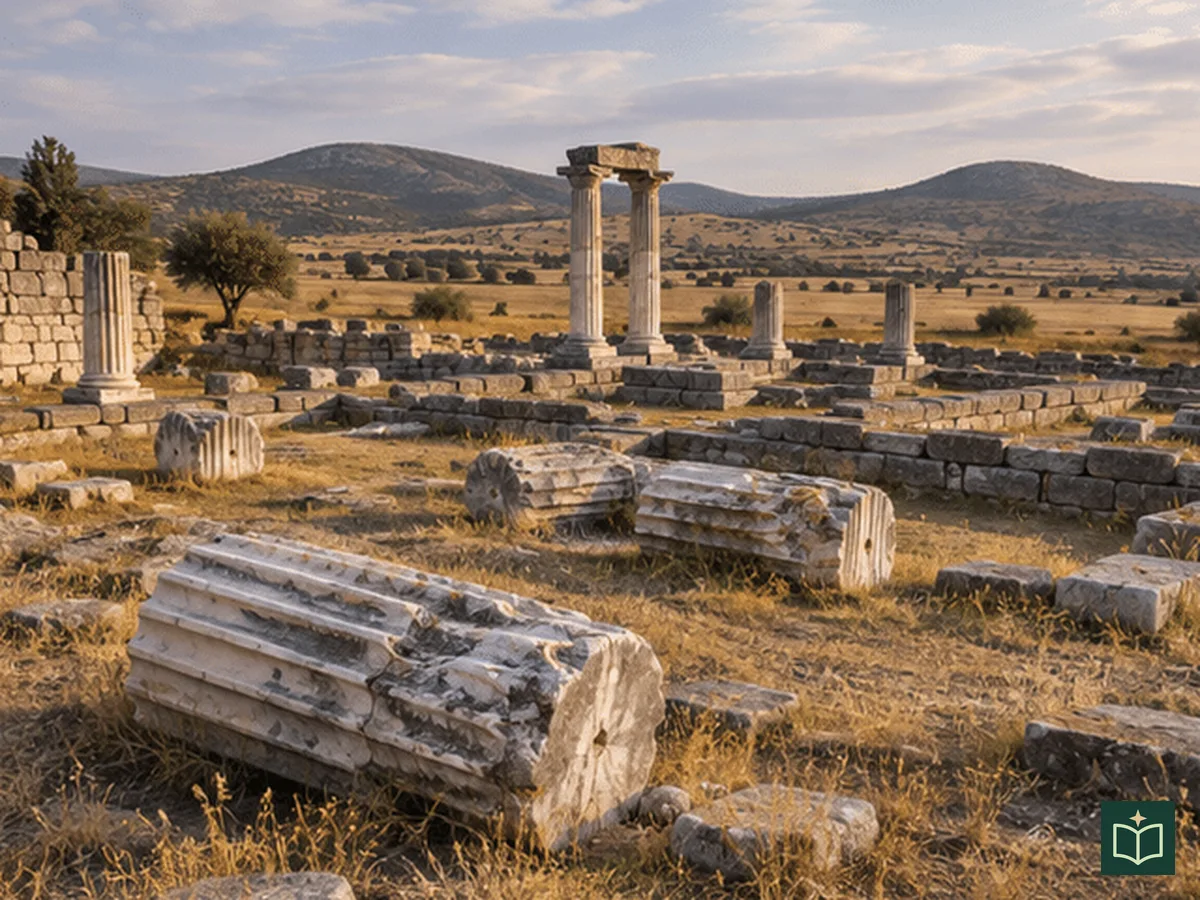
The period from Alexander’s death to 31 BC is called the Hellenistic age, from Hellenes, the Greeks’ name for themselves. Greek kings founded new cities with theatres, gymnasiums and Greek law, settled by veterans and migrants. A common form of Greek, called Koine, became the language of trade and government across the region; the Hebrew scriptures were translated into it at Alexandria, and later the New Testament was written in it. The reach was remarkable. At Ai-Khanoum in northern Afghanistan, archaeologists found a Greek city with a theatre, a gymnasium and inscriptions of moral sayings copied from Delphi in Greece. Greek and local traditions mixed in art, religion and science.
Echoes in the Gulf, and an ending
The Hellenistic world reached the Gulf too. On Failaka island, off Kuwait, archaeologists found a Seleucid fortress and temples, and ancient writers record that Alexander gave the island the Greek name Ikaros. Over time Rome absorbed the western kingdoms: Macedonia in 168 BC, and the Seleucid remnants in 64 BC. Egypt was the last to fall, after the defeat of Cleopatra VII and Mark Antony at Actium in 31 BC. In the east, the Parthians took Iran and Mesopotamia. Alexander himself became a figure of legend in many cultures, known as Iskandar in Persian and Arabic literature, and his name survives in cities such as Alexandria.
Sources & further reading
Figures are rounded and widely published; check the linked organisations for the latest editions. These organisations do not endorse this website.