A physician of al-Andalus
Abu al-Qasim Khalaf ibn al-Abbas al-Zahrawi, known in Latin as Albucasis, was born around 936 near Córdoba, then capital of the Umayyad caliphate in al-Andalus. His name probably comes from Madinat al-Zahra, the palace-city built just outside Córdoba, where he is thought to have lived and worked. Little is known about his life beyond what his writing reveals. He appears to have practised for around five decades, possibly as a court physician, and he died around 1013, during the civil wars that ended the caliphate. He wrote for students as much as for experienced doctors, often addressing his readers directly and warning them about cases they should not attempt.
The Kitab al-Tasrif
His great work, the Kitab al-Tasrif, is usually translated as 'The Method of Medicine'. It runs to thirty parts and covers medicine, pharmacy, diet and surgery. Most of it draws on earlier Greek and Arabic writers, which was normal practice for medical encyclopaedias of the time. The thirtieth and final part, on surgery, is the most original. It is divided into three sections: cauterisation, which uses heated metal to stop bleeding or treat disease; operations involving cutting, such as removing stones, treating wounds and surgery of the eye, ear and teeth; and the setting of fractures and dislocations. Throughout, al-Zahrawi explains when to operate and, just as importantly, when not to.
Why the drawings mattered
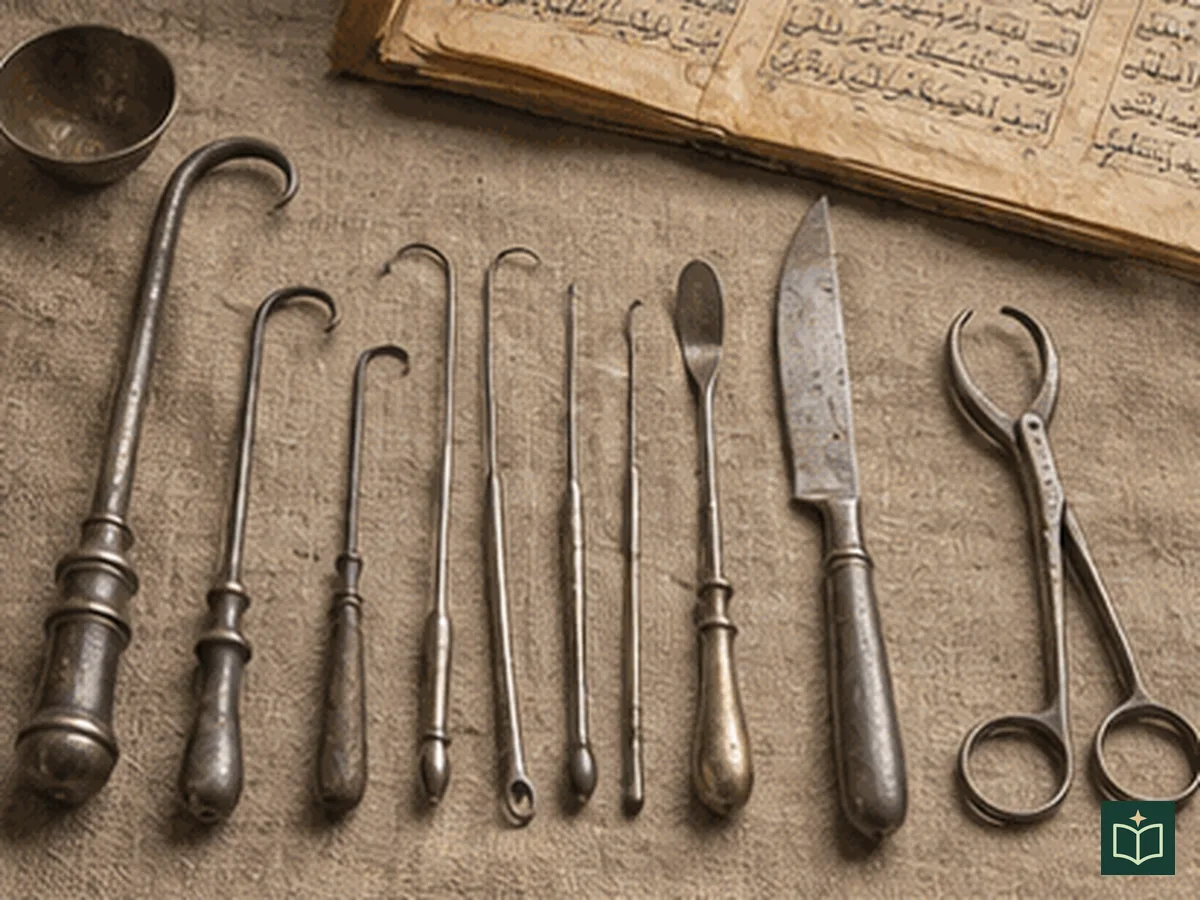
Before printing, illustrations were risky: every copy was made by hand, and copyists could distort pictures. Al-Zahrawi nevertheless included drawings of around 200 instruments, from scalpels, hooks and probes to forceps, saws, specula, bone drills and syringes. He described what each was for and sometimes how to make it. The result was something close to a catalogue, allowing physicians in distant cities to commission similar tools from metalworkers. Some instruments were his own designs or adaptations, including a hidden knife for opening abscesses discreetly and tools for removing objects from the throat. The drawings are among the earliest systematic illustrations of surgical instruments known from any tradition.
Techniques he described
The surgical volume describes many procedures in practical detail. Al-Zahrawi wrote about tying off blood vessels with thread to control bleeding, using catgut for internal stitches because the body absorbs it, removing bladder stones, managing difficult childbirth, extracting teeth, treating dislocated shoulders and draining fluid. He emphasised anatomy, saying a surgeon must know the structure of the body before cutting. Historians are careful about claims that he 'invented' particular techniques, since some may have earlier roots, but his work is often the earliest clear written description to survive. His warnings about dangerous operations, such as those near major arteries, reflect hard-won practical experience.
The road to Europe
In the twelfth century Gerard of Cremona, the prolific translator working in Toledo, rendered the surgical volume into Latin. It spread through Europe's medical schools at Salerno, Montpellier and elsewhere. The fourteenth-century French surgeon Guy de Chauliac quoted al-Zahrawi many times in his own influential textbook. After printing arrived, Latin editions appeared from the late fifteenth century, and the work was translated into other languages, including Hebrew and Provençal. In Europe it helped raise the status of surgery, which was often treated as a manual craft below learned medicine. Al-Zahrawi's insistence that surgery required both knowledge and skill matched the ambitions of reformers there.
Legacy and limits
Al-Zahrawi is often called the father of surgery. The title is a modern honour rather than a historical fact, and surgeons in ancient India, Egypt and Greece had written about operations long before. Many of his treatments, especially widespread cautery, would horrify a modern patient, and he worked without effective anaesthesia or any knowledge of germs. Yet his work stands out for its structure, clarity and drawings. Today his name is on hospitals, streets and medical awards across Spain and the Arab world, and his home city of Córdoba has a statue and a street called after him. His manual remains a key source for historians of medicine.
Sources & further reading
- Britannica · Abu al-Qasim al-Zahrawi ↗
- US National Library of Medicine · Islamic Medical Manuscripts ↗
Figures are rounded and widely published; check the linked organisations for the latest editions. These organisations do not endorse this website.