An engineer at court
Badi al-Zaman Abu al-Izz Ismail ibn al-Razzaz al-Jazari served the Artuqid rulers of Diyarbakir, in what is now south-eastern Turkey, for about 25 years. His name refers to al-Jazira, the 'island' between the upper Tigris and Euphrates. Around 1206, at the request of his patron, he completed a book usually called The Book of Knowledge of Ingenious Mechanical Devices. It describes about fifty machines, grouped into six categories: clocks, vessels and figures for drinking parties, devices for hand-washing and bloodletting, fountains and musical machines, water-raising machines, and miscellaneous items such as locks. Each comes with drawings and step-by-step instructions, written so that a skilled craftsman could build it.
The elephant clock
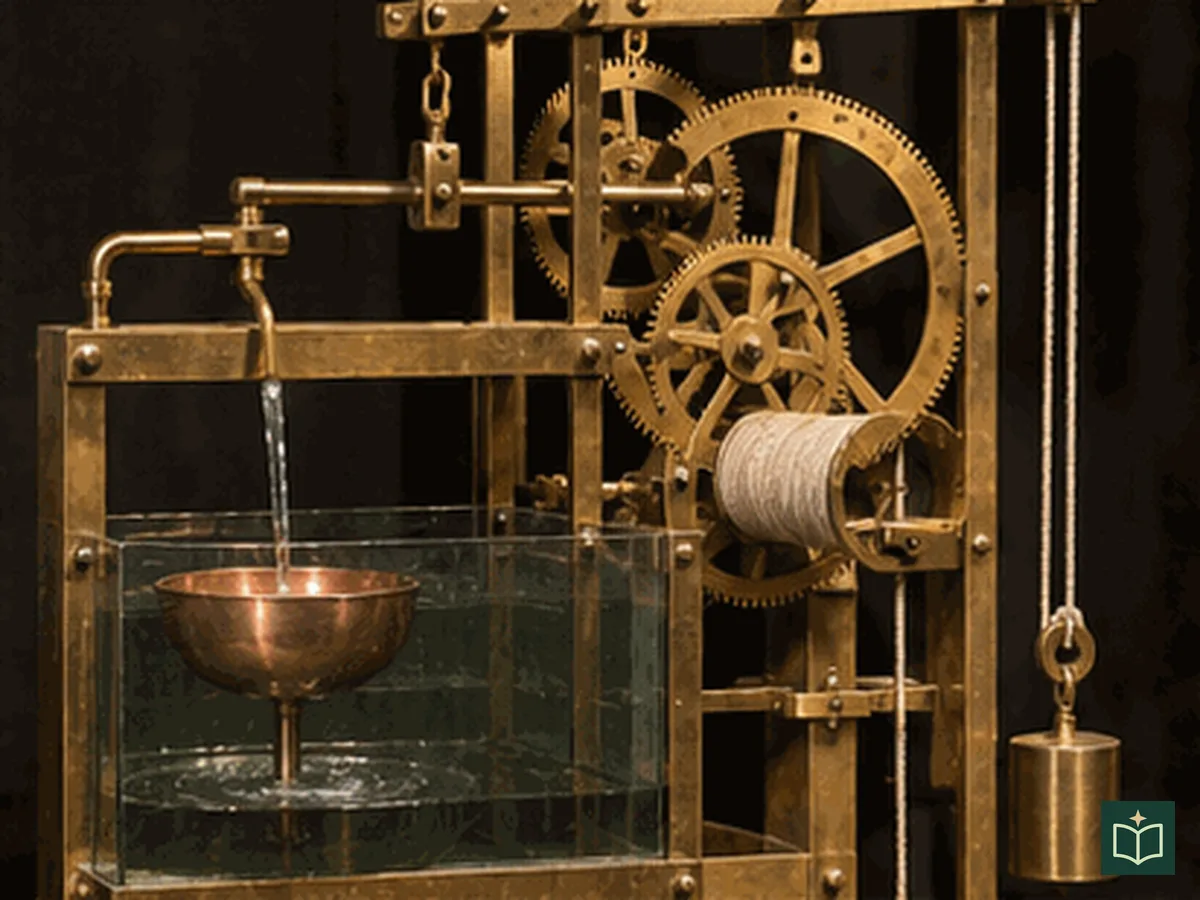
His most famous design is the elephant clock. A large model elephant carries a tower topped by a castle, with a mechanical bird, figures of people and serpents. Inside the elephant, a perforated bowl floats in a tank of water and fills slowly, sinking at a steady rate over half an hour. As it sinks it pulls strings that release a metal ball at the top, which drops into a serpent's mouth, tilts it, and triggers the figures to move and strike a cymbal. The bowl is then pulled back up, ready to start again. The decoration combined Indian, Persian, Egyptian, Chinese and Arab motifs, symbolising a world connected through trade and learning.
Automata and amusements
Many devices were designed to entertain at court. A boat carrying four mechanical musicians floated on a lake and played at intervals during parties, driven by water flowing through a hidden mechanism. A hand-washing device featured a figure that poured water from a jug and then offered soap and a towel. Drinking vessels and serving figures moved on timers. These automata were not robots in the modern sense, since they followed fixed sequences rather than sensing or deciding. But they show careful control of timing using water flow, floats, siphons and valves. Earlier engineers in Alexandria and Baghdad, including the Banu Musa brothers, had built similar marvels, and al-Jazari acknowledged them.
Machines for raising water
Not everything was a toy. Al-Jazari described several machines for lifting water for irrigation and households, an urgent task in the region. One used an animal turning a wheel to drive buckets on a chain. Another, a double-acting pump powered by a water wheel, used two opposing pistons with suction pipes so that water was drawn up and pushed out continuously. It converted the rotating motion of a wheel into the back-and-forth motion of the pistons. Historians of technology see this as one of the earliest known descriptions of a crank-and-connecting-rod type of mechanism in a machine, a principle later central to steam engines and car engines.
Why engineers still study it
Al-Jazari's book stands out for how practical it is. He explained materials, measurements and assembly, and admitted when designs needed adjusting by trial and error. He used segmental gears, calibrated orifices to control flow, techniques for casting metal in sand moulds, and combination locks. Several manuscripts survive, some with fine paintings, held in collections in Istanbul, Oxford, Paris and elsewhere. Modern engineers and museums have rebuilt his machines from the instructions, and they work. Visitors to Ibn Battuta Mall in Dubai can see a large working replica of the elephant clock. Such reconstructions show that his descriptions were accurate, not imaginative illustrations.
Myths and fair claims
Al-Jazari is sometimes called the inventor of the robot or the crankshaft. Those claims go too far. His figures were pre-programmed mechanisms, and the history of the crank is long and spread across several cultures. What can fairly be said is that he gathered, improved and documented a rich engineering tradition with rare clarity. His book belongs in a line running from Hellenistic engineers through the scholars of Abbasid Baghdad to the clockmakers of medieval Europe. It is a reminder that engineering knowledge travels through careful records. A machine that is drawn, measured and explained can be rebuilt eight centuries later; a machine that is only praised cannot.
Sources & further reading
Figures are rounded and widely published; check the linked organisations for the latest editions. These organisations do not endorse this website.