Baghdad's golden age
In the 8th and 9th centuries, Baghdad, capital of the Abbasid Caliphate, became one of the world's great centres of learning. Under caliphs such as Harun al-Rashid and al-Mamun, scholars gathered at an institution known as the House of Wisdom, translating Greek, Persian and Indian works into Arabic and building upon them in mathematics, astronomy, medicine and philosophy. This era is often called the Islamic Golden Age.
Who was al-Khwarizmi?
Muhammad ibn Musa al-Khwarizmi was a Persian scholar, probably from the region of Khwarazm in Central Asia, who worked in Baghdad in the early 9th century. He wrote influential works on mathematics, astronomy and geography, including astronomical tables and a revised map of the world. Little is known about his personal life, but his books shaped mathematics for centuries, in the Islamic world and in Europe.
The book of al-jabr
Around 820, al-Khwarizmi wrote a book usually known as The Compendious Book on Calculation by Completion and Balancing. It explained systematic methods for solving linear and quadratic equations, with practical examples from inheritance, trade and land measurement. The Arabic word al-jabr in its title, meaning restoration or completion, referred to a step in solving equations. Through Latin translations, al-jabr became the word algebra.
Hindu-Arabic numerals
Al-Khwarizmi also wrote a book explaining the Indian system of numerals, including the use of zero and place value, where a digit's position determines its value. This system made calculation far easier than Roman numerals. His work helped spread these numerals through the Islamic world and later into Europe, where they became known as Arabic numerals. Today, they are used almost everywhere, from shop receipts to computer code.
From a name to a word
In the 12th century, scholars in Spain translated al-Khwarizmi's arithmetic book into Latin. One version began with the words Dixit Algorizmi, meaning thus spoke al-Khwarizmi. His name, in forms such as Algorismus, came to refer to the method of calculating with Hindu-Arabic numerals, and later, as algorithm, to any step-by-step procedure for solving a problem. The word thus preserves his name in every computer science textbook.
What an algorithm is
An algorithm is a precise set of steps that, when followed, solves a problem or completes a task. A recipe, long division and the instructions for sorting a list of names are all algorithms. Computers work by following algorithms written in programming languages. The idea of a clear, mechanical procedure that anyone, or any machine, can follow is at the heart of computing.
Algorithms and AI
Modern AI is built from algorithms, but of a special kind. Traditional algorithms spell out every step, while machine learning algorithms describe how a computer should learn from data, adjusting millions or billions of numbers to recognise patterns. Neural networks, training methods such as backpropagation and techniques for searching and reasoning are all algorithms. In this sense, every AI system carries a thread back to al-Khwarizmi's systematic methods.
A wider tradition
Al-Khwarizmi was part of a wider tradition of scholarship in the Islamic world that influenced science and technology. Scholars such as al-Kindi wrote on cryptography, describing frequency analysis for breaking codes; Ibn al-Haytham pioneered experimental methods in optics; and engineers such as the Banu Musa brothers and al-Jazari designed ingenious automatic machines. Their works were studied in Europe for centuries and influenced the Renaissance.
Remembered in the region
Al-Khwarizmi's legacy is celebrated across the Arab and Islamic world and in Central Asia, where statues and institutions bear his name. In the UAE and Gulf, educators highlight the region's scientific heritage as inspiration for young people studying mathematics, computer science and AI. Abu Dhabi's MBZUAI and other institutions see themselves as continuing a long tradition of learning in the region.
Why it matters
The story of al-Khwarizmi reminds us that today's technologies rest on ideas developed over centuries by people from many cultures. The algorithms powering AI trace their roots to a scholar in 9th-century Baghdad who sought clear, systematic ways to solve problems. For students in the Arab world and everywhere, it is a powerful reminder that great contributions to science can come from anywhere. Each time someone writes code or trains an AI model, they are, in a small way, continuing his work.
Sources & further reading
- Encyclopaedia Britannica · al-Khwarizmi ↗
- MacTutor History of Mathematics · Abu Ja'far Muhammad ibn Musa Al-Khwarizmi ↗
- Encyclopaedia Britannica · Algorithm ↗
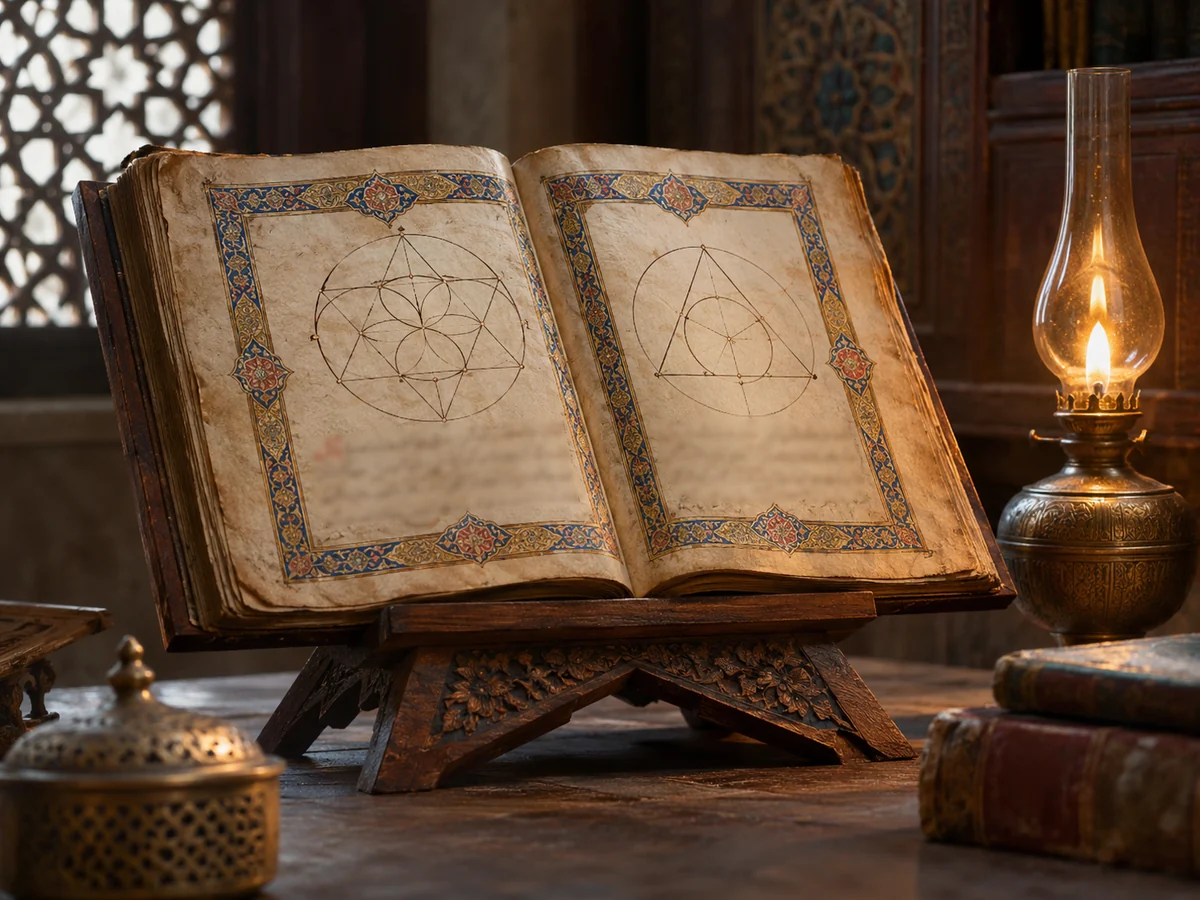
Historical details about al-Khwarizmi's life are limited. Photograph: original AI-generated illustration (Adobe Firefly). Reference organisations do not endorse this website.