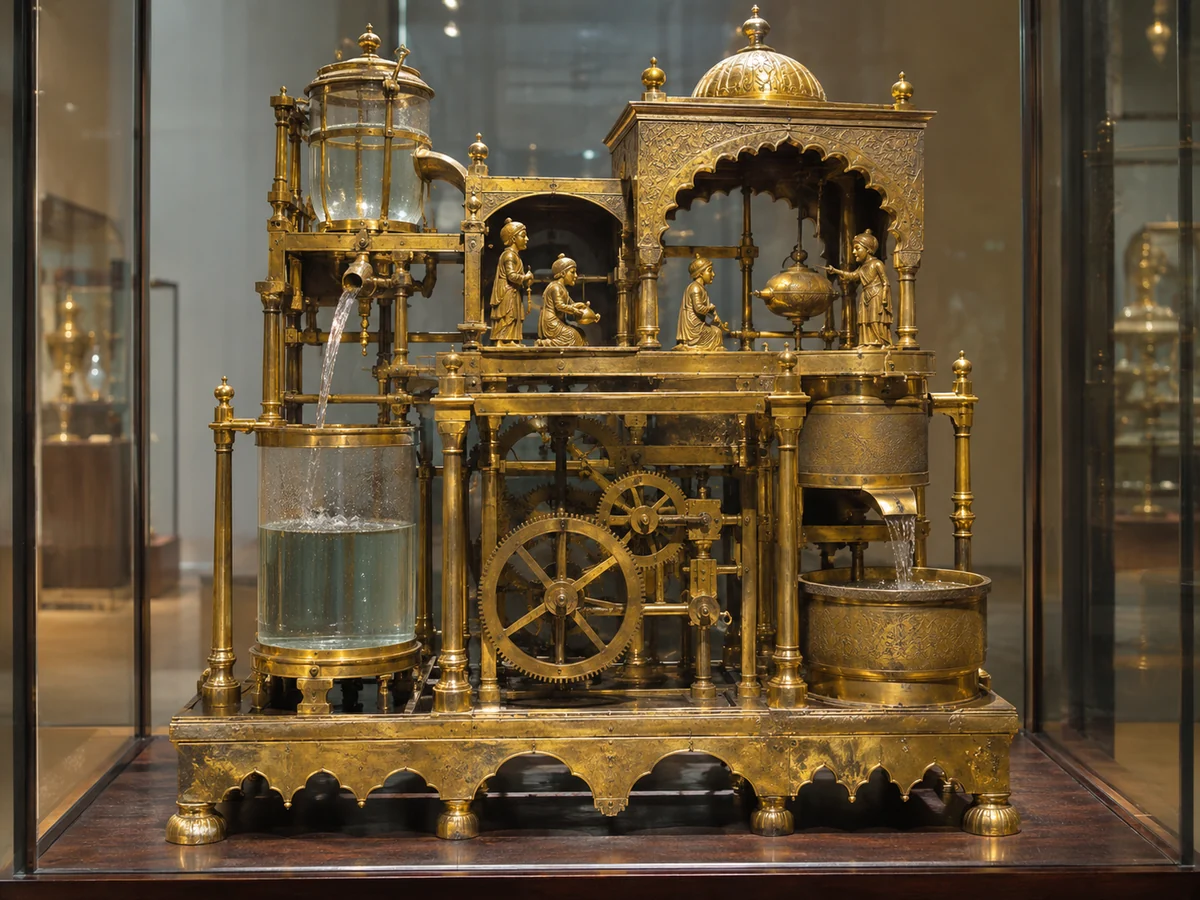
An ancient dream
People have imagined and built machines that move on their own for thousands of years. Ancient Greek engineers such as Hero of Alexandria described automata powered by water, air and weights, including a theatre of moving figures and a cart that could follow a programmed path using strings wound around its axle. The dream of mechanical helpers and performers continued in many cultures, including the medieval Islamic world.
The Banu Musa brothers
In 9th-century Baghdad, three brothers known as the Banu Musa, the sons of Musa, worked as scholars and engineers associated with the House of Wisdom. Their Book of Ingenious Devices described about a hundred mechanisms, including trick vessels, fountains and automatic controls. One of their most remarkable designs was an automatic flute player powered by water, which played music encoded on a rotating cylinder with pins.
A programmable machine
The Banu Musa flute player's cylinder worked somewhat like a music box: pins on the rotating cylinder opened and closed valves, controlling which notes played. By changing the cylinder, the machine could play a different tune. Historians of technology have described it as one of the earliest known programmable machines, since its behaviour could be changed by changing the stored instructions rather than rebuilding the machine.
Al-Jazari
Badi al-Zaman Abu al-Izz Ismail ibn al-Razzaz al-Jazari was an engineer who served the Artuqid rulers in Diyarbakir, in upper Mesopotamia, in what is now south-eastern Türkiye. In 1206, he completed The Book of Knowledge of Ingenious Mechanical Devices, describing about 50 machines with detailed instructions and illustrations so that others could build them, an unusual and valuable practice for the time.
The elephant clock
One of al-Jazari's most famous designs was the elephant clock, a water clock built in the shape of an elephant carrying a tower decorated with figures, birds and dragons. A float sinking in water inside the elephant measured time, triggering mechanisms every half hour: a ball dropped, figures moved and sounds marked the time. The clock combined engineering ideas and artistic styles from India, Persia, Egypt, Greece and China.
Robot musicians and servants
Al-Jazari also described automata designed to entertain and serve, such as a boat with four mechanical musicians that played at royal drinking parties, with rhythms that could be changed by rearranging pegs on a rotating drum. He described a hand-washing machine in which a figure offered water and a towel, and a mechanical servant that poured drinks. These designs used water power, floats, valves and gears in clever combinations.
Engineering innovations
Beyond automata, al-Jazari's book included practical machines such as water-raising devices for irrigation, using mechanisms like crankshafts and segmental gears, and pumps. Historians have credited him with some of the earliest known uses or descriptions of certain mechanical components. His emphasis on precise construction and testing reflects a careful engineering approach that anticipated later developments.
Influence and legacy
Copies of al-Jazari's book survive in libraries and museums around the world, and its colourful illustrations are celebrated as works of art. Modern engineers and museums have built working reconstructions of his machines, including a large elephant clock in a shopping centre in Dubai. Al-Jazari is often described as a father of robotics or mechanical engineering, though historians note he built on earlier traditions from many lands.
From automata to AI
Early automata followed fixed sequences set by their designers, unlike modern robots, which use sensors and AI to perceive their surroundings and adapt. Yet the core ideas, storing instructions, controlling sequences of actions and building machines that act without constant human operation, connect al-Jazari's devices to today's robots. Modern robots combine mechanical engineering with computing and machine learning.
Why it matters
The stories of the Banu Musa brothers and al-Jazari show that the quest for intelligent machines has deep roots, including in the Arab and Islamic world. For young people in the UAE and the region studying robotics and AI, these inventors are a reminder of a rich heritage of creativity and engineering. Today's AI and robotics build on centuries of human ingenuity from many cultures, and the next breakthroughs could come from the same region again.
Sources & further reading
- Wikipedia · Ismail al-Jazari ↗
- Wikipedia · Banu Musa ↗
- Wikipedia · Book of Knowledge of Ingenious Mechanical Devices ↗
Historians debate some attributions and details of early inventions. Photograph: original AI-generated illustration (Adobe Firefly). Reference organisations do not endorse this website.