Where and when
The kingdom of Aksum was centred on the city of the same name in the northern highlands of today’s Ethiopia, close to the border with Eritrea. It rose in the first centuries CE and was at its most powerful from roughly the third to the sixth century, before declining in the seventh. At its height, its influence reached from the Ethiopian plateau to the Red Sea coast and, for a time, across the water into southern Arabia. The highlands offered good farmland and a cooler climate, while its position made it a natural link between African trade routes and the busy shipping lanes of the Red Sea.
A Red Sea trading power
Aksum’s main port was Adulis, on the coast of today’s Eritrea. A Greek merchant’s guide from the first century CE, the Periplus of the Erythraean Sea, describes Adulis as a trading market and lists exports such as ivory, tortoiseshell and rhinoceros horn. Imports included cloth, metal goods, glass and wine. Ships from Roman Egypt, Arabia and India called there. The Persian religious teacher Mani, in the third century, is reported to have named Aksum as one of the four great kingdoms of the world, alongside Rome, Persia and China. Whether or not the attribution is exact, it reflects Aksum’s international standing.
Coins that spoke for the state
Aksum was among the few states of its era to issue its own gold coinage, alongside powers such as Rome. From the late third century, its kings minted coins in gold, silver and bronze. Gold issues usually carried Greek inscriptions, suited to international trade, while lower-value coins sometimes used Ge’ez, the local language. The coins name a long sequence of rulers, which helps historians reconstruct a chronology that would otherwise be lost. They also record a major change: early coins show pre-Christian symbols such as the crescent and disc, and later issues bear the cross. Coins found as far away as India and Arabia show how widely Aksum’s money travelled.
Christianity and Ge’ez
In the fourth century, King Ezana adopted Christianity, making Aksum one of the earliest states to do so. Tradition credits the conversion to Frumentius, a Syrian Christian who came to the royal court and later became the first bishop of Aksum. Ezana’s inscriptions, carved in Greek, Ge’ez and a South Arabian script, show the change in his language and symbols. The Ge’ez script developed into a writing system that marks vowels by modifying consonant signs, and it remains in use for the liturgy of the Ethiopian Orthodox Church. Amharic and Tigrinya are written with scripts descended from it. It is one of Africa’s oldest living scripts.
The stelae
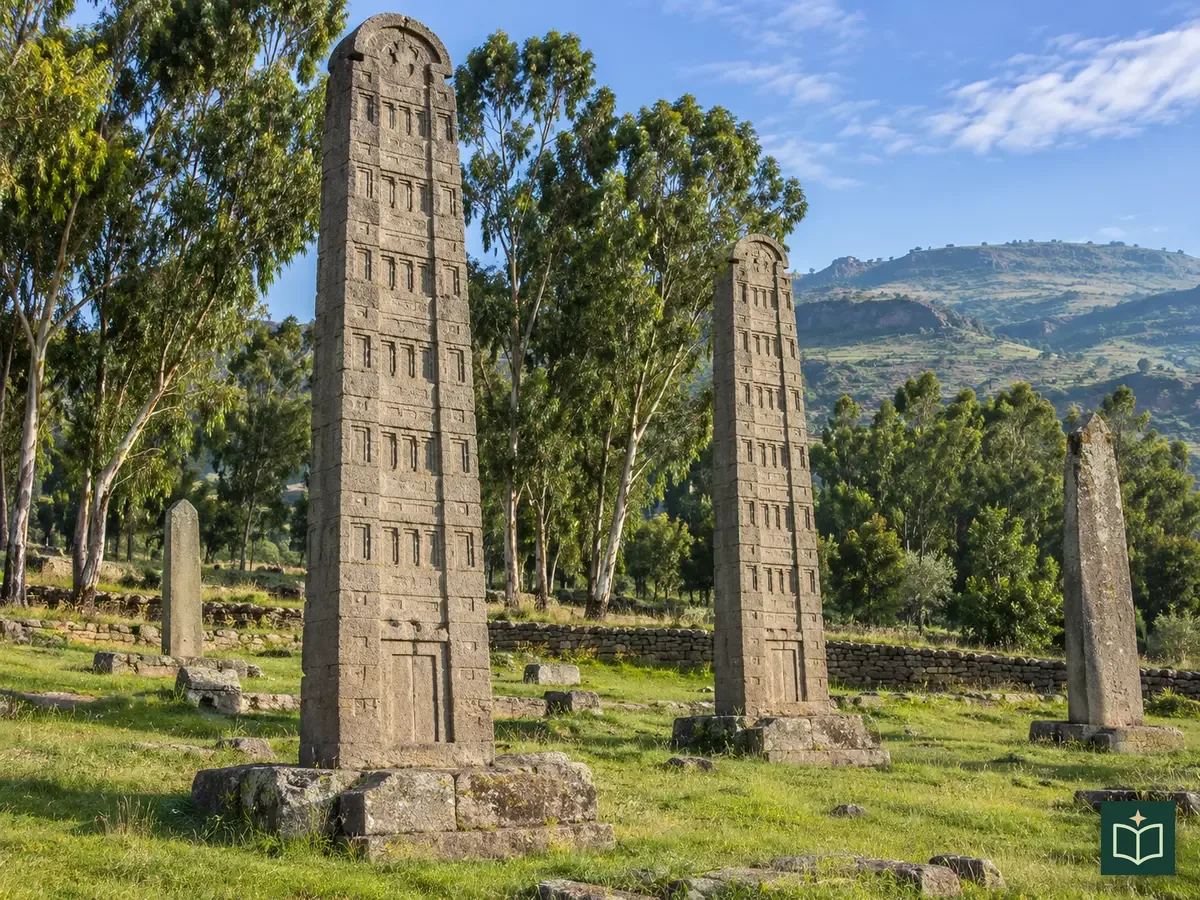
Aksum’s most famous monuments are its tall carved granite stelae, which marked elite tombs. Many are carved to look like multi-storey buildings, with false doors and windows. The largest, often called the Great Stele, was about 33 metres long and is thought to have fallen and broken, possibly while being raised. Another stele of around 24 metres was taken to Rome in 1937 during the Italian occupation. After long negotiations, it was returned to Ethiopia in 2005 and re-erected in 2008. UNESCO inscribed the archaeological site of Aksum as a World Heritage Site in 1980. The stelae field remains the city’s most striking sight.
Decline and legacy
Aksum declined from the seventh century. Contributing factors probably included changes in Red Sea trade, the rise of new powers in Arabia and the wider region, and environmental pressures such as soil erosion around the capital. The political centre of Ethiopian states later shifted southwards. Yet Aksum remained deeply important. It is a major religious centre for Ethiopian Orthodox Christians, and its church of St Mary of Zion is associated with a tradition about the Ark of the Covenant, which is a matter of faith rather than historical evidence. Aksum is a reminder that Africa hosted major ancient states. Its influence is still felt.
Sources & further reading
Figures are rounded and widely published; check the linked organisations for the latest editions. These organisations do not endorse this website.