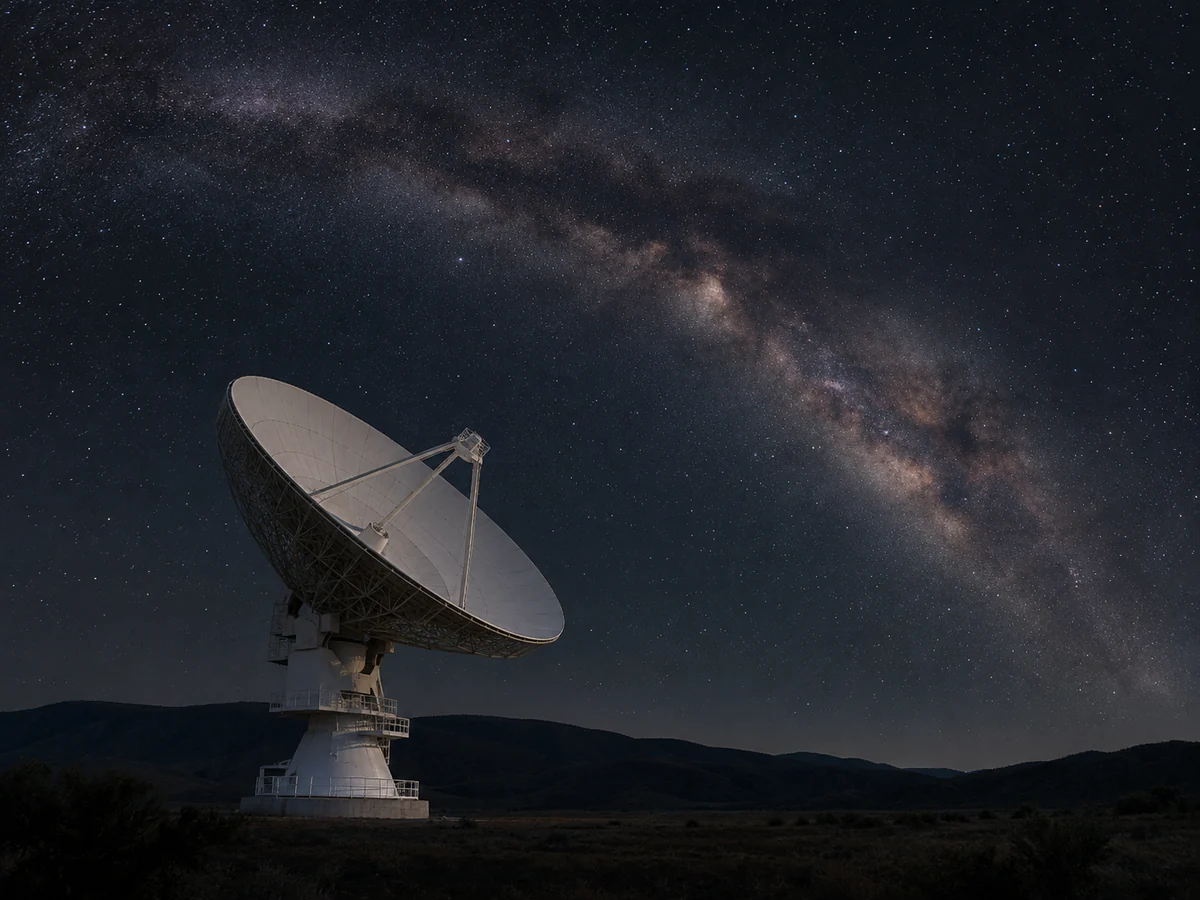
Are we alone?
Whether life exists elsewhere in the universe is one of humanity's oldest questions. Since 1960, scientists involved in the search for extraterrestrial intelligence, or SETI, have used radio telescopes to listen for signals that could only have been produced by technology, known as technosignatures. Radio waves travel vast distances through space at the speed of light and pass easily through clouds of dust and gas, making them a natural way for any civilisation to communicate.
A noisy universe
The biggest challenge is interference. Radio telescopes pick up signals from mobile phones, satellites, aircraft radar, television transmitters and other human technology, which can look similar to the kind of narrow, steady signal scientists hope to find. A single telescope can record enormous amounts of data, far more than humans can inspect, and traditional computer programs flag many false alarms.
Breakthrough Listen
In 2015, the Breakthrough Listen initiative, funded by Yuri Milner's Breakthrough Initiatives, launched the most comprehensive search for alien technosignatures yet, using some of the world's largest radio telescopes, including the Green Bank Telescope in West Virginia. It has observed thousands of nearby stars and galaxies, producing huge datasets that are made available to researchers.
A student's idea
Peter Ma, an undergraduate at the University of Toronto who had taught himself to code, developed a deep learning approach to search this data more effectively. Working with researchers from Breakthrough Listen, the SETI Institute and other institutions, he trained a type of neural network called a variational autoencoder to recognise what interference looks like, and to flag signals with features expected of a distant transmitter.
How it worked
Breakthrough Listen observes a target star, then points away, then back again, repeating the pattern. A genuine signal from a distant star should appear only when the telescope points at it, while human interference tends to appear regardless of direction. Ma's AI learned these patterns, partly by training on simulated signals inserted into real data, and dramatically reduced the number of false candidates compared with earlier methods.
Eight signals
The team applied the AI to more than 480 hours of observations of 820 nearby stars, about 150 terabytes of data that had already been searched with classical techniques in 2017. The AI flagged more than 20,000 signals for closer inspection, and the researchers identified eight signals of interest with characteristics expected of technosignatures that earlier searches had missed. The results were published in Nature Astronomy in January 2023.
Looking again
To test whether the signals were real, astronomers pointed the Green Bank Telescope at the same stars again. None of the eight signals was detected a second time. This does not rule out an alien origin, but scientists consider repetition essential before taking any candidate seriously. Most likely, the signals were rare forms of interference. Scientists stressed that the real advance was the method, not the candidates, because it could search far larger datasets more reliably than before.
Scaling up
Researchers plan to apply AI methods to much larger surveys. Breakthrough Listen has worked with the MeerKAT radio telescope array in South Africa, aiming to search around a million stars. Future telescopes, such as the Square Kilometre Array being built in South Africa and Australia, will produce even more data, making AI essential for spotting anything unusual in real time.
AI across astronomy
The SETI work is part of a wider transformation of astronomy by AI. Machine learning is used to discover exoplanets in telescope data, classify billions of galaxies, detect gravitational waves, find fast radio bursts and spot asteroids that could threaten Earth. The UAE, which sent the Hope probe to Mars, is building its own space science capabilities, where such AI tools are increasingly important.
Why it matters
Finding evidence of alien technology would be one of the most profound discoveries in history. AI cannot guarantee such a discovery, but it can make sure that if a signal is hidden in our data, we are far more likely to notice it. The search also shows how AI can help scientists explore huge datasets in any field, revealing patterns humans would never have time to find.
Sources & further reading
- SETI Institute · Will machine learning help us find extraterrestrial life? (2023) ↗
- arXiv · A deep-learning search for technosignatures of 820 nearby stars, Ma et al. (2023) ↗
- NVIDIA · AI joins hunt for ET: study finds 8 potential alien signals (2023) ↗
No signal has been confirmed as being of alien origin. Photograph: original AI-generated illustration (Adobe Firefly). Reference organisations do not endorse this website.