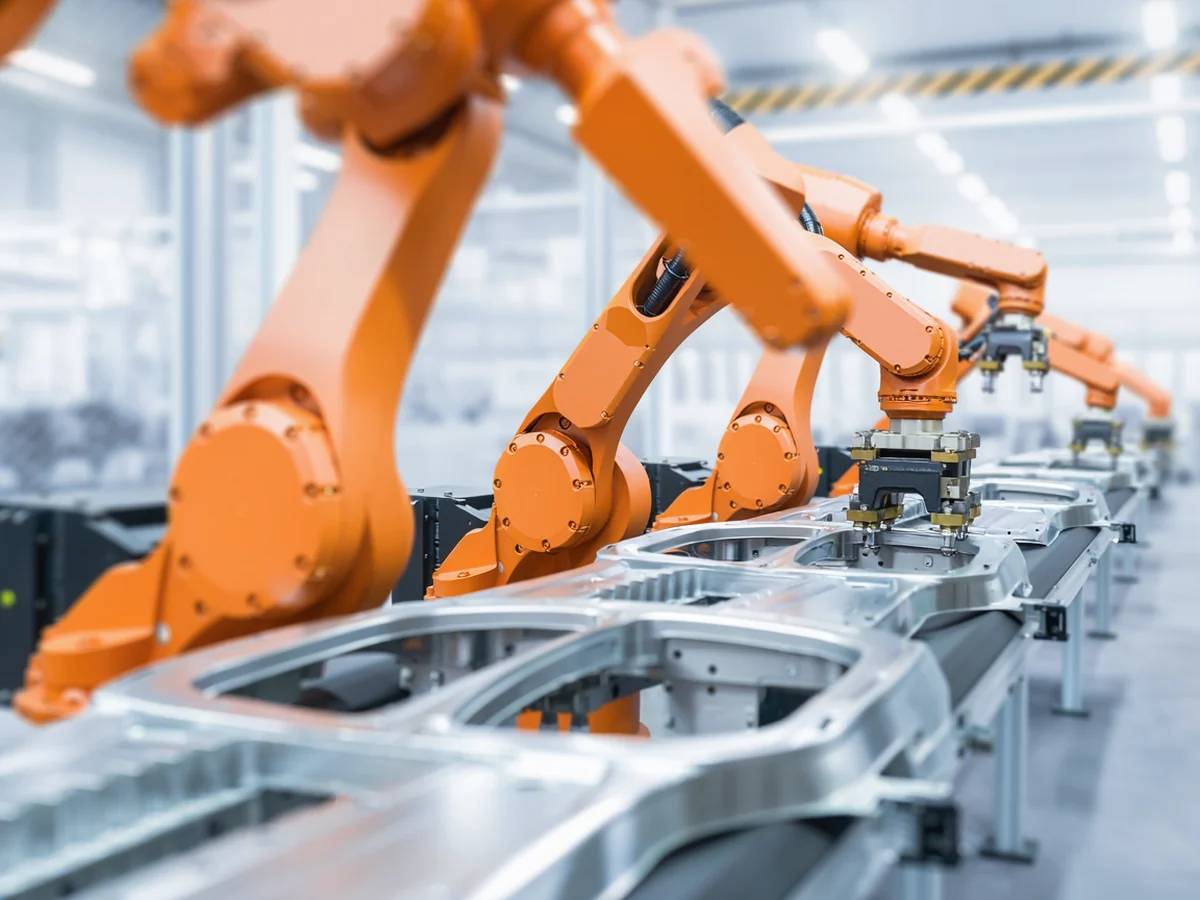
The fourth industrial revolution
Manufacturing has gone through several revolutions: steam power, electricity and mass production, then computers and automation. The current wave, often called Industry 4.0, connects machines, sensors and software so that factories can collect data on every step of production. AI makes sense of this data, finding patterns that help factories produce better products with less waste, energy and downtime.
Eyes that never tire
Inspecting products for scratches, cracks, misalignments or missing parts has traditionally been done by people, who can become tired and miss defects, especially on fast production lines. AI vision systems use cameras and deep learning to inspect every item in real time, detecting flaws that are tiny or hard to see. They are used to check car body panels, electronic circuit boards, pharmaceuticals, food packaging, steel and textiles.
Predicting failures
When a critical machine breaks down unexpectedly, an entire production line may stop, costing large sums. Predictive maintenance uses sensors that measure vibration, temperature, sound and power use, and AI models that learn what normal operation looks like and spot early warning signs of wear. Maintenance can then be scheduled at convenient times before failures happen, reducing downtime and extending equipment life.
Fine-tuning the process
Many manufacturing processes, such as chemical production, steelmaking, semiconductor fabrication and cement kilns, depend on controlling numerous variables precisely. AI can analyse historical data to find the settings that maximise output and quality while minimising energy and raw materials, and it can adjust settings continuously as conditions change. Small percentage improvements in large plants translate into big savings and lower emissions.
Lighthouse factories
Since 2018, the World Economic Forum and McKinsey have recognised advanced factories as members of a Global Lighthouse Network, which highlights sites leading in the use of Fourth Industrial Revolution technologies. Many lighthouses use AI extensively and report large improvements in productivity, product quality, delivery times and energy use. The network includes factories in China, Europe, the United States, India and the Middle East, including several sites in Saudi Arabia.
Robots that adapt
Traditional industrial robots perform the same precise movements repeatedly and must be carefully programmed for each task. AI is making robots more flexible: computer vision lets them locate and pick up parts in varying positions, and learning techniques allow them to adapt to new products more quickly. Collaborative robots, or cobots, work safely alongside people, handling heavy or repetitive tasks while humans do more complex work.
Digital twins
A digital twin is a detailed virtual model of a product, machine or entire factory that is updated with real-time data. Engineers can use it to simulate changes, such as a new production layout or different machine settings, before applying them in the real world. Combined with AI, digital twins can predict how a factory will perform and suggest improvements, reducing the cost and risk of experimentation.
Supply chains
AI helps manufacturers forecast demand, plan production schedules, manage inventory and anticipate supply disruptions by analysing orders, market data, weather and shipping information. The disruptions of the COVID-19 pandemic and later global shocks highlighted the value of more resilient, data-driven supply chains. Generative AI is also being used to help engineers design parts, search technical documents and write maintenance instructions.
Workers and skills
AI and automation change factory jobs. Some routine manual and inspection tasks are being automated, while demand grows for technicians, data specialists and workers who can operate and maintain advanced equipment. Many manufacturers face shortages of skilled workers and see AI as a way to fill gaps. Training programmes, apprenticeships and partnerships with universities are important for helping workers adapt and for making sure the gains from AI are widely shared.
Industry in the UAE
The UAE's Operation 300bn strategy aims to raise the industrial sector's contribution to the economy, with advanced technology including AI as a key pillar. The Ministry of Industry and Advanced Technology promotes the adoption of Industry 4.0 tools, and large UAE industrial companies have announced AI projects to improve efficiency and cut energy use. As factories become smarter, AI is helping the UAE diversify its economy beyond oil and build industries that can compete globally on quality, speed and efficiency.
Sources & further reading
- World Economic Forum · Global Lighthouse Network ↗
- McKinsey · What are Industry 4.0, the Fourth Industrial Revolution, and 4IR? ↗
- UAE Ministry of Industry and Advanced Technology · Operation 300bn ↗
A general overview; results vary widely between factories. Photograph: original AI-generated illustration (Adobe Firefly). Reference organisations do not endorse this website.