A global hub
Dubai International Airport, known by its code DXB, has been the world's busiest airport for international passengers for more than a decade, handling tens of millions of travellers each year. Moving so many people efficiently is a huge challenge, especially at immigration, where long queues can frustrate travellers and slow down connections. Dubai's authorities have invested heavily in biometric and AI technology to make border control faster while maintaining security.
Smart gates
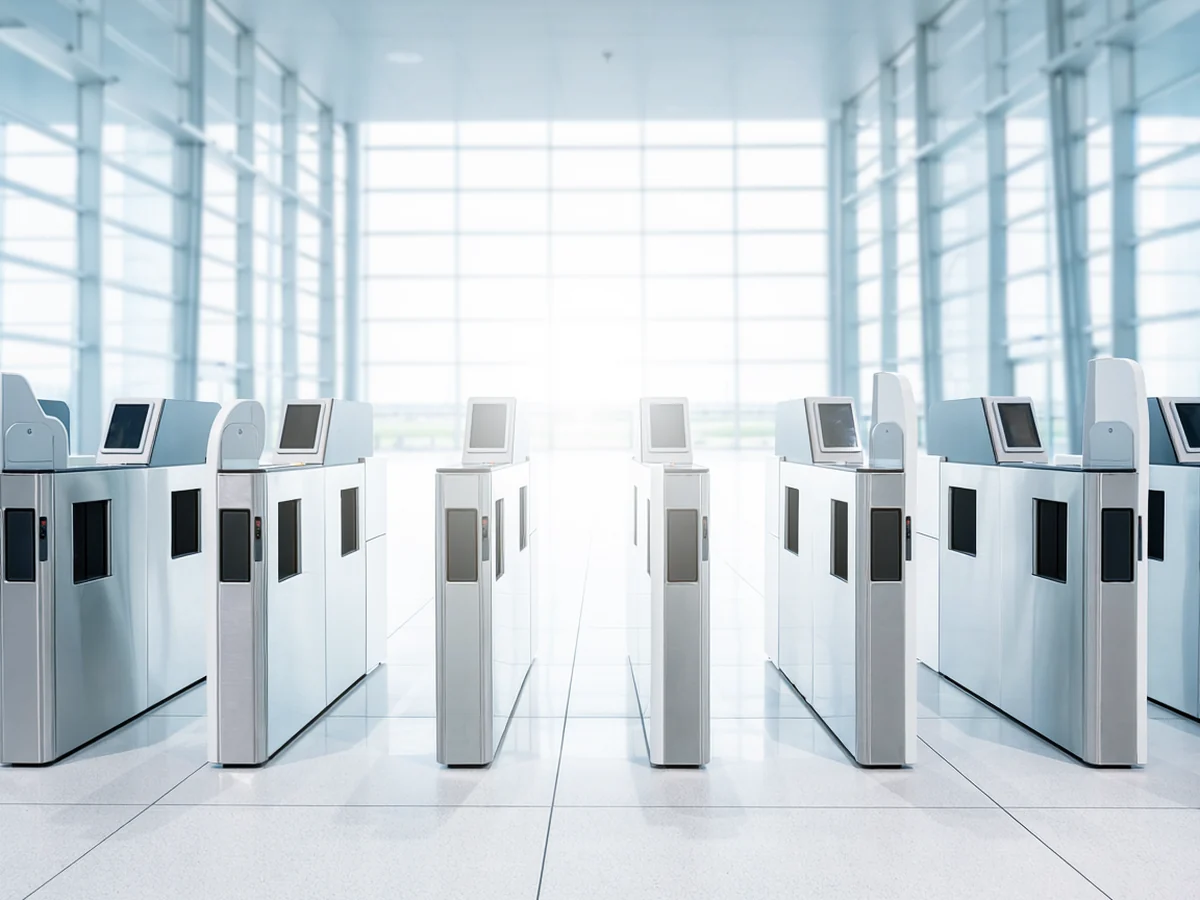
Dubai introduced electronic gates more than a decade ago and has steadily upgraded them with facial and iris recognition. Eligible travellers, including UAE residents and many visitors, can use smart gates to complete passport control by looking at a camera, without speaking to an officer. Dubai's General Directorate of Residency and Foreigners Affairs reported that more than 9.3 million passengers used smart gates between January and August 2026, over 60% of all passengers in that period.
The smart corridor
Dubai went further with walk-through systems. A smart tunnel was first tested several years ago, and in 2025, during Dubai AI Week, authorities launched Unlimited Smart Travel at Terminal 3, a corridor where up to ten travellers can complete immigration together in about 14 seconds without showing documents. Cameras capture faces from multiple angles as people walk through, and AI matches them with pre-registered records.
The Red Carpet
The service, often called the biometric Red Carpet, was first offered to premium passengers and later expanded. According to the residency authority, 745,188 travellers used it between January and August 2026, with an average processing time of 3.4 seconds and no stops. Officials see it as a step towards fully automated, document-free border control and plan to extend similar technology to the new Al Maktoum International Airport.
Biometrics across the journey
Emirates, Dubai's flagship airline, announced in November 2025 that it had invested 85 million dirhams to install more than 200 biometric cameras across Terminal 3. Registered passengers can use facial recognition at check-in, immigration, lounges and boarding gates, without repeatedly showing passports or boarding passes. Abu Dhabi's Zayed International Airport has also introduced biometric systems across the passenger journey.
How facial recognition works
Facial recognition systems use AI to convert a face into a numerical template that captures its distinctive features, such as the distances between key points. When a traveller approaches a gate, the system creates a template from the camera image and compares it with the stored template linked to their passport or residency record. Modern systems are highly accurate under good conditions and can work with people wearing glasses or with changed hairstyles.
AI behind the scenes
Beyond immigration, airports use AI to predict passenger flows, plan staffing, manage baggage systems, optimise gate assignments and guide travellers with interactive maps and chatbots. Airlines use AI for pricing, scheduling crews, predicting maintenance needs and rebooking passengers during disruptions. Security screening increasingly uses AI to help officers analyse X-ray images of luggage for prohibited items.
Privacy and choice
Biometric systems raise privacy questions about how facial data is stored, who can access it and how long it is kept. Authorities say data is handled securely under UAE law, and travellers who do not wish to use biometrics can usually use traditional counters. Surveys by the International Air Transport Association suggest many travellers are willing to share biometric data in exchange for faster, simpler journeys.
A global trend
Airports in Singapore, Hong Kong, Europe and the United States are also adopting biometric boarding and automated border control. The European Union has introduced a new Entry/Exit System that records non-EU travellers' biometric data at external borders. The industry's vision, promoted by IATA under the name One ID, is a journey in which a traveller's face serves as their passport and boarding pass at every step.
Why it matters
For a city whose economy depends heavily on aviation, tourism and trade, getting travellers through the airport quickly is a competitive advantage. Dubai's use of AI at its borders reflects the UAE's broader strategy of using technology to improve government services. It also shows how AI is reshaping everyday experiences in ways that bring both convenience and new questions about privacy and data protection.
Sources & further reading
- Gulf News · Dubai's biometric Red Carpet processes 745,188 travellers in eight months of 2026 ↗
- Emirates · Emirates invests in innovative facial recognition technology across DXB (2025) ↗
- Gulf News · 'Unlimited Smart Travel': Dubai airport introduces new passport control initiative ↗
Eligibility for smart gates and corridors depends on nationality, residency and registration. Photograph: original AI-generated illustration (Adobe Firefly). Reference organisations do not endorse this website.