A city made rich by cloth
In the fourteenth and fifteenth centuries, Florence was one of the largest and wealthiest cities in Europe. Its fortune came first from cloth. The wool guild, the Arte della Lana, organised thousands of workers who turned imported wool into fine textiles sold across Europe and the Mediterranean. Florentine merchants then moved into banking. In 1252 the city began minting the gold florin, which became a trusted currency for international trade. Florentine banks lent to popes and kings, and managed papal revenues. Even after major banks collapsed in the 1340s, Florentine finance recovered, and the city kept the capital needed to fund ambitious projects.
Guilds that competed in stone
Florence was governed largely by its guilds, associations of merchants and craftsmen who held political power. They competed for prestige, and one way to do so was through public art. Guilds were responsible for decorating the city's major buildings. In 1401 the cloth merchants' guild held a competition for new bronze doors for the baptistery; Lorenzo Ghiberti won, beating Filippo Brunelleschi. At the guild church of Orsanmichele, each guild commissioned a statue of its patron saint for a niche on the exterior, and they hired leading sculptors, including Donatello and Ghiberti. Public rivalry of this kind pushed artists to innovate and take risks.
A proud republic
Florence saw itself as a republic, governed by citizens rather than a prince. Around 1400 it faced a serious threat from Milan, ruled by the expansionist Visconti dukes. Florentine writers and officials, such as the chancellors Coluccio Salutati and Leonardo Bruni, presented the struggle as a defence of liberty, drawing parallels with the Roman Republic. Some historians call this civic humanism. The idea that citizens should be educated, active in public life and inspired by classical models encouraged investment in learning, rhetoric and civic monuments. It also gave the city a sense of mission that art and architecture could express.
Scholars and old texts
Florence became a centre of humanism, the movement to recover and study classical Greek and Latin writings. Petrarch, whose family came from Florence, had already inspired the search for lost manuscripts. In 1397 the Byzantine scholar Manuel Chrysoloras began teaching Greek in the city, giving Florentines direct access to Greek texts. The Church council held in Florence in 1439 brought more Greek scholars and books. Cosimo de' Medici later sponsored Marsilio Ficino to translate Plato into Latin. Libraries were founded, and newly copied texts circulated widely. These studies influenced art as well, encouraging interest in proportion, perspective and the realistic human figure.
The Medici and their patronage
The Medici family rose through banking. Giovanni di Bicci de' Medici founded the Medici Bank in 1397, which became the papacy's main banker. His son Cosimo dominated Florentine politics from 1434 without holding a royal title, and he and his grandson Lorenzo, known as the Magnificent, were generous patrons. They funded churches, palaces, libraries and the work of artists such as Donatello, Botticelli and the young Michelangelo. But the Medici were not alone. Other families, such as the Rucellai and Strozzi, also commissioned major works, and patronage was a way to display wealth, gain status and, for some, atone for the sin of usury.
Limits of the story
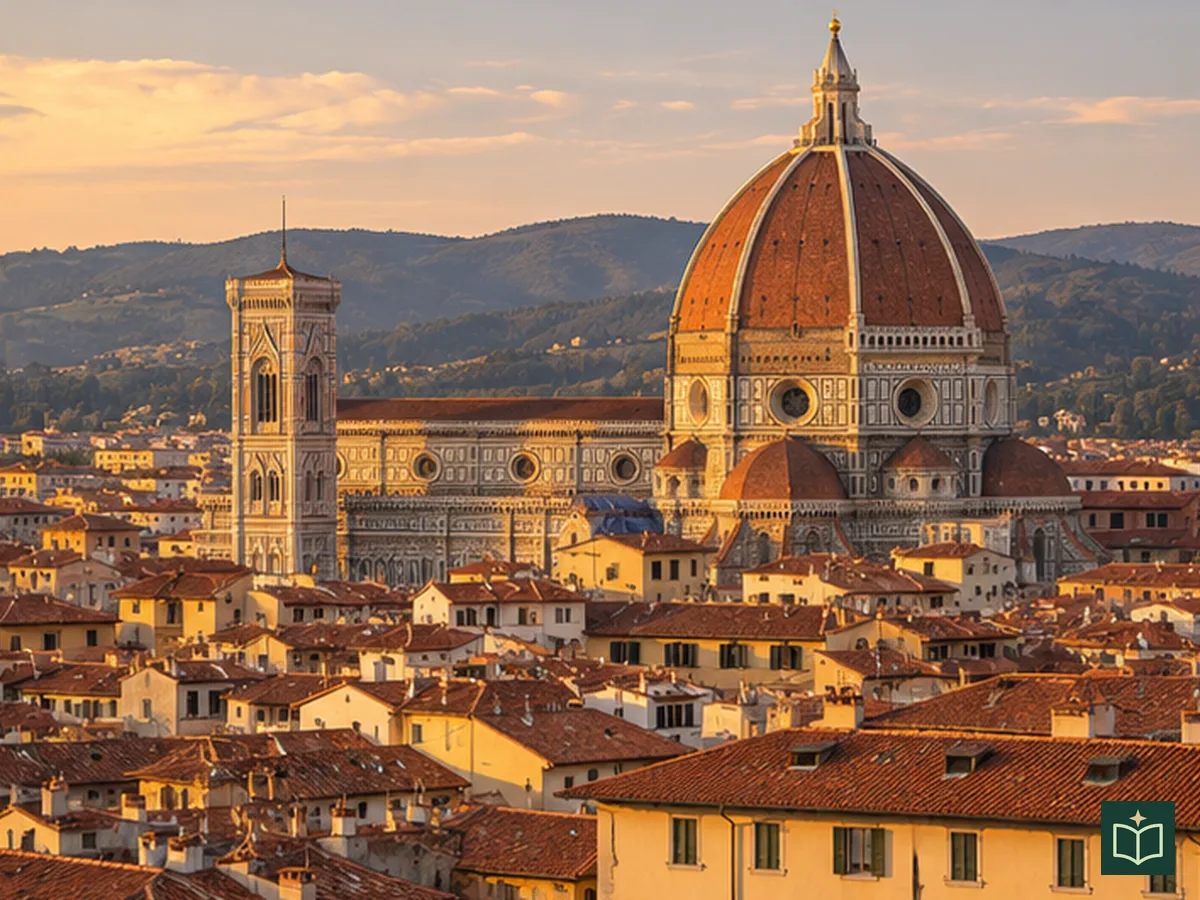
The Renaissance was not born in Florence alone, nor all at once. Ideas about classical learning developed in other Italian cities such as Padua, and Flemish painters were making major advances in oil painting at the same time. The changes built gradually on medieval foundations rather than breaking from them. Florence also had a darker side: deep inequality, political exiles and the devastation of plague, which killed a large share of its population in 1348. Still, Brunelleschi's great dome, completed in 1436, and the work of artists and scholars in the city made Florence the place where these trends first came together most visibly.
Sources & further reading
Figures are rounded and widely published; check the linked organisations for the latest editions. These organisations do not endorse this website.